PERMUTATION-PADLOCK
A 1915 letter lock that quietly reinvents the medieval screw-key puzzle padlock
Combination shackle padlock with rotary letter tumblers
⚿ How it works
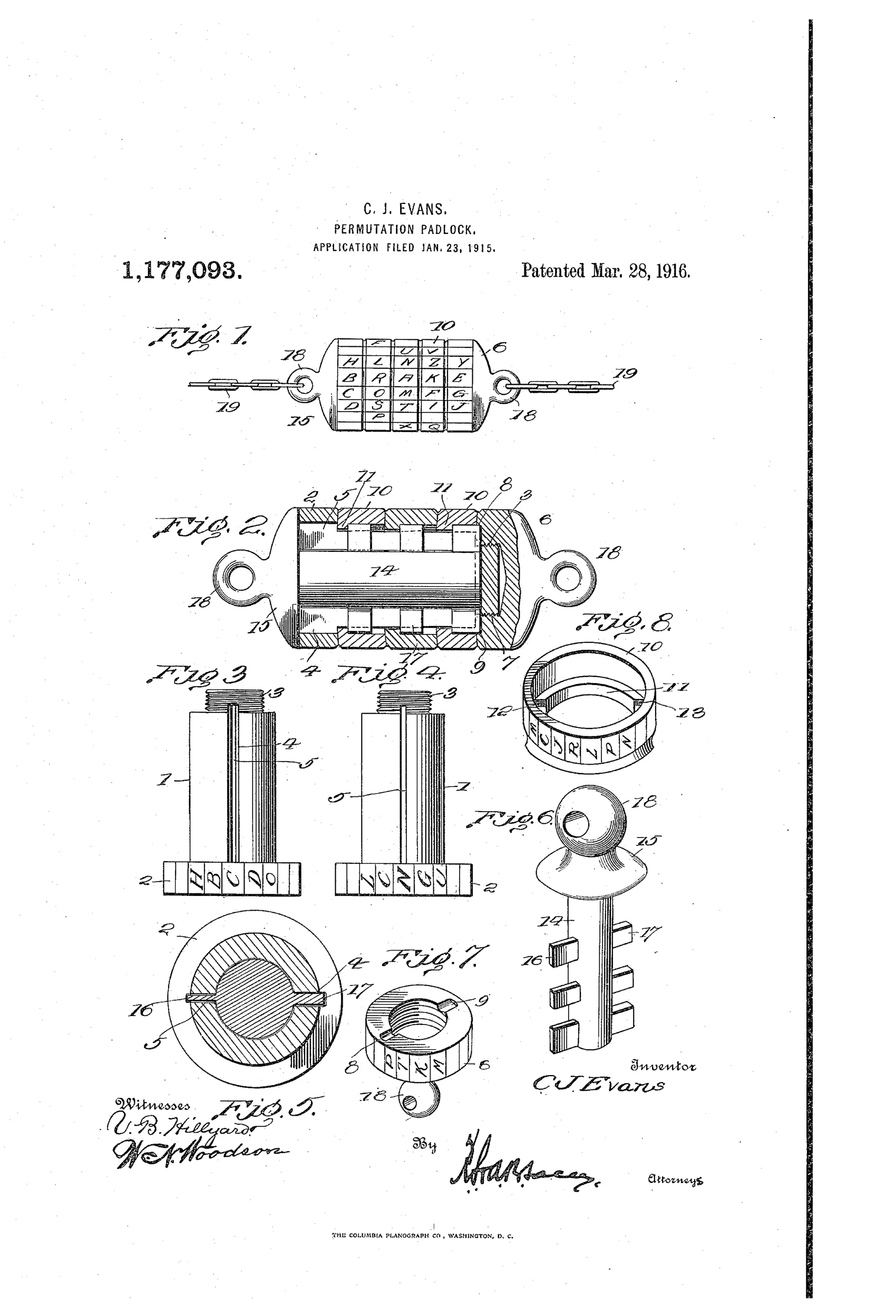
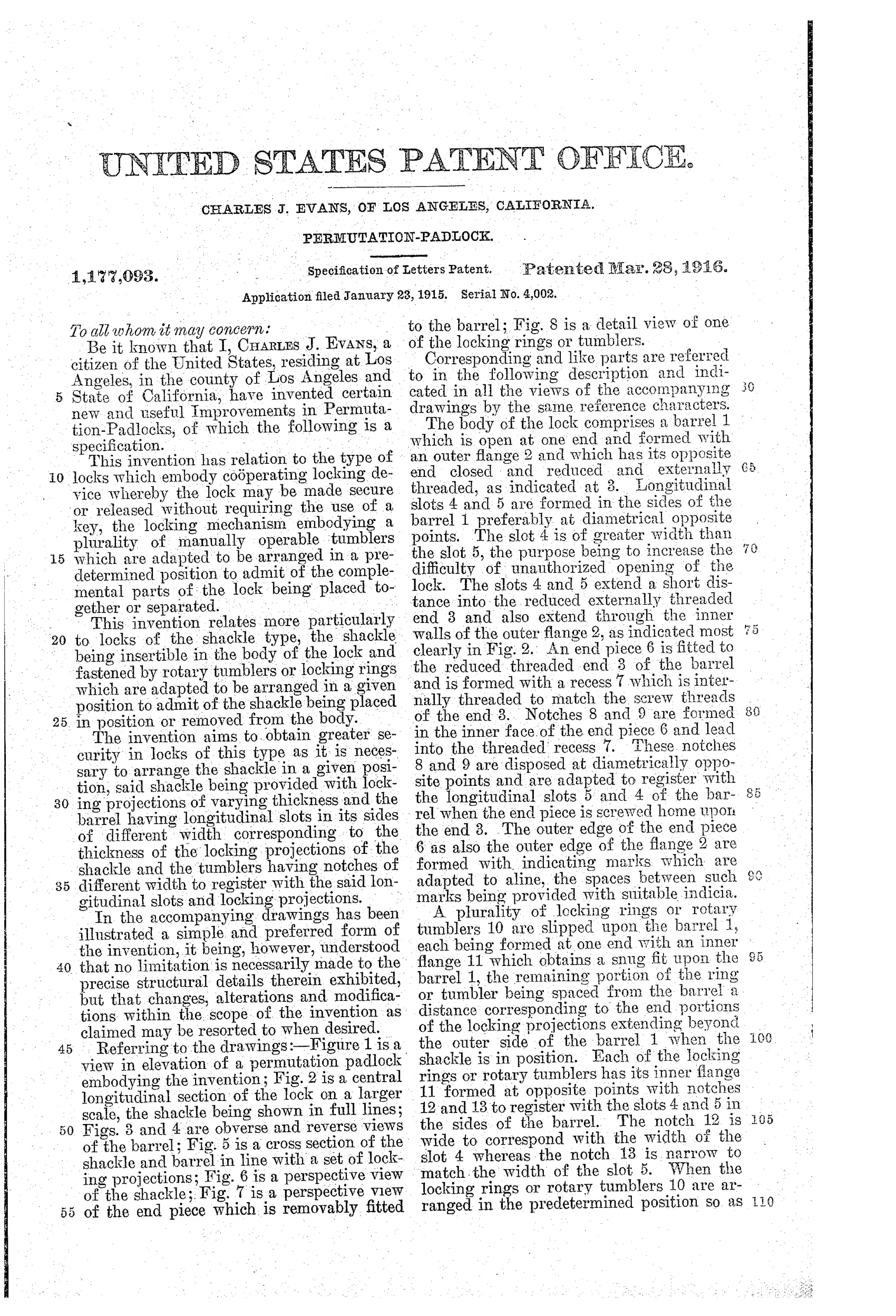
The lock has a barrel with two longitudinal slots of different widths cut into its sides, and a removable threaded end piece secured to the barrel. Multiple rotary tumbler rings fit around the barrel, each with an inner flange bearing wide and narrow notches that must align with the barrel's slots to permit shackle insertion or removal. The shackle itself has locking projections of varying thickness that pass through the aligned slots and notches into the end piece, locking it in place. Turning the letter-marked tumblers out of alignment traps the shackle projections, securing the lock until the correct letter combination is restored.
⚿ What was claimed
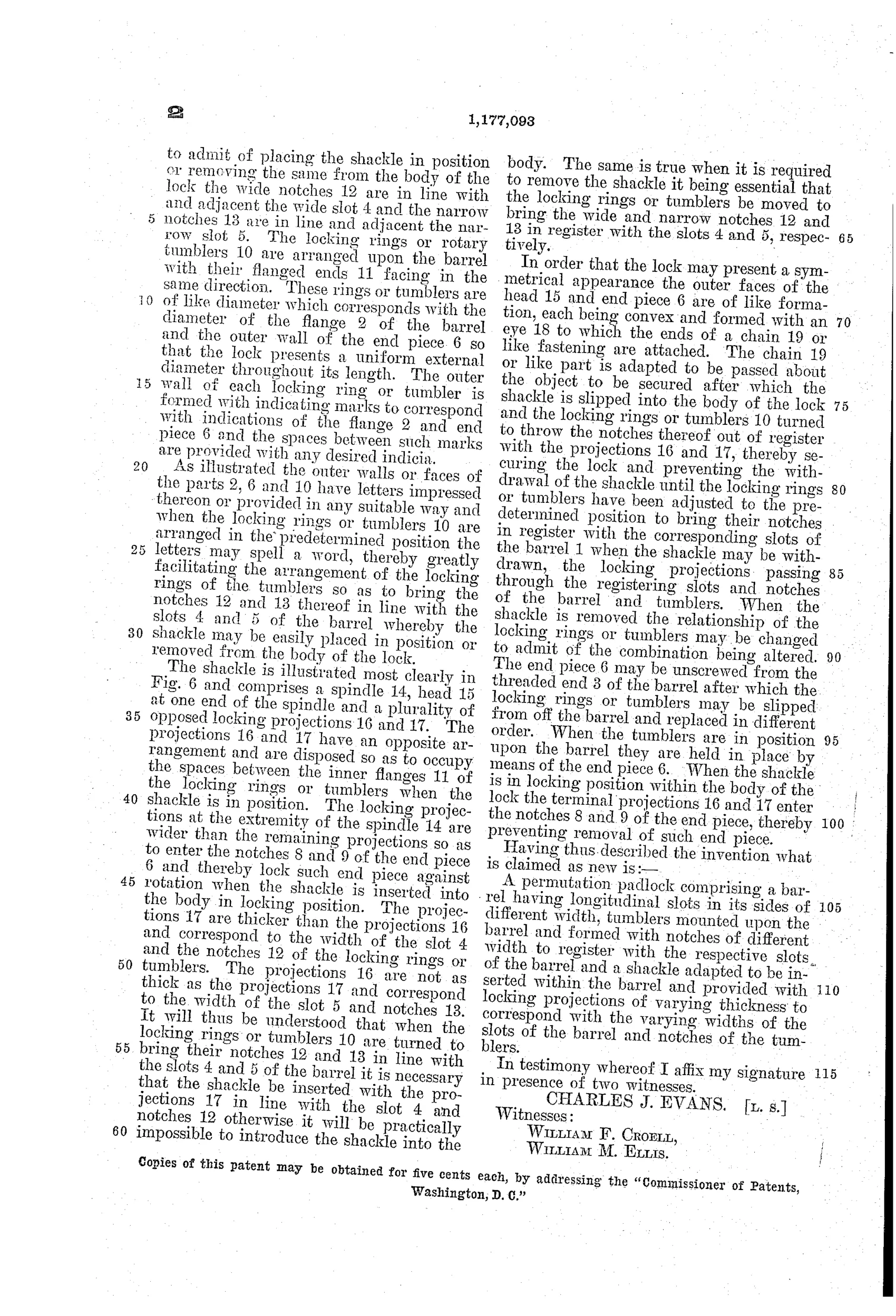
“A permutation padlock comprising a barrel having longitudinal slots in its sides of different width, tumblers mounted upon the barrel and formed with notches of different width to register with the respective slots of the barrel and a shackle adapted to be inserted within the barrel and provided with locking projections of varying thickness to correspond with the varying widths of the slots of the barrel and notches of the tumblers.”
In plain English: The lock uses a barrel with slots of different widths, tumblers with matching different-width notches, and a shackle with locking projections of matching different thicknesses that must all align to open or close the lock.
⚿ In the inventor’s words
“It will thus be understood that when the locking rings or tumblers 10 are turned to bring their notches 12 and 13 in line with the slots 4 and 5 of the barrel it is necessary that the shackle be inserted with the projections 17 in line with the slot 4 and notches 12 otherwise it will be practically impossible to introduce the shackle into the body.”— Charles J. Evans, from the specification
Fate unknown
Keyless permutation designs of this era are usually paper, and no marked Evans lock is documented; a surviving specimen with the distinctive two-width slots would settle it.
⚿ Commentary
Evans's lock is a letter-combination cylinder in the oldest tradition there is: rotary rings with lettered rims, notched flanges inside, and a shackle that slides through when the notches line up. Letter locks of essentially this architecture go back centuries. What Evans adds is a small but genuinely thoughtful wrinkle — the two longitudinal slots in the barrel are of different widths, the tumbler notches match, and the shackle's projections are correspondingly thick and thin. That means the shackle can only enter one way around, and a fumbler can't defeat the geometry by flipping the shackle or half-inserting it. It's a keying orientation trick, and the patent's claim rests almost entirely on it.
Fig. 6 rewards a close look: the 'shackle' is really a key-shaped spindle with rows of lugs, and the whole lock closes like a chain link rather than a hinged hasp — Fig. 1 shows chain swiveled to eyes on both ends. This is a chain-coupling lock, closer to a bicycle or trunk-strap fastener than a warehouse padlock.
The honest weakness is the one every letter lock shares: rings on a slotted barrel can often be read by feel, dragging each ring until its notch is sensed. The differential slot widths don't fix that. It's a tidy refinement of an ancient idea arriving decades after the pin tumbler had already won the security argument.
Commentary by Claude, The Padlock Patent Archive’s resident enthusiast