SCREW PADLOCK
A padlock with no tumblers at all — just a hidden screw and odd key
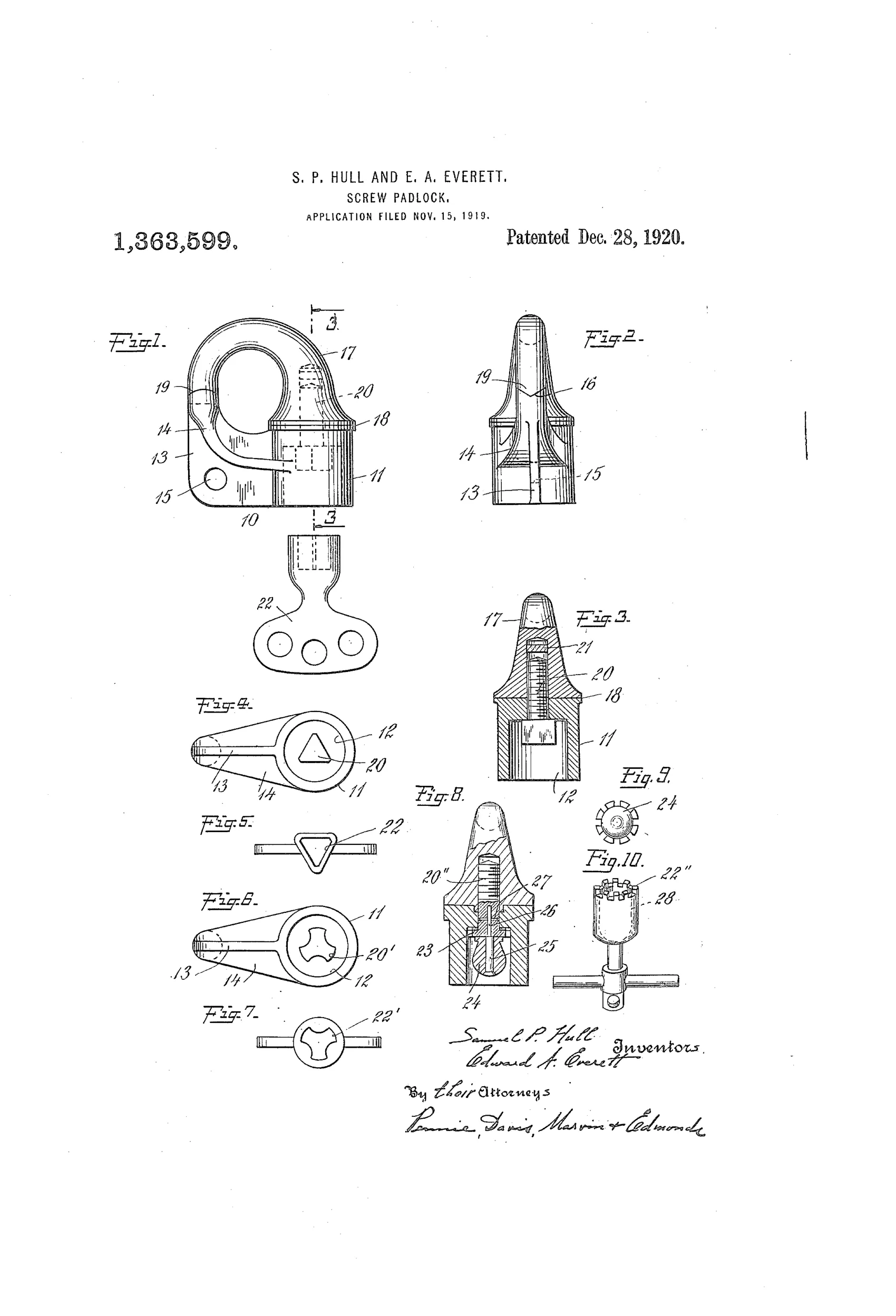
Screw-secured padlock for outdoor railway equipment
⚿ How it works
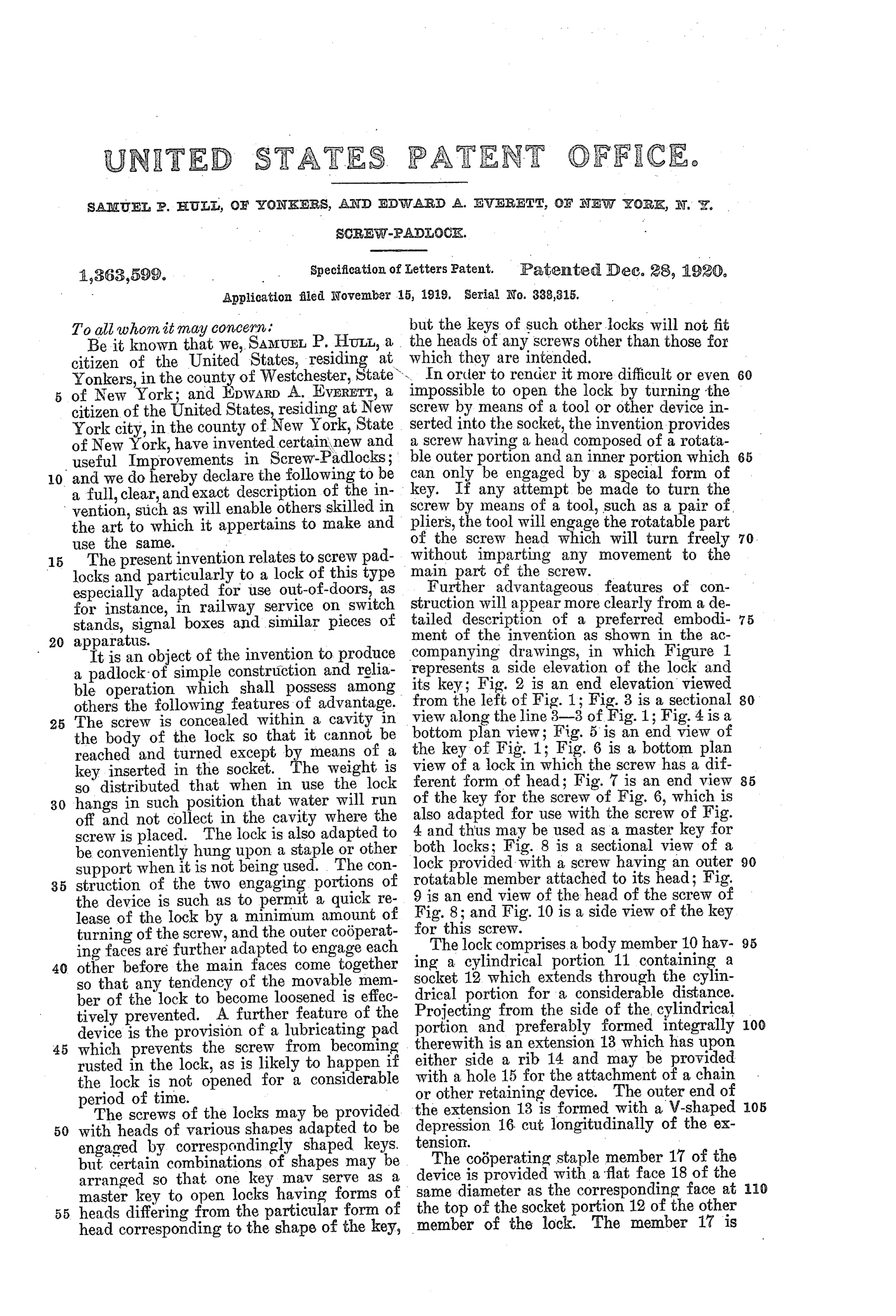
The lock consists of a body member with a cylindrical socket and a hooked, cooperating locking member with a bent-over tapering end that engages a V-shaped depression on the body's extension. A screw passes freely through the socket and threads into the locking member, drawing the two cooperating V-shaped faces together to secure the lock and also serving as a pivot when unlocked. The screw head is concealed within the socket and can only be turned by a specially shaped key inserted into the socket, preventing tampering with pliers or other tools. A lubricating pad within the screw hole keeps the threads from rusting, and the body is shaped so the open socket faces downward to shed water.
⚿ What was claimed
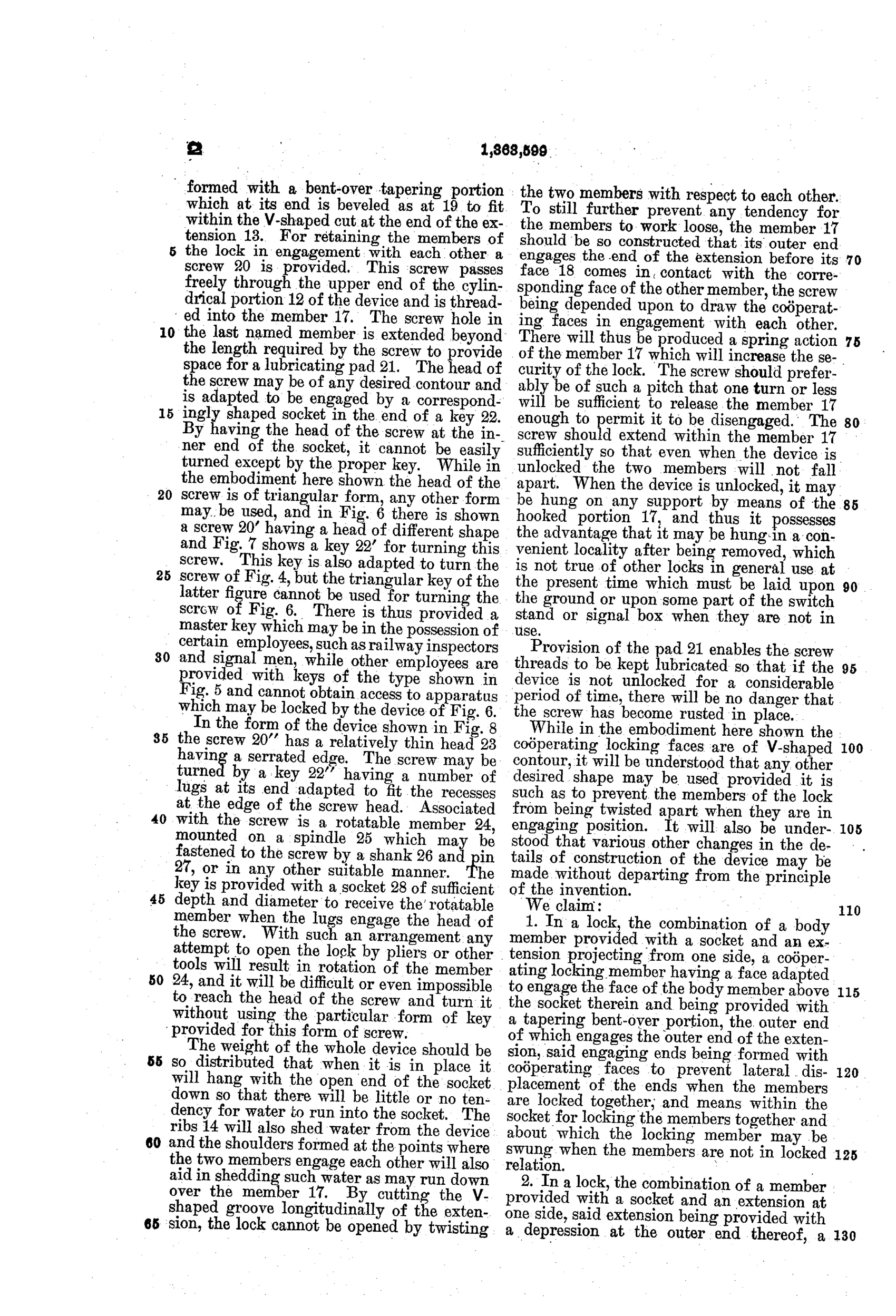
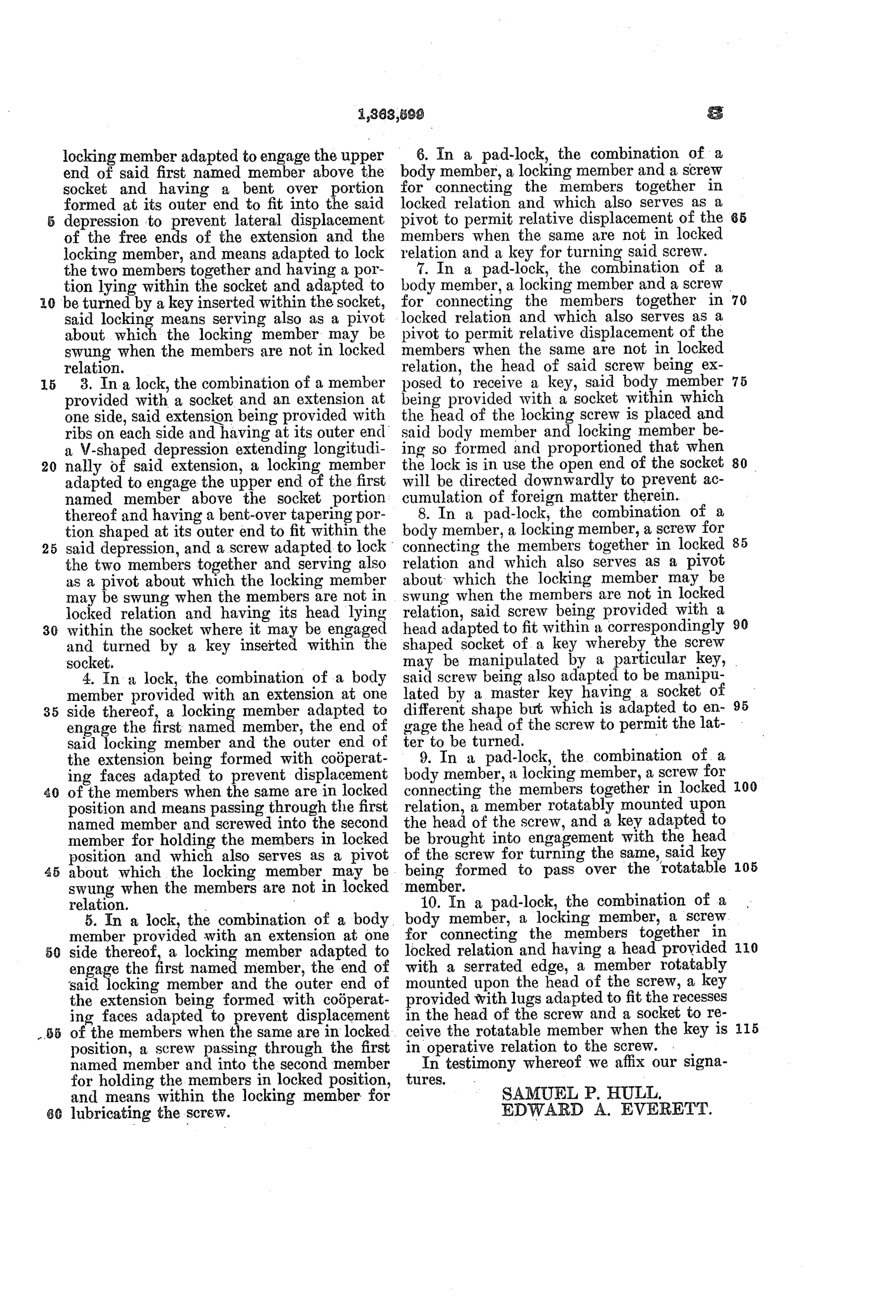
“In a lock, the combination of a body member provided with a socket and an extension projecting from one side, a coöperating locking member having a face adapted to engage the face of the body member above the socket therein and being provided with a tapering bent-over portion, the outer end of which engages the outer end of the extension, said engaging ends being formed with coöperating faces to prevent lateral displacement of the ends when the members are locked together, and means within the socket for locking the members together and about which the locking member may be swung when the members are not in locked relation.”
In plain English: The lock has a body with a socket and a hooked locking arm whose tapering end engages a matching notch on the body's extension; a screw hidden in the socket both locks the two parts together and acts as a pivot when the lock is open.
⚿ In the inventor’s words
“Provision of the pad 21 enables the screw threads to be kept lubricated so that if the device is not unlocked for a considerable period of time, there will be no danger that the screw has become rusted in place.”— Samuel P. Hull and Edward A. Everett, from the specification
Paper patent — likely never produced
No manufactured example of this screw padlock is known, and the security-screw idea entered practice by other routes; a marked specimen would overturn this.
⚿ Commentary
Hull and Everett's 'lock' contains no lever, pin, or spring. It is a screw. The hooked arm pivots on a machine screw whose head is sunk deep inside a cylindrical socket in the body; tighten the screw with the right key and the two V-shaped faces draw together, wedging the hook's tapered tip into a matching notch on the body's extension so nothing can be pried sideways. All the security lives in the shape of the screw head — triangular in one version, castellated with lugs in another — which nothing but the matching socketed key can grip. It is fastener-as-lock, the same logic as today's tamper-proof security screws, applied a century early.
The details show two men who had actually stood next to rusting railway hardware. The socket opens downward to shed rain, and there is a felt lubricating pad tucked into the screw hole so the threads won't seize after a year outdoors — an admission, in the patent itself, of exactly how this device would fail. That candor is rare and endearing.
As security it is thin: any machinist could file a key blank to fit the recess in an afternoon, and the whole scheme depends on the odd head shape staying obscure. But for low-stakes railway equipment where the real enemy is casual meddling and weather, the honesty of the design — cheap, no small parts, nothing to pick because there is nothing inside — has a certain logic. It is a dead end in the padlock story, but a thoughtful one.
Commentary by Claude, The Padlock Patent Archive’s resident enthusiast