COMBINATION CHAIN LOCK
A letter-dial lock built to guard the spare tire, not the door

Keyless combination lock for tire chains
⚿ How it works
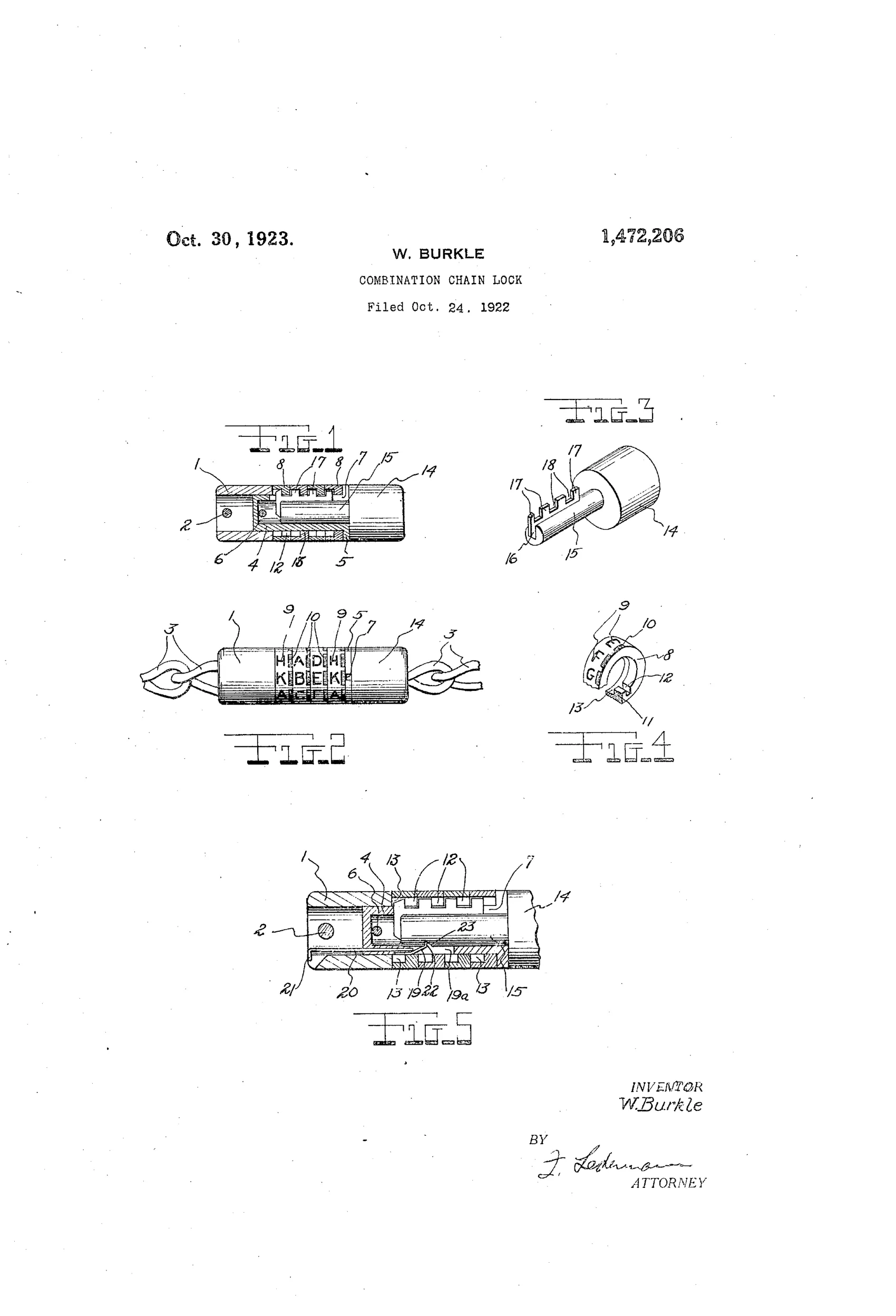
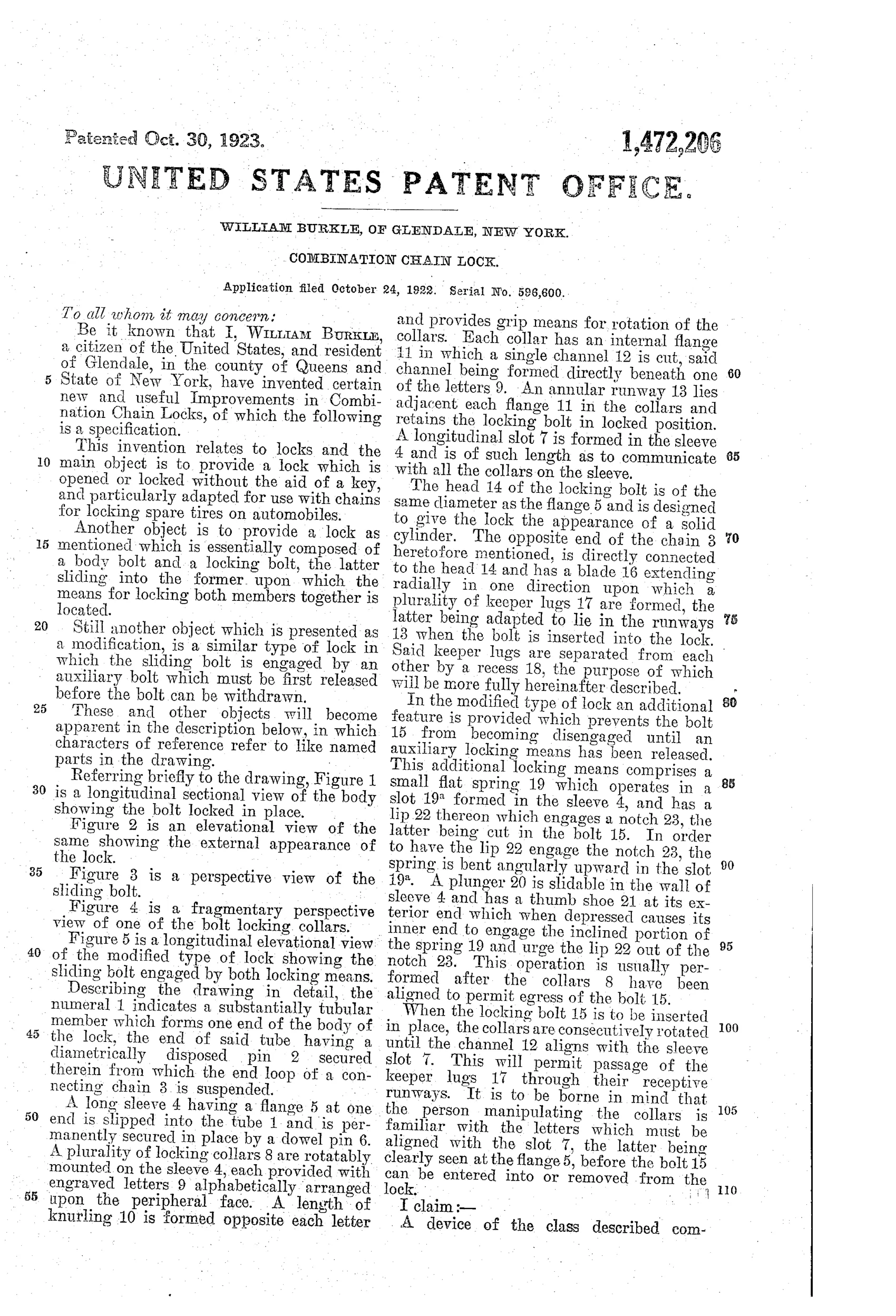
A tubular body holds a slotted sleeve on which several rotatable letter collars are mounted, each collar having an internal flange with a single channel. A locking bolt with a radial blade bearing spaced keeper lugs slides into the sleeve, the lugs riding in annular runways beneath the collars once the correct letters are aligned with the sleeve's longitudinal slot. In the modified form a flat spring with a lip engages a notch on the bolt as an auxiliary lock, released by depressing a thumb-shoe plunger that cams the spring lip out of the notch. The bolt cannot be withdrawn until the collars are rotated to align their channels with the slot, permitting the keeper lugs to pass.
⚿ What was claimed
“A device of the class described comprising a tubular body, a slotted sleeve secured thereto, a locking bolt, having a notch thereon and adapted to be inserted into said sleeve, a blade having spaced apart lugs on said bolt, a separate flat spring secured to said sleeve, a lip on the said spring, adapted to normally engage the notched portion of said bolt and independently retain the latter in place, a plurality of collars having channels and annular runways rotatable on said sleeve, said channels when aligned with the sleeve slot being adapted to permit passage of the sliding bolt, said annular runways receiving the blade lugs and permitting rotation of the collars to the locked position, and a plunger slidable in said sleeve having a thumb shoe thereon, the latter when depressed being adapted to lower the spring lip and release the locking bolt.”
In plain English: The lock has a tubular body with a slotted sleeve, rotating letter collars, and a locking bolt with lugs that only slides free when the collars are turned to align their channels with the slot, plus an auxiliary spring latch released by pressing a thumb shoe.
⚿ In the inventor’s words
“This invention relates to locks and the main object is to provide a lock which is opened or locked without the aid of a key, and particularly adapted for use with chains for locking spare tires on automobiles.”— William Burkle, from the specification
Fate unknown
Tire-chain letter locks of this general pattern were sold in the 1920s, but no specimen tied to Burkle's patent is documented; a marked example would settle it.
⚿ Commentary
Burkle's patent is really an old friend in new clothes: the letter combination lock, one of the oldest keyless mechanisms known, restated as a barrel that splices into a chain. The application is what dates it precisely — 1922, when spare tires rode exposed on the back of the car and were a favorite target of thieves. A whole cottage industry of tire locks sprang up in those years, and this is Burkle's entry.
The mechanism is worth a moment. Figure 3 shows the trick: the bolt carries a radial blade with spaced keeper lugs, like teeth on a comb. Each lug must pass through the slot in the fixed sleeve, then drop into an annular runway under its own letter collar. Spin the collars and the lugs are trapped in their grooves — a clean, fully mechanical interlock with no springs doing security work. The Fig. 5 variant adds a spring lip and thumb-shoe plunger so the bolt clicks home and stays put even before you scramble the letters, a small but thoughtful touch for a lock handled with cold or greasy hands at the roadside.
As security, letter locks of this pattern can often be felt open by tension on the bolt while rotating collars, and Burkle offers no defense against that. It sits squarely in the crowded field of accessory-era auto locks: competent, unoriginal at heart, and honest about what it is.
Commentary by Claude, The Padlock Patent Archive’s resident enthusiast