Permutation-Lock.
Split the dial from the tumblers, and the picker has nothing to feel
Combination lock for trunks
⚿ How it works
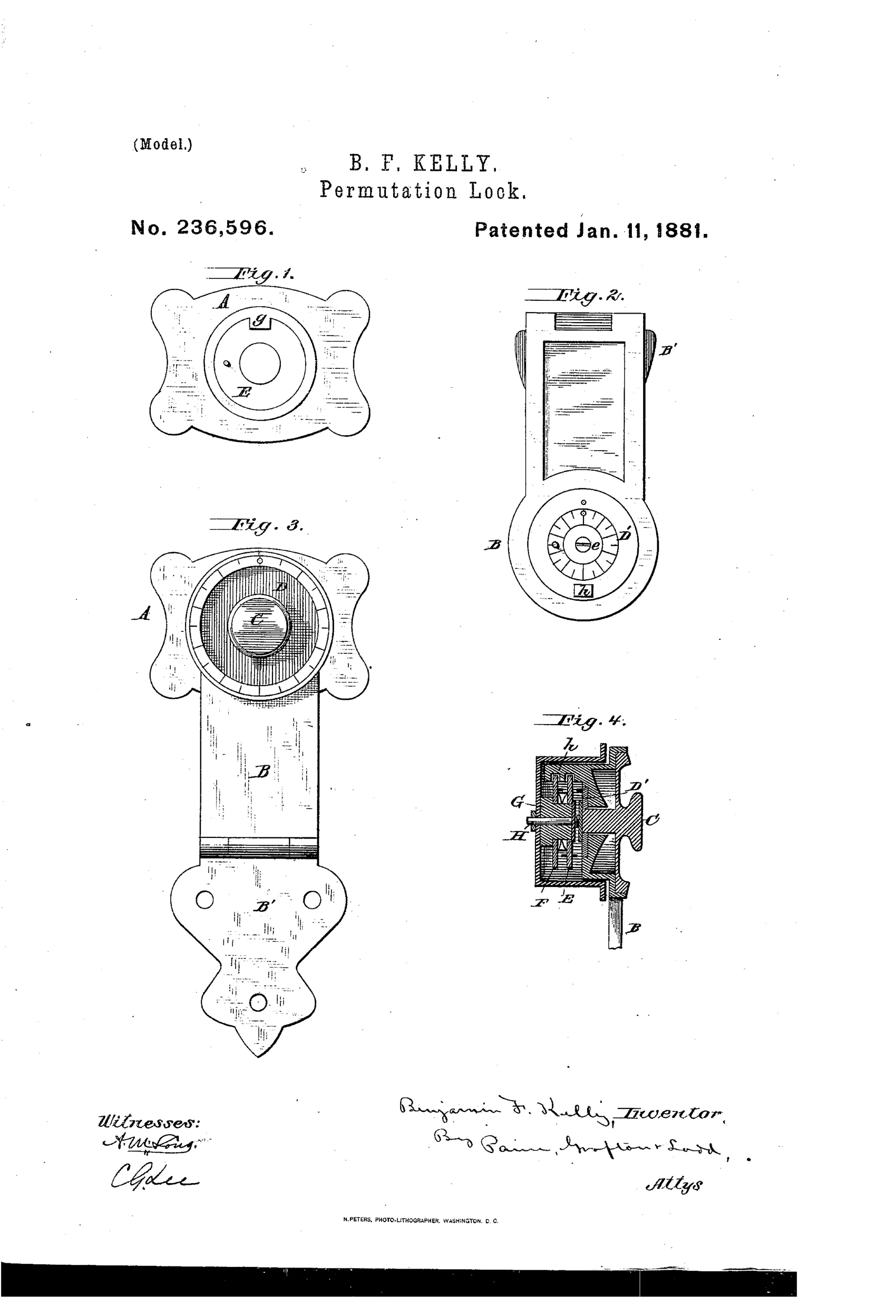
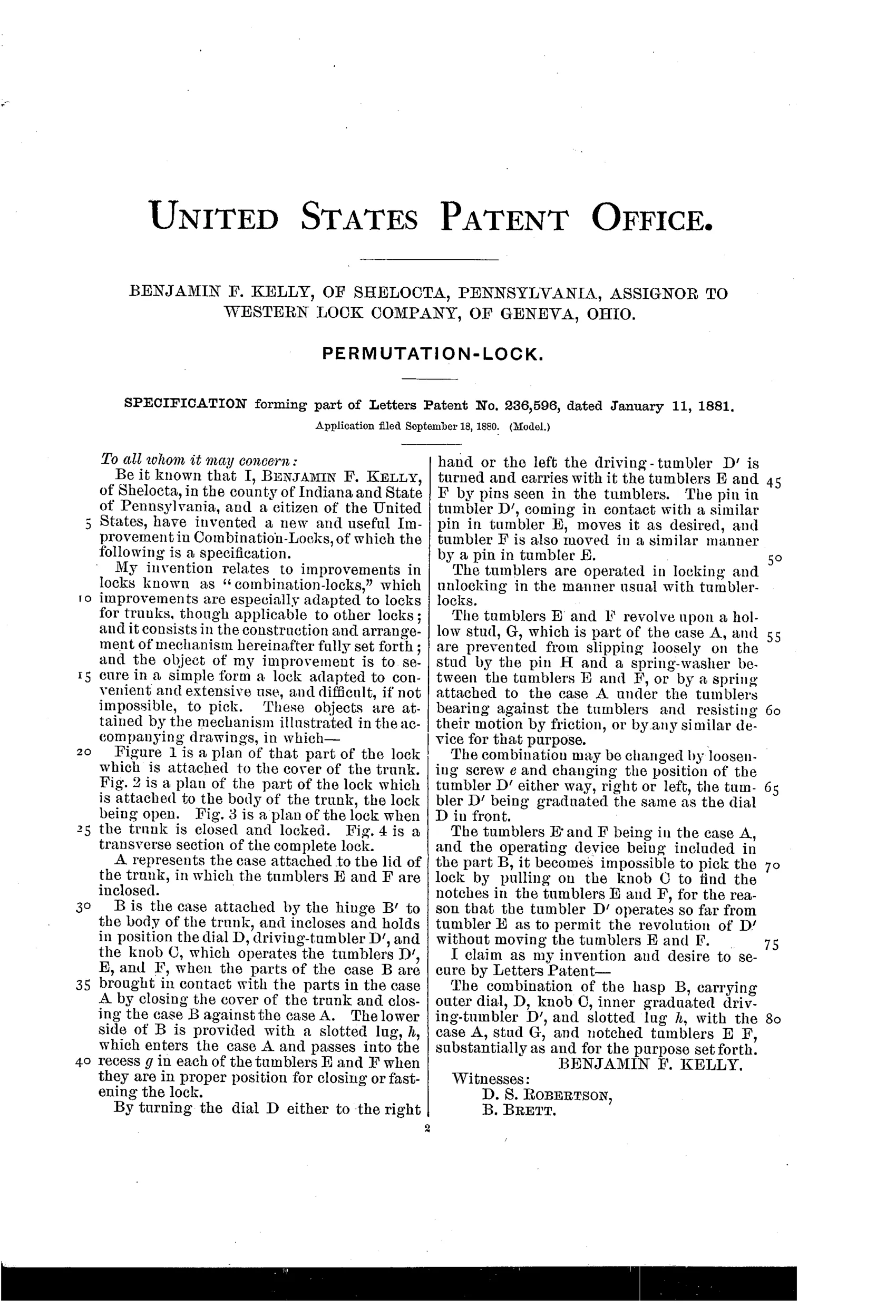
A case A attached to the trunk lid encloses two notched tumblers, E and F, mounted on a hollow stud G and held from slipping by a pin and spring-washer. A separate hasp case B, hinged to the trunk body, carries a graduated outer dial D, an operating knob C, and an inner driving-tumbler D' with a slotted lug h. When the trunk is closed, the lug h passes into the case A and engages recesses in the tumblers, and turning the dial moves the driving-tumbler D', which via pins carries tumblers E and F to set or release the combination. Because the tumbler-setting mechanism (E and F) is sealed inside case A while the operating dial and knob are in case B, the two cannot be manipulated together to feel out the combination, making the lock resistant to picking.
⚿ What was claimed
“The combination of the hasp B, carrying outer dial, D, knob C, inner graduated driving-tumbler D', and slotted lug h, with the case A, stud G, and notched tumblers E F, substantially as and for the purpose set forth.”
In plain English: The lock's claim covers the specific combination of the hinged hasp with its dial, knob, inner tumbler, and slotted lug working together with the separate case holding the stud and notched tumblers.
⚿ In the inventor’s words
“The tumblers E and F being in the case A, and the operating device being included in the part B, it becomes impossible to pick the lock by pulling on the knob C to find the notches in the tumblers E and F, for the reason that the tumbler D' operates so far from tumbler E as to permit the revolution of D' without moving the tumblers E and F.”— Benjamin F. Kelly, from the specification
Fate unknown
The assignment to Western Lock Company hints at commercial intent, but no marked trunk-lock specimen matching this design is documented; one turning up would settle it.
⚿ Commentary
Kelly's answer to lock manipulation is architectural: put the notched tumblers in one case, screwed to the trunk lid, and the dial and knob in a separate hinged hasp on the trunk body. The two halves only talk to each other when the trunk is closed, through a slotted lug that reaches across the joint. The specification says it plainly — you can't pull on the knob to feel for the tumbler notches, because the driving tumbler sits far enough from the gated ones that it can spin freely without dragging them. That's the same insight behind serrated false gates and later manipulation-resistant safe locks, arrived at by brute geographic separation.
Fig. 4 is the view worth studying. The section shows how the lug h has to thread into the sealed case A and pick up the tumblers E and F on their hollow stud — a lot of blind alignment happening every time the lid drops. That's the weak point in practice: trunk hardware lives a hard life, and a mechanism that depends on two separately-mounted cases meeting precisely will go out of true with the first warped lid or sprung hinge.
Still, this is a genuine idea, not a novelty. The assignment to the Western Lock Company of Geneva, Ohio suggests someone thought it worth backing. Whether it survived contact with actual trunk manufacture is another question — the keyless-permutation corner of this field is littered with patents that stopped at the drawing.
Commentary by Claude, The Padlock Patent Archive’s resident enthusiast