HASP-LOCK.
Snap it shut, no key needed — the lock lives inside the hasp itself
Combined hasp and self-locking padlock mechanism
⚿ How it works
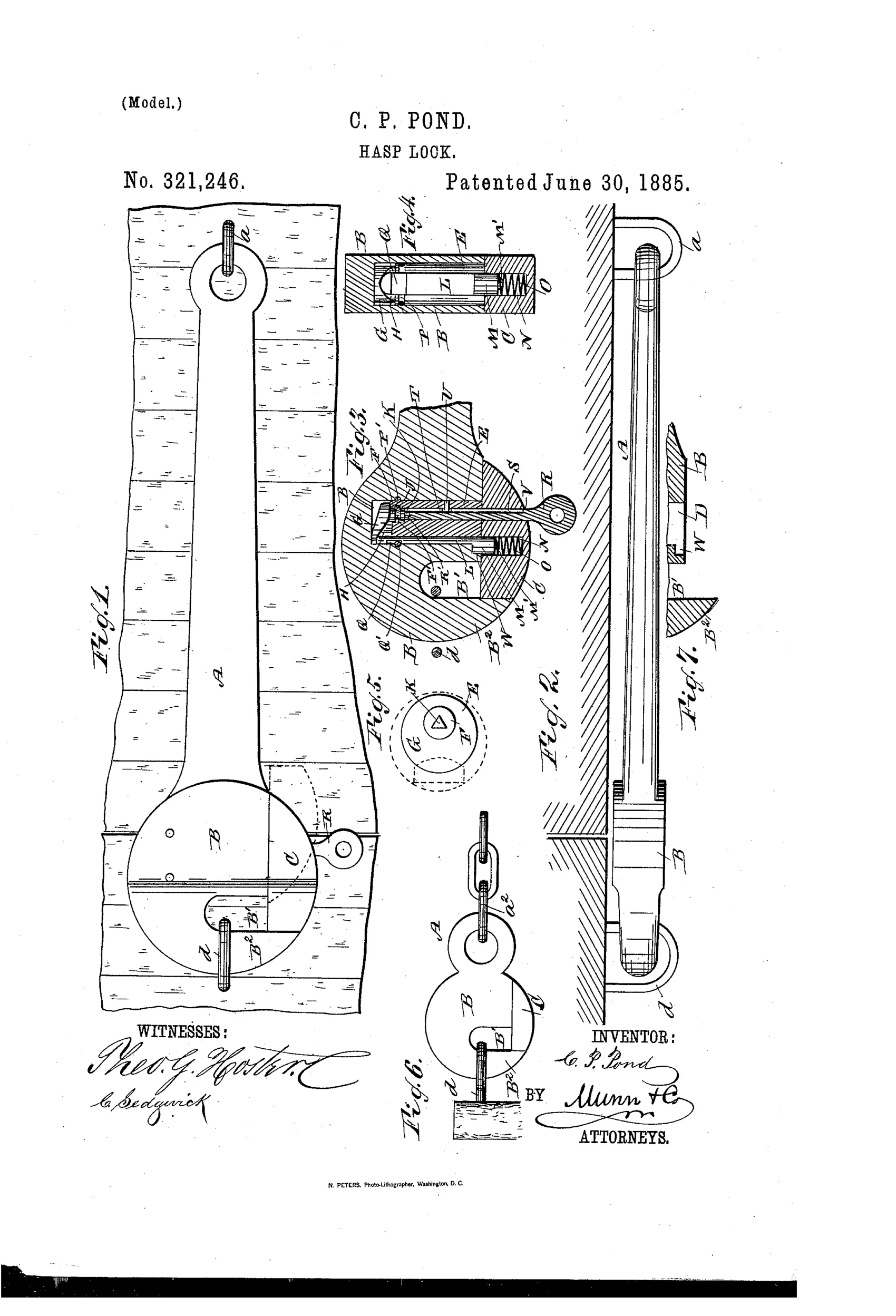
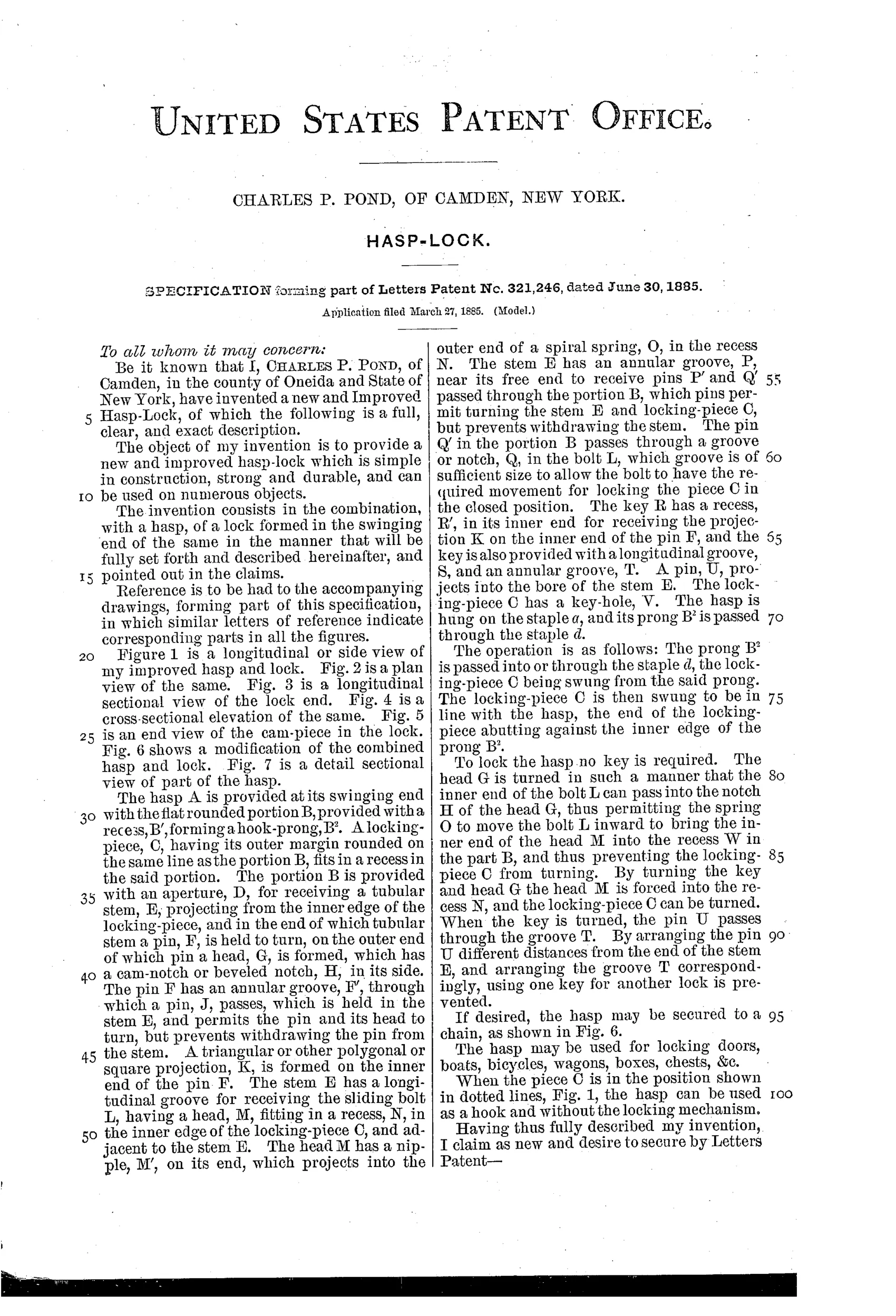
The hasp's swinging end carries a flat rounded portion with a hook-prong that engages a staple, and a rounded locking-piece pivots into a recess to close the hasp. A tubular stem projecting from the locking-piece houses a pin with a cam-notched head, an internal sliding bolt, and a spring, so that turning the head via a fitted key withdraws the bolt from a recess in the hasp portion, freeing the locking-piece to swing open. No key is needed to lock the hasp, since closing it simply lets the spring drive the bolt into the locking recess automatically. Varying the position of a pin and corresponding groove in the key and stem prevents one key from operating a different lock.
⚿ What was claimed
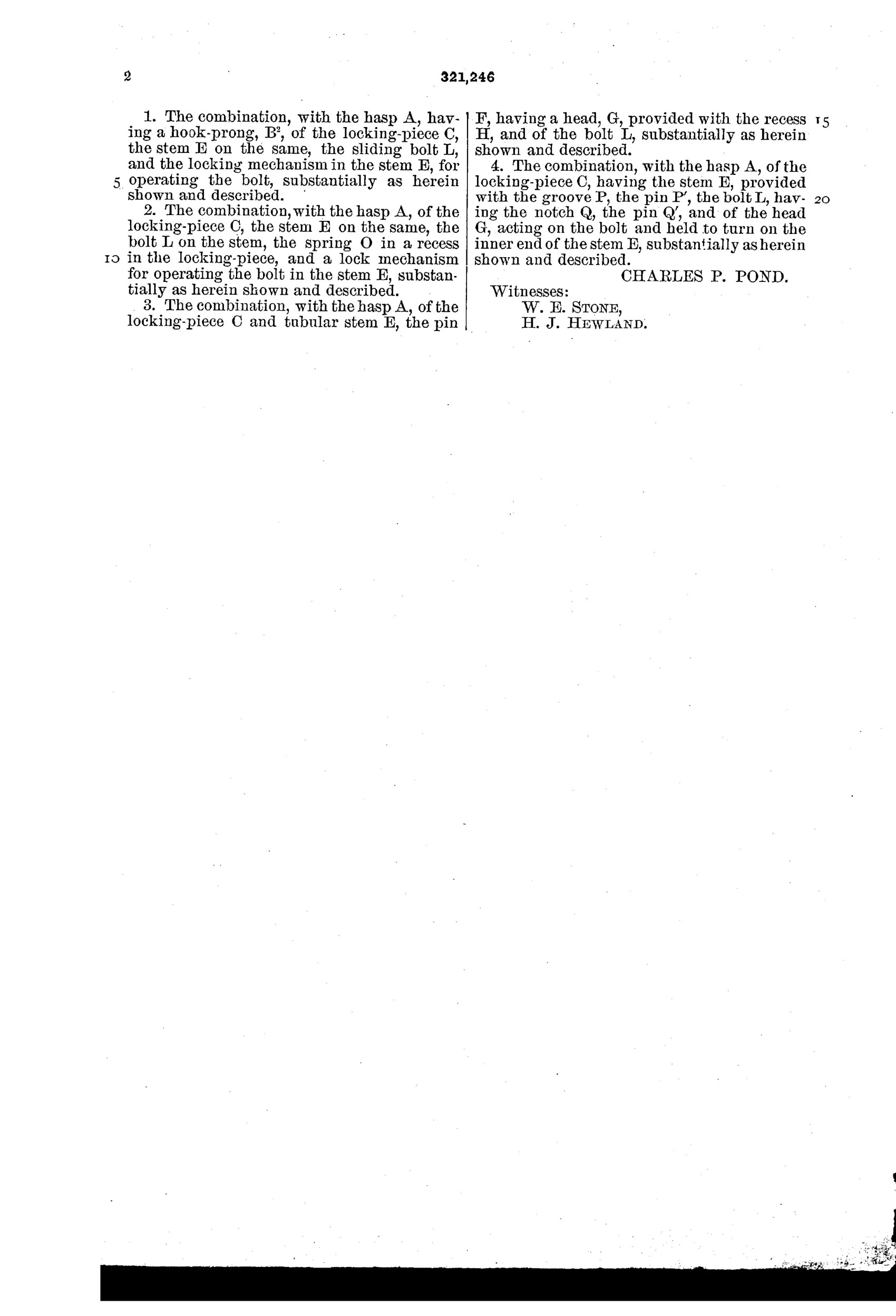
“The combination, with the hasp A, having a hook-prong, B^2, of the locking-piece C, the stem E on the same, the sliding bolt L, and the locking mechanism in the stem E, for operating the bolt, substantially as herein shown and described.”
In plain English: The lock combines a hasp with a hook-shaped prong, a rotating locking piece, a hollow stem, and an internal sliding bolt operated by a key mechanism inside the stem.
⚿ In the inventor’s words
“To lock the hasp no key is required.”— Charles P. Pond, from the specification
Paper patent — likely never produced
The near-trivial keying and the integrated-hasp format that the trade never adopted make production unlikely, and no marked example is known to me; a surviving specimen would overturn this.
⚿ Commentary
Pond's idea is to stop treating the padlock as a separate object. Instead of a hasp plus a lock hanging from a staple, the whole works becomes one piece of hardware: the hasp's swinging end carries a hook-prong that grabs the staple, a rounded locking-piece pivots over it, and a spring-driven bolt inside a tubular stem snaps home automatically. His own line says it best — 'To lock the hasp no key is required.' That self-locking convenience is the real selling point, decades before spring-shackle padlocks made it commonplace.
The drawing repays a close look at Figures 3 and 4. The 'key' is barely a key at all — it's a fitted sleeve that engages a cam-notched pin head inside the stem, and the only thing distinguishing one lock from another is the position of a single pin and matching groove. That's ward-level security in 1885, the same year pin-tumbler padlocks were already spreading. A determined person with a bent wire and five minutes would not be greatly inconvenienced.
Still, as hardware rather than high security, it's honest work: fewer loose parts to lose or steal, nothing dangling to be smashed off, and the Fig. 6 chain variant shows Pond thinking about gates and wagons. It sits in the busy sideline of integrated hasp-locks — a category that never displaced the humble padlock, mostly because a broken mechanism meant replacing the whole hasp.
Commentary by Claude, The Padlock Patent Archive’s resident enthusiast