IMPROVEMENT IN PADLOCKS
A self-locking padlock that snaps shut on its own mainspring — Civil War era
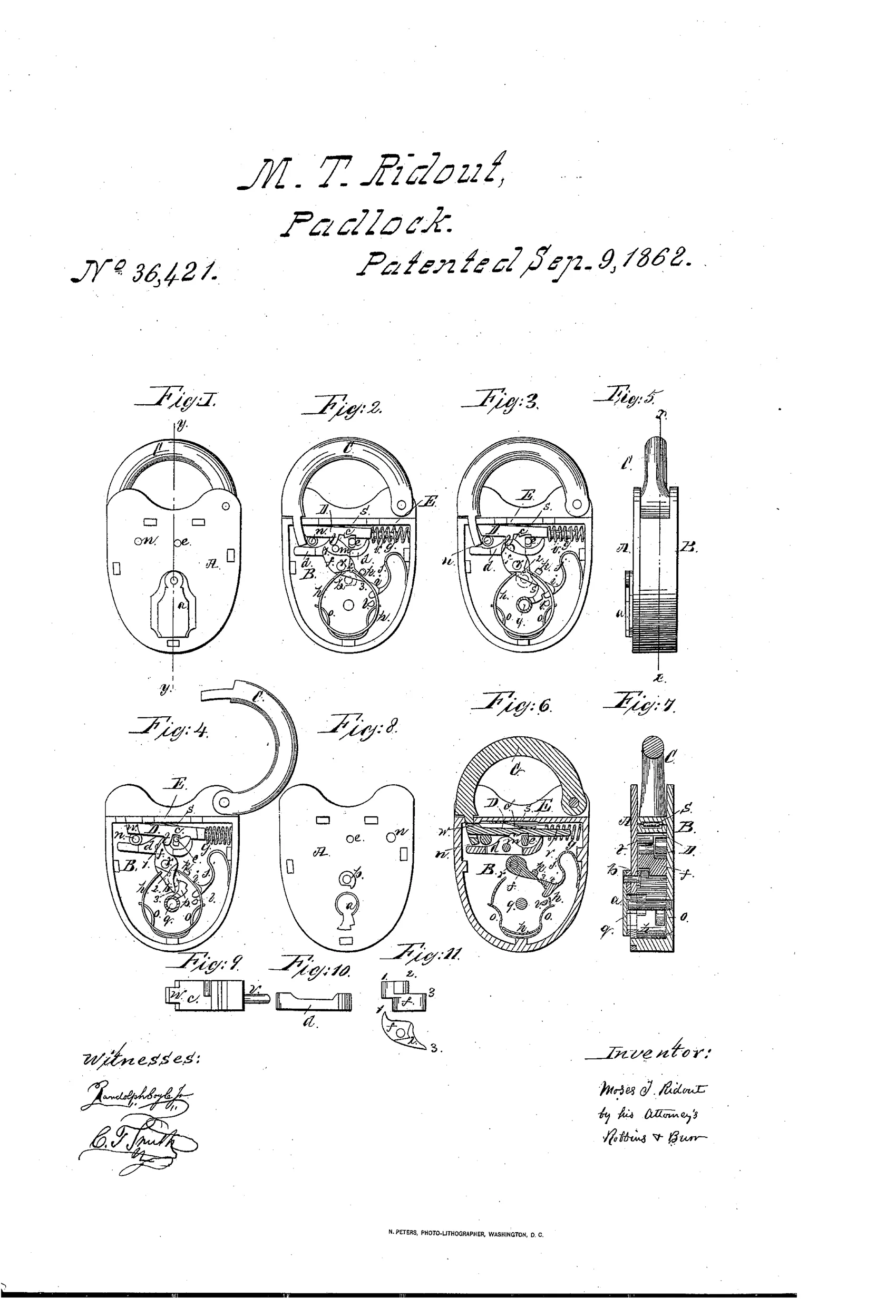
A shackle padlock with tumbler and spring bolt
⚿ How it works
The bolt D is guided beneath the lock case by studs and driven forward to the locking position by a helical mainspring g once released. A pivoted tumbler d, actuated by the perforated head of the shackle C, lifts the bolt free of a holding stud so the mainspring can drive it shut. The key acts on the bolt through a shaped tumbler f with two legs and an angle, which is caught and released by a spring catch i and stop k as the key is turned. A rotating key-hole cover a with an internal cam b resets the tumbler f to the locked position when the key is withdrawn, guarding against tampering.
⚿ What was claimed
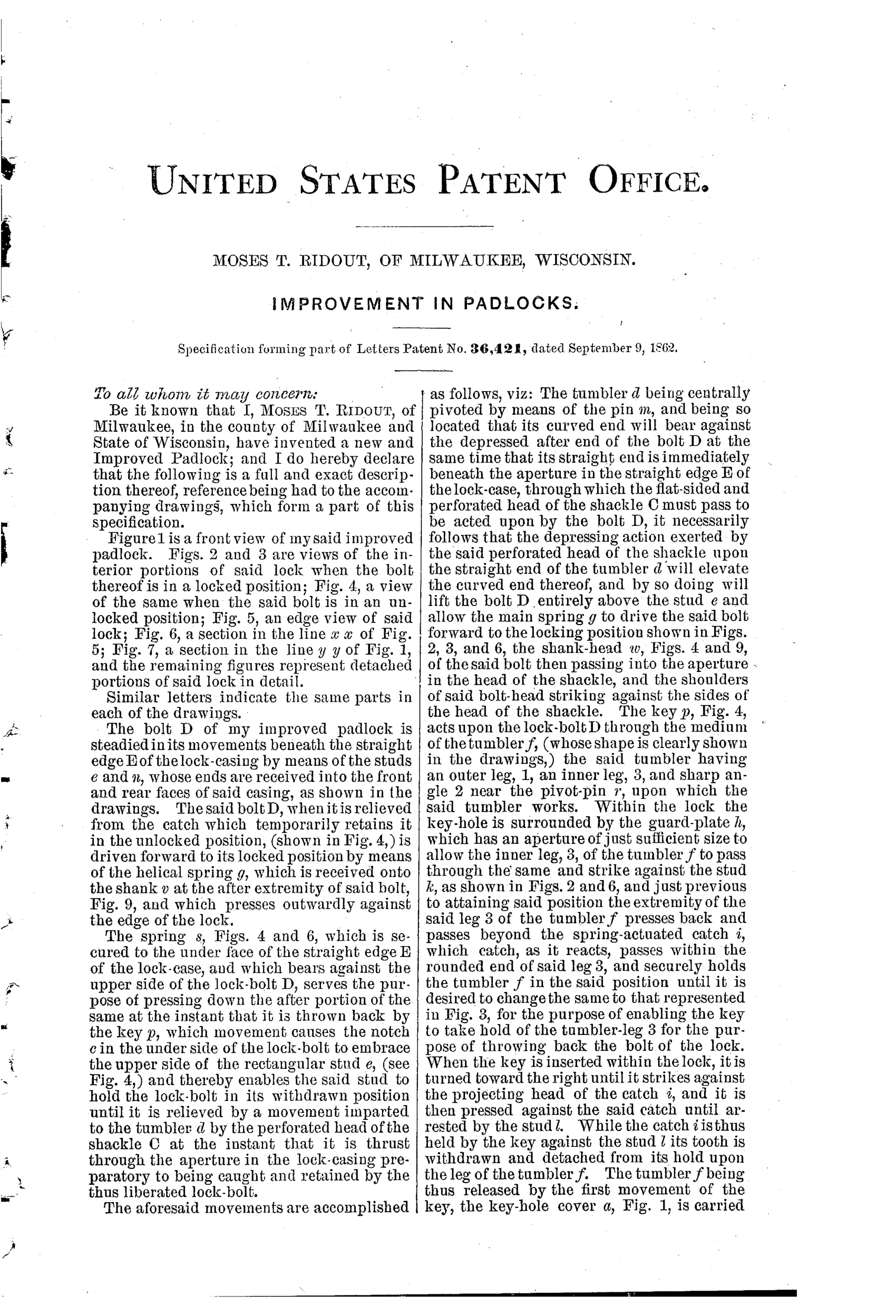
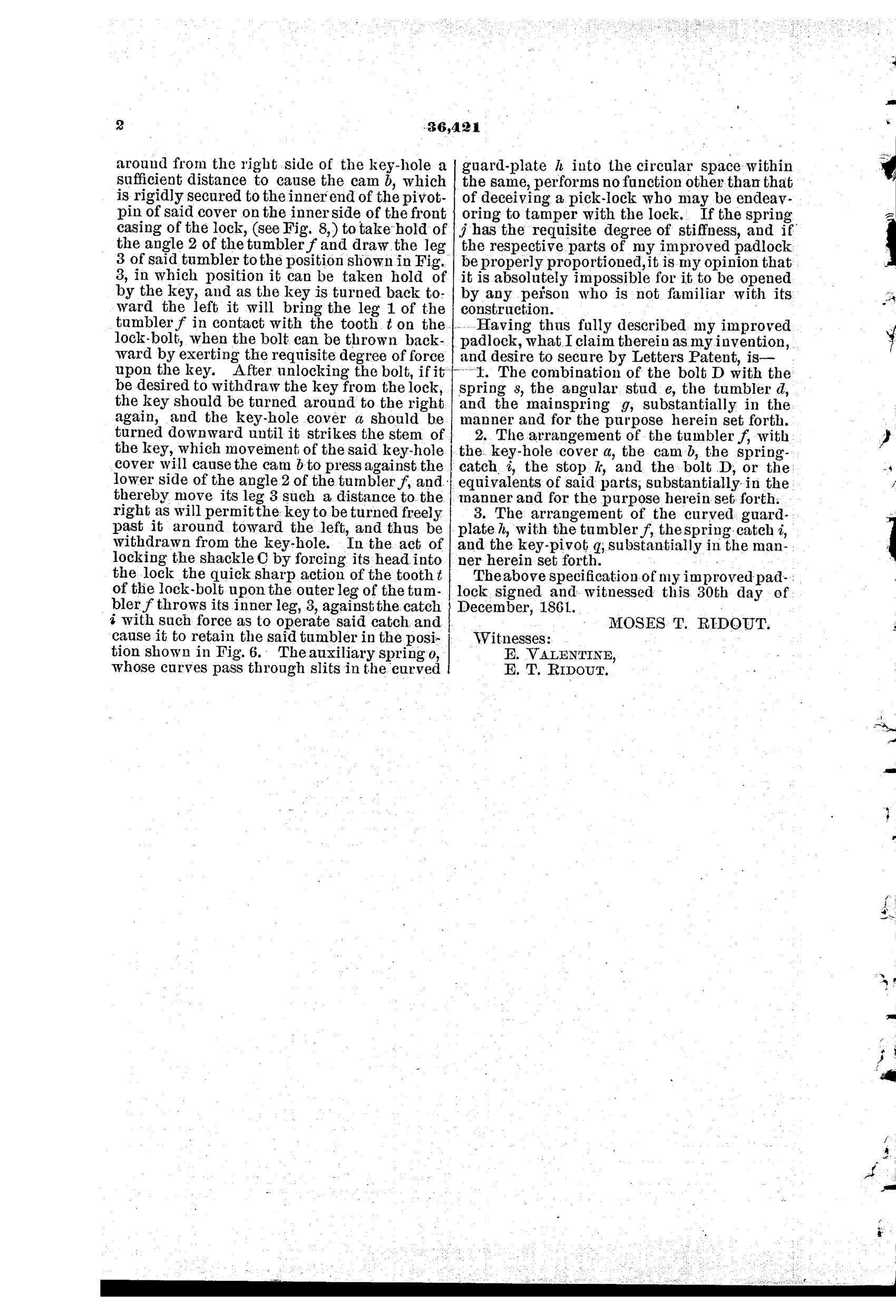
“The combination of the bolt D with the spring s, the angular stud e, the tumbler d, and the mainspring g, substantially in the manner and for the purpose herein set forth.”
In plain English: The inventor claims the specific combination of the lock bolt, a spring, an angled stud, a pivoting tumbler, and a mainspring working together to lock and unlock the shackle.
⚿ In the inventor’s words
“If the spring j has the requisite degree of stiffness, and if the respective parts of my improved padlock be properly proportioned, it is my opinion that it is absolutely impossible for it to be opened by any person who is not familiar with its construction.”— Moses T. Ridout, from the specification
Fate unknown
No known production hardware matches this Milwaukee design; a surviving specimen with the cam-reset keyhole cover would settle it.
⚿ Commentary
Ridout's core idea is that closing the shackle should do the locking for you. The perforated head of shackle C trips the pivoted tumbler d, which lifts the bolt off a holding stud, and the coiled mainspring g slams the bolt home. That's a genuinely useful feature — a self-locking padlock can be snapped shut one-handed in the dark — and it anticipates the spring-shackle convenience that later became standard on switch and warehouse locks, though achieved here through a bolt driven forward rather than a shackle held under bias.
The second half of the patent is the interesting, fussier part: a rotating keyhole cover a with an internal cam b that mechanically resets the key-tumbler f to the locked position as the key is withdrawn. Most keyhole covers of the period are just dust guards; making the cover an active part of the security train, resetting the tumbler so a pick can't find it left in a helpful state, is a clever touch a casual reader would skim past in Figs. 6 and 7.
That said, the inventor's boast that the lock is 'absolutely impossible' to open by strangers is the standard 1860s overreach — one shaped tumbler and a spring catch is modest security, and the mechanism carries a lot of small parts (see the three-view tumbler details in Fig. 11) for what it delivers. A workmanlike wartime entry with one honestly good instinct: the lock that locks itself.
Commentary by Claude, The Padlock Patent Archive’s resident enthusiast