COMBINED TAG-HOLDER AND HASP-LOCK.
Lock your trunk and its address tag in one motion, Savannah, 1888
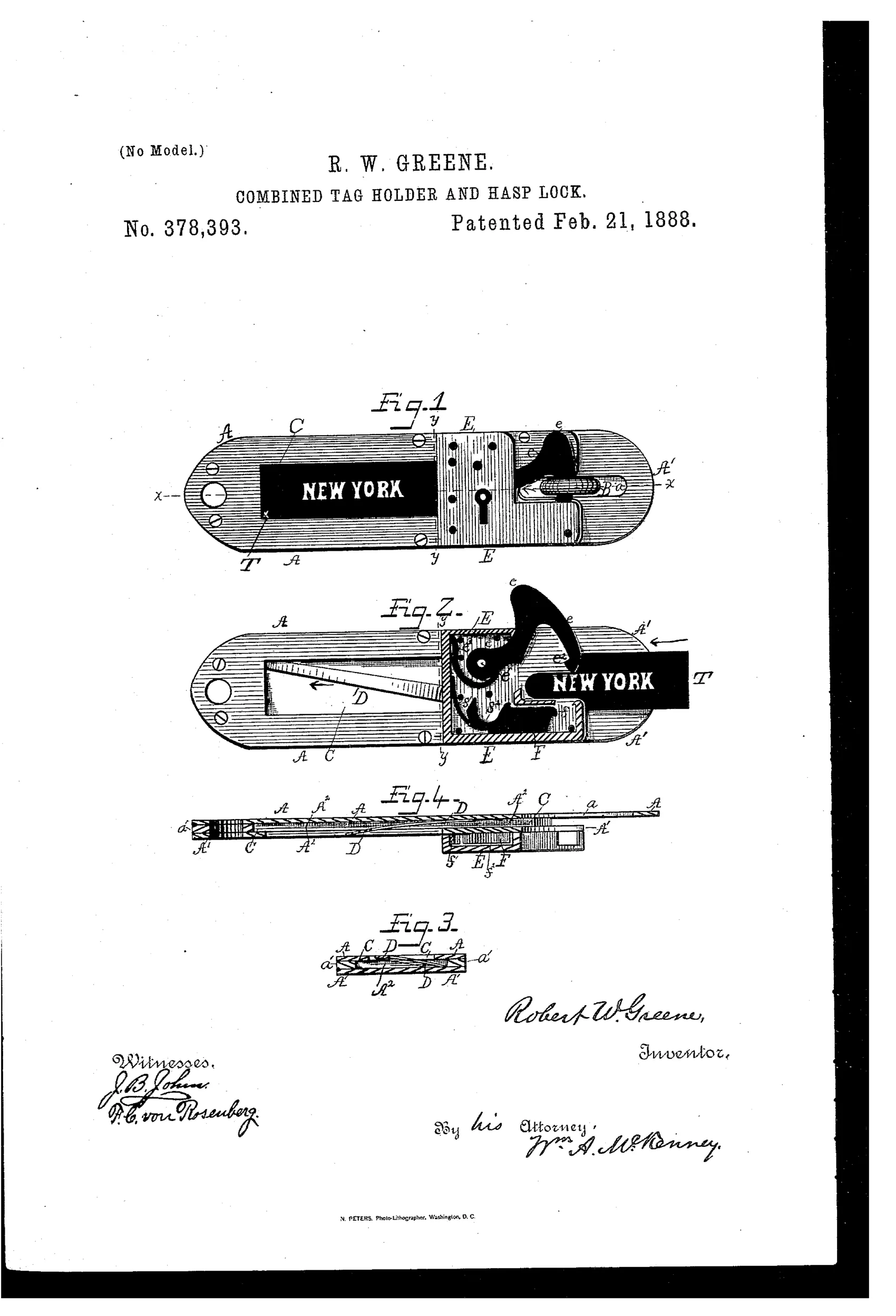
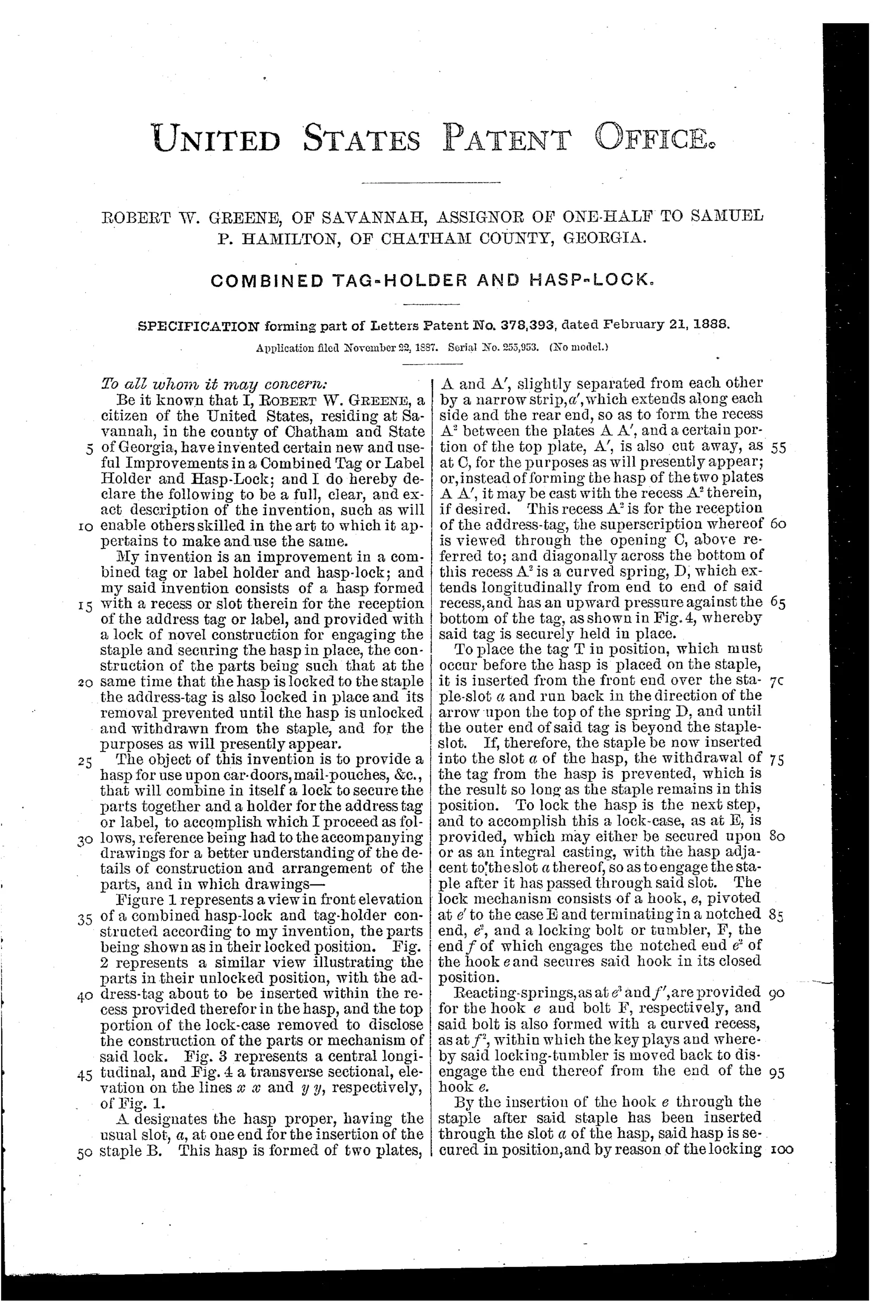
Combined address-tag holder and hasp lock
⚿ How it works
The hasp is formed of two plates slightly separated by a narrow strip to create a recess that holds an address tag, with an opening to view the tag's writing. A curved spring inside the recess presses upward against the tag to hold it securely once inserted past the staple slot. A lock case mounted on the hasp contains a pivoted hook with a notched end that engages a staple passed through the hasp slot. A locking bolt or tumbler engages the notch on the hook to secure it, with reacting springs on both the hook and bolt, and a key acting in a curved recess in the bolt disengages it to unlock the hasp.
⚿ What was claimed
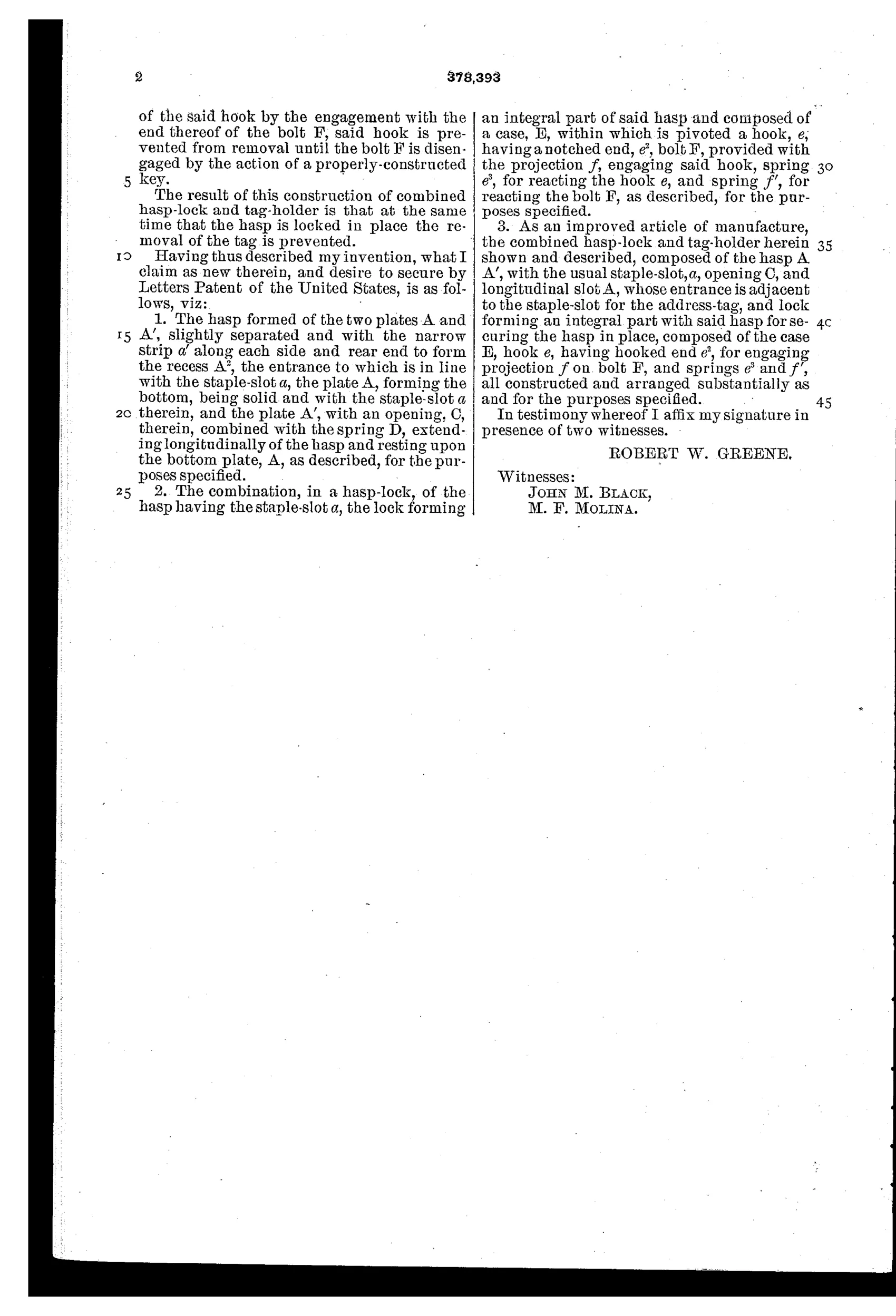
“The combination, in a hasp-lock, of the hasp having the staple-slot a, the lock forming an integral part of said hasp and composed of a case, E, within which is pivoted a hook, e, having a notched end, e2, bolt F, provided with the projection f, engaging said hook, spring e3, for reacting the hook e, and spring f', for reacting the bolt F, as described, for the purposes specified.”
In plain English: The lock consists of a hook pivoted inside a case built into the hasp, which is held closed by a spring-loaded bolt that engages a notch in the hook, with both parts pushed back into position by their own springs.
⚿ In the inventor’s words
“The result of this construction of combined hasp-lock and tag-holder is that at the same time that the hasp is locked in place the removal of the tag is prevented.”— Robert W. Greene, from the specification
Fate unknown
No production example of this combined tag-holder hasp is documented; a surviving marked specimen or express-company hardware catalog listing would settle it.
⚿ Commentary
This is a shipping-era problem solved with real economy: when your trunk or crate went off with a railway express company, the address tag was as vulnerable as the contents. A tag that falls off — or gets swapped — sends your goods into limbo. Greene's answer is to build the tag holder into the hasp itself, so the same act that locks the trunk traps the tag. The drawing makes the point better than the text: Fig. 2 shows the 'NEW YORK' tag sliding in while the lock is open, Fig. 1 shows it framed in its window once shut, held by a curved spring pressing it up from below.
The lock proper is nothing exotic — a pivoted hook inside a case, notched to catch a spring bolt, released by a key working in a curved recess. That is standard hasp-lock architecture for the period, and Greene doesn't pretend otherwise; his claim carefully ties the lock to the slotted, double-plate hasp that forms the tag recess. The cleverness is in the combination, not the tumbler work.
As security, the tag is only as safe as the padlock-grade mechanism guarding it, and a determined thief could still deface the writing through the viewing window. But as a piece of practical 1880s baggage hardware, it's a tidy idea from an inventor thinking about the whole journey, not just the lock.
Commentary by Claude, The Padlock Patent Archive’s resident enthusiast