COMBINED UMBRELLA-LOCK AND SATCHEL-FASTENER.
A bicycle lock for the umbrella age, chained to a Pullman seat
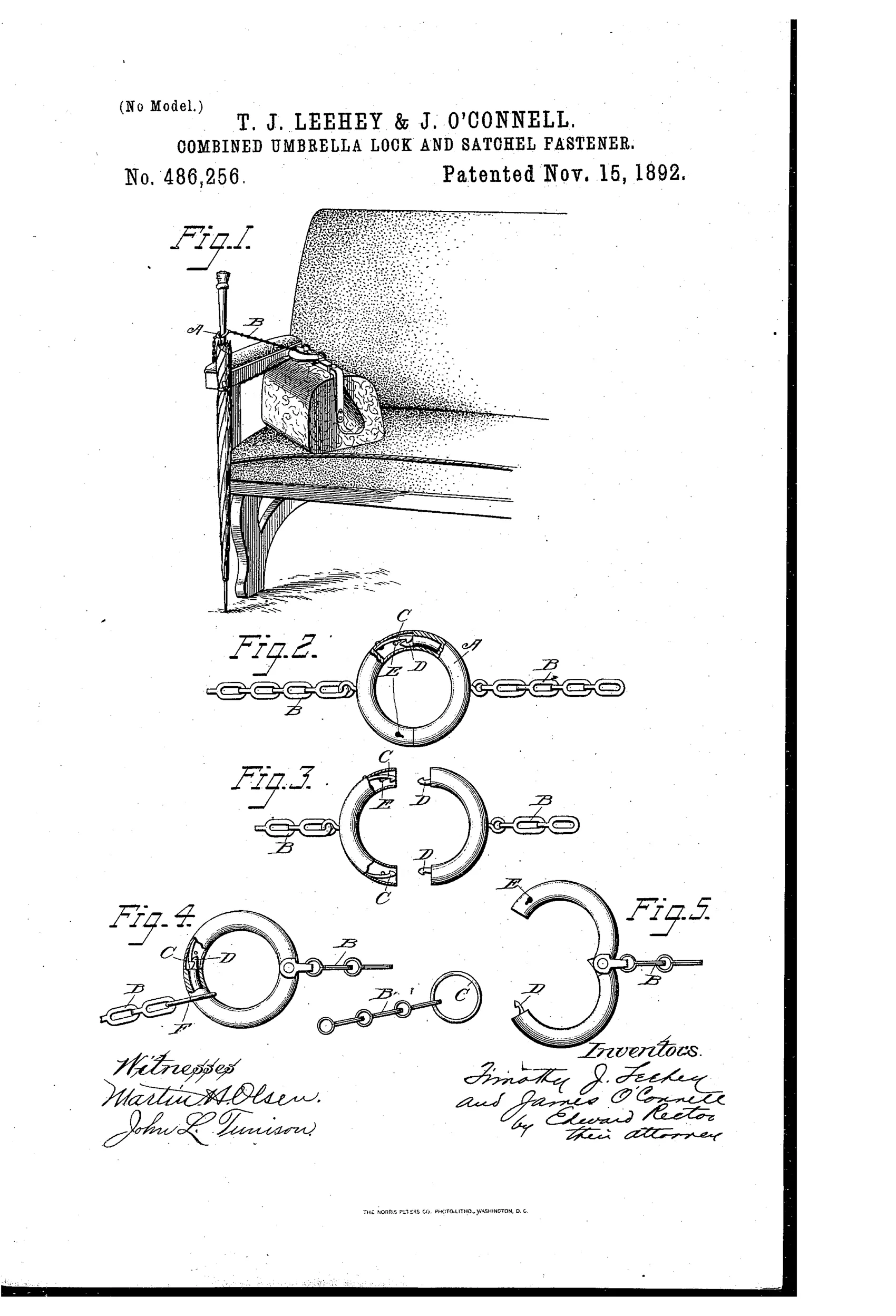
A locking ring-and-chain umbrella/satchel security device.
⚿ How it works
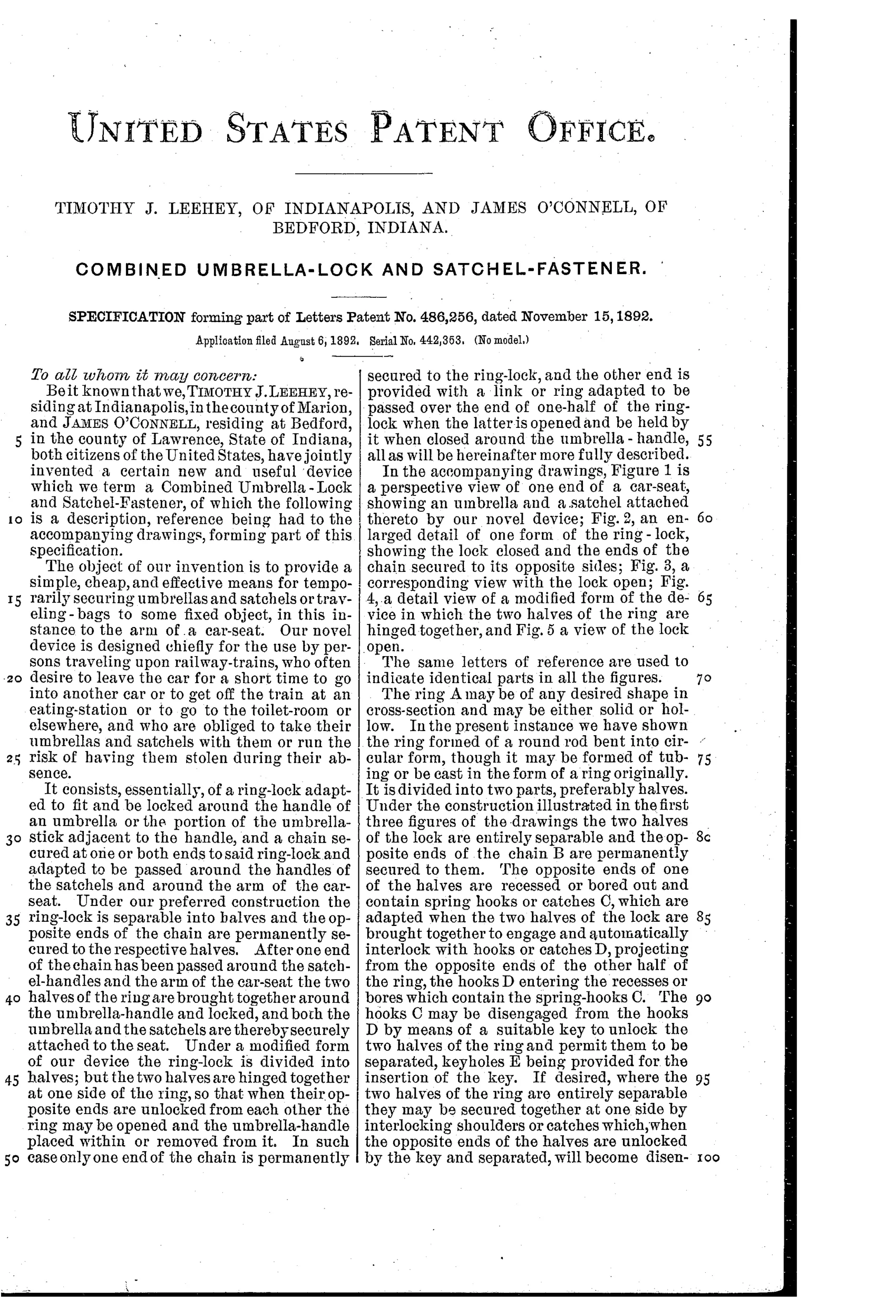
A split ring-lock is designed to fit around and be locked closed on an umbrella handle. One or both ends of a chain are secured to the ring-lock, and the free end of the chain is passed around a satchel handle and around the arm of a car-seat. Spring hooks or catches on one half of the ring engage with hooks on the other half to automatically interlock the ring when closed, and a key inserted through a keyhole disengages the catches to open it. In a modified form the two halves of the ring are hinged together on one side, so only the opposite ends need be unlocked to open the ring, and the free chain end carries a small ring or link that slips over the ring-lock before it is closed.
⚿ What was claimed
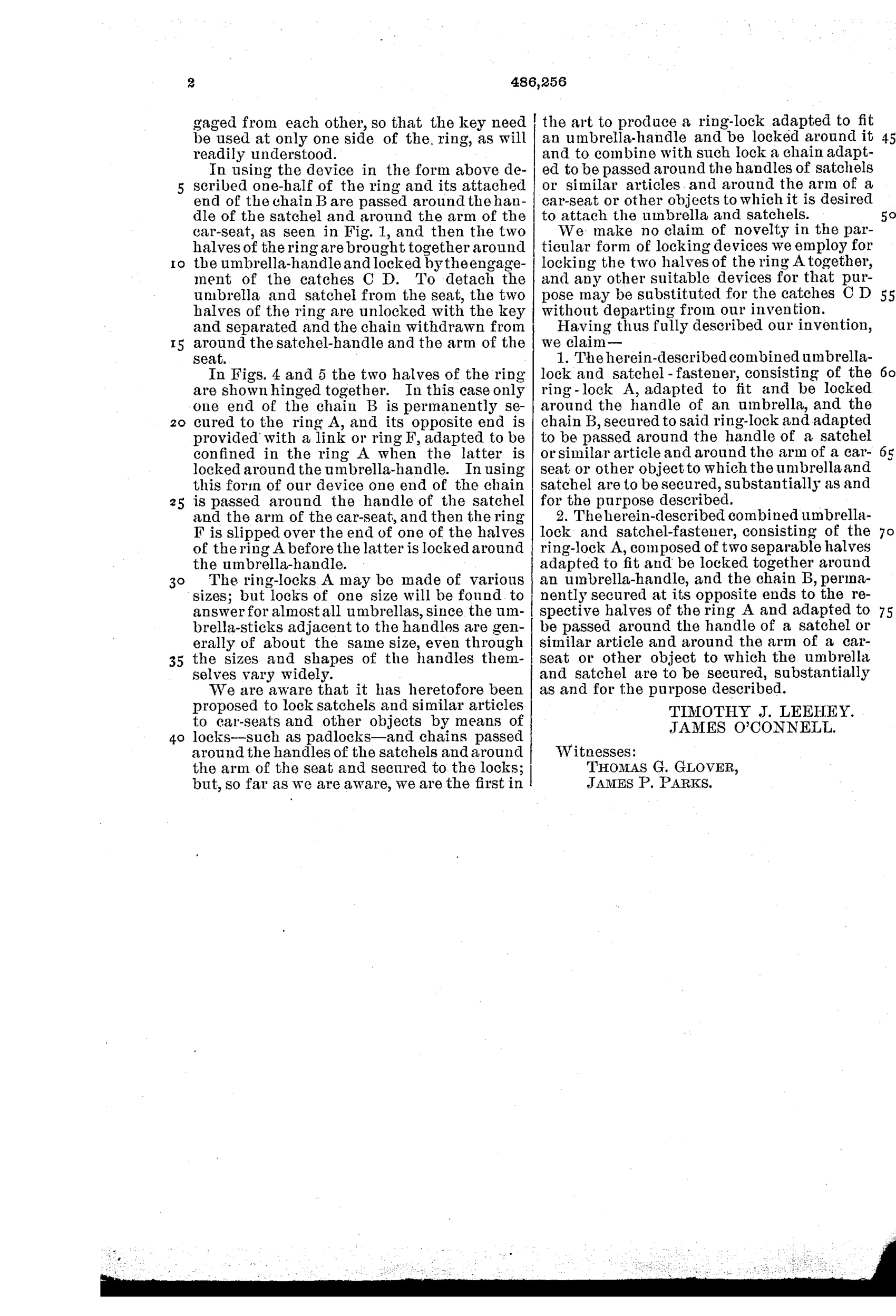
“The herein-described combined umbrella-lock and satchel-fastener, consisting of the ring-lock A, adapted to fit and be locked around the handle of an umbrella, and the chain B, secured to said ring-lock and adapted to be passed around the handle of a satchel or similar article and around the arm of a car-seat or other object to which the umbrella and satchel are to be secured, substantially as and for the purpose described.”
In plain English: A locking ring that clamps around an umbrella handle, attached to a chain that wraps around a satchel handle and a car-seat arm to secure both items together.
⚿ In the inventor’s words
“Our novel device is designed chiefly for the use by persons traveling upon railway-trains, who often desire to leave the car for a short time to go into another car or to get off the train at an eating-station or to go to the toilet-room or elsewhere, and who are obliged to take their umbrellas and satchels with them or run the risk of having them stolen during their absence.”— Timothy J. Leehey and James O'Connell, from the specification
Fate unknown
No manufactured example or trade-catalog listing is documented; a surviving marked ring-lock would settle it.
⚿ Commentary
Before anyone thought to cable a laptop to a coffee-shop table, Leehey and O'Connell of Indianapolis were solving the same problem for the 1890s traveler: how to visit the dining car without hauling your umbrella and satchel along or trusting your seatmates. Their answer is essentially a padlock stretched into a ring — a split annulus that snaps closed around the umbrella handle, with a chain that loops through the satchel grip and around the car-seat arm.
The mechanism is the interesting part for lock people. Figures 2 and 3 show the ring made of two half-circles whose ends carry spring hooks that self-engage when pressed together — a self-locking shackle, in effect, opened by a key poked through a keyhole in the ring body. The hinged variant in Figures 4 and 5 is the smarter design: only one joint needs to unlock, and the chain's free end carries a small link that slips over the open ring before closing, so one lock secures everything.
Security-wise, this is deterrence, not protection. The spring catches are simple, the ring must be sized to a handle it can't grip tightly, and a thief with a pocketknife could just cut the umbrella below the ring. But that's true of every luggage lock ever sold. As a category entry it's a charming dead end — the padlock principle wandering off into travel accessories rather than advancing it.
Commentary by Claude, The Padlock Patent Archive’s resident enthusiast