PADLOCK.
An 1893 bicycle chain lock — decades before the cycle-lock trade existed
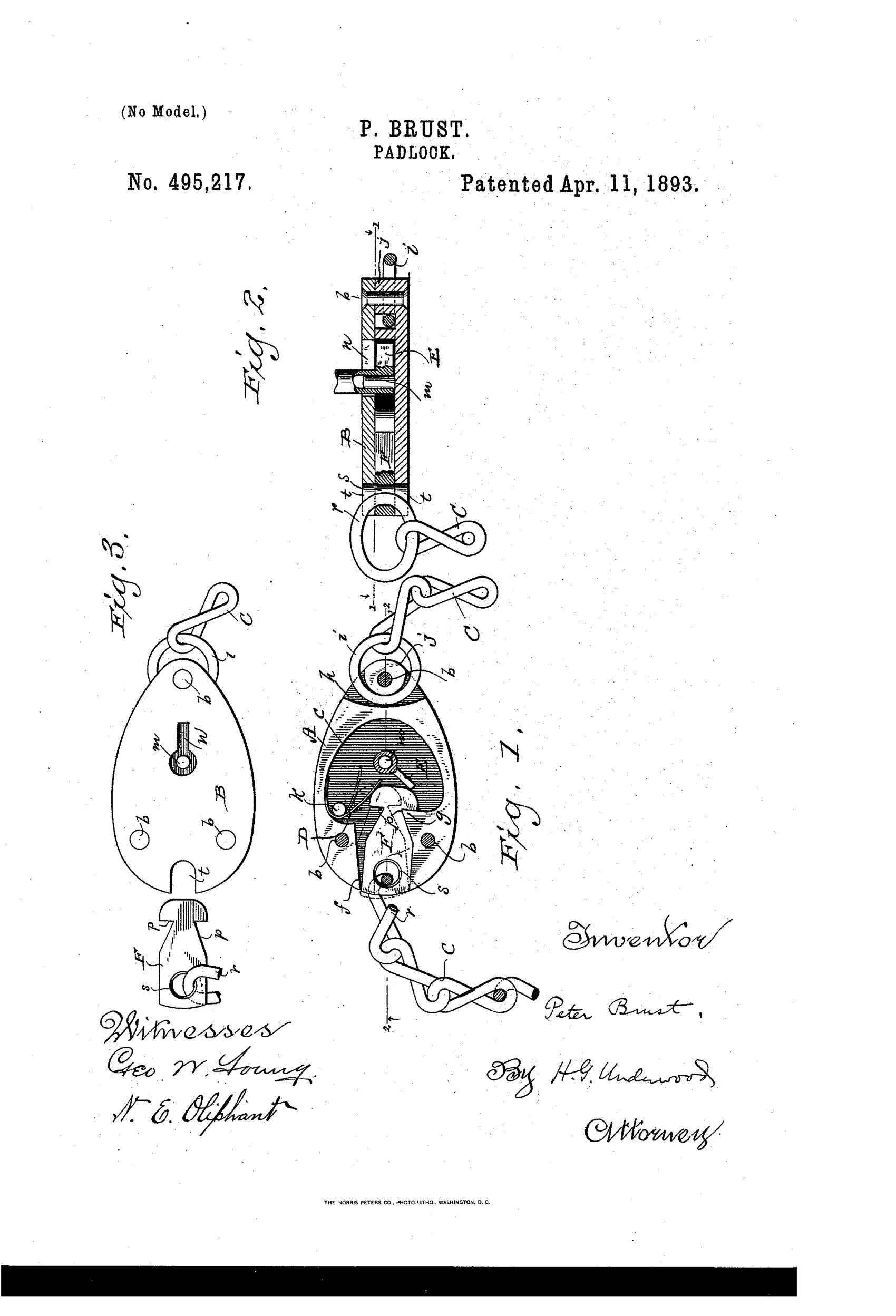
Detachable two-piece chain padlock for bicycles
⚿ How it works
The lock body has an entrance and recess forming a shoulder, with a spring held between a pin and the recess boundary so it normally blocks the entrance. A separate plug section, attached to the free end of a chain, is inserted into the entrance and forced past the spring until a notch in the plug engages the shoulder, locking the chain ends together. A right-angle detachable key turns a pin in the body to push the notched plug out of engagement against the spring's resistance, automatically ejecting it and releasing the chain. The device is designed to permanently join a chain's ends to a lock for securing bicycles.
⚿ What was claimed
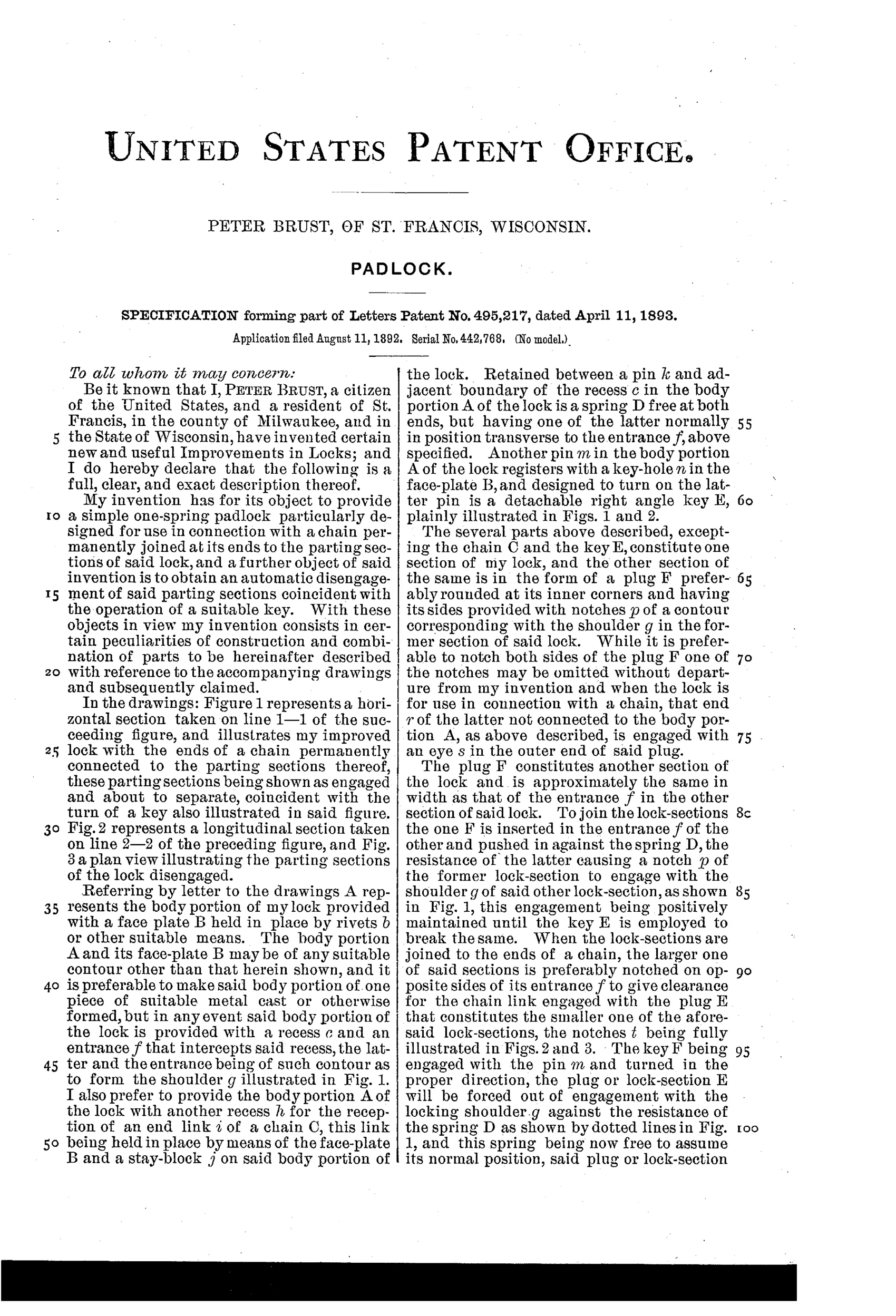
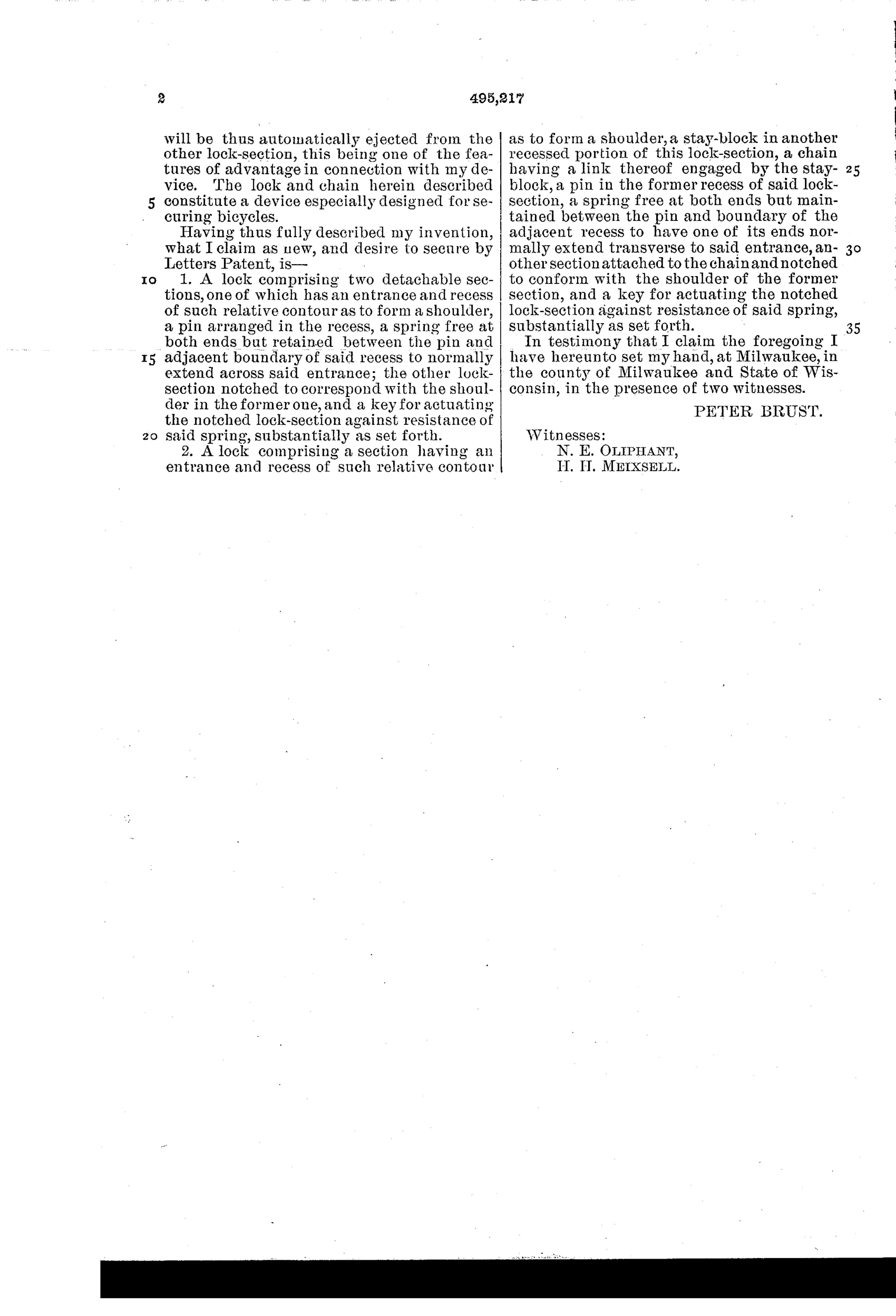
“A lock comprising two detachable sections, one of which has an entrance and recess of such relative contour as to form a shoulder, a pin arranged in the recess, a spring free at both ends but retained between the pin and adjacent boundary of said recess to normally extend across said entrance; the other lock-section notched to correspond with the shoulder in the former one, and a key for actuating the notched lock-section against resistance of said spring, substantially as set forth.”
In plain English: The lock has two separable parts that snap together via a spring-loaded shoulder-and-notch fit, and a special key pushes the notched part free against the spring to unlock it.
⚿ In the inventor’s words
“The lock and chain herein described constitute a device especially designed for securing bicycles.”— Peter Brust, from the specification
Fate unknown
No manufactured example or maker connection is documented for Brust's design; a surviving marked lock or period cycle-trade advertisement would settle it.
⚿ Commentary
Peter Brust of St. Francis, Wisconsin filed this in 1892, right at the crest of the first great bicycle boom, and his patent says the quiet part out loud: this is 'a device especially designed for securing bicycles.' That makes it a very early entry in what would eventually become its own hardware category, though in 1893 it was just a padlock patent like any other.
The mechanism is a plug lock rather than a shackle lock. One end of the chain terminates in a notched plug; the other end is fixed to an oval body containing a flat spring pinned across the entrance. Push the plug in, the spring snaps into the notch behind an internal shoulder, and the chain is closed. The right-angle key turns a pin that levers the plug back against the spring — and here is the nice touch a casual reader misses in Fig. 1: the spring doesn't just release the plug, it ejects it. The lock spits the chain end out at you, so there's no fumbling to separate the halves.
As security it is thin — a single spring and shoulder, no tumblers of any kind, defeated by anything that can reach the notch. But security wasn't really the point; convenience was. It's essentially the snap-shackle 'pancake' lock idea applied to a chain end, and it sits closer to the trick-lock family than to the Yale lineage. A clever dead end, but an honest one.
Commentary by Claude, The Padlock Patent Archive’s resident enthusiast