COMBINED LOCK AND WRENCH
The wrench's own sliding jaw doubles as the lock bolt for a bicycle shackle
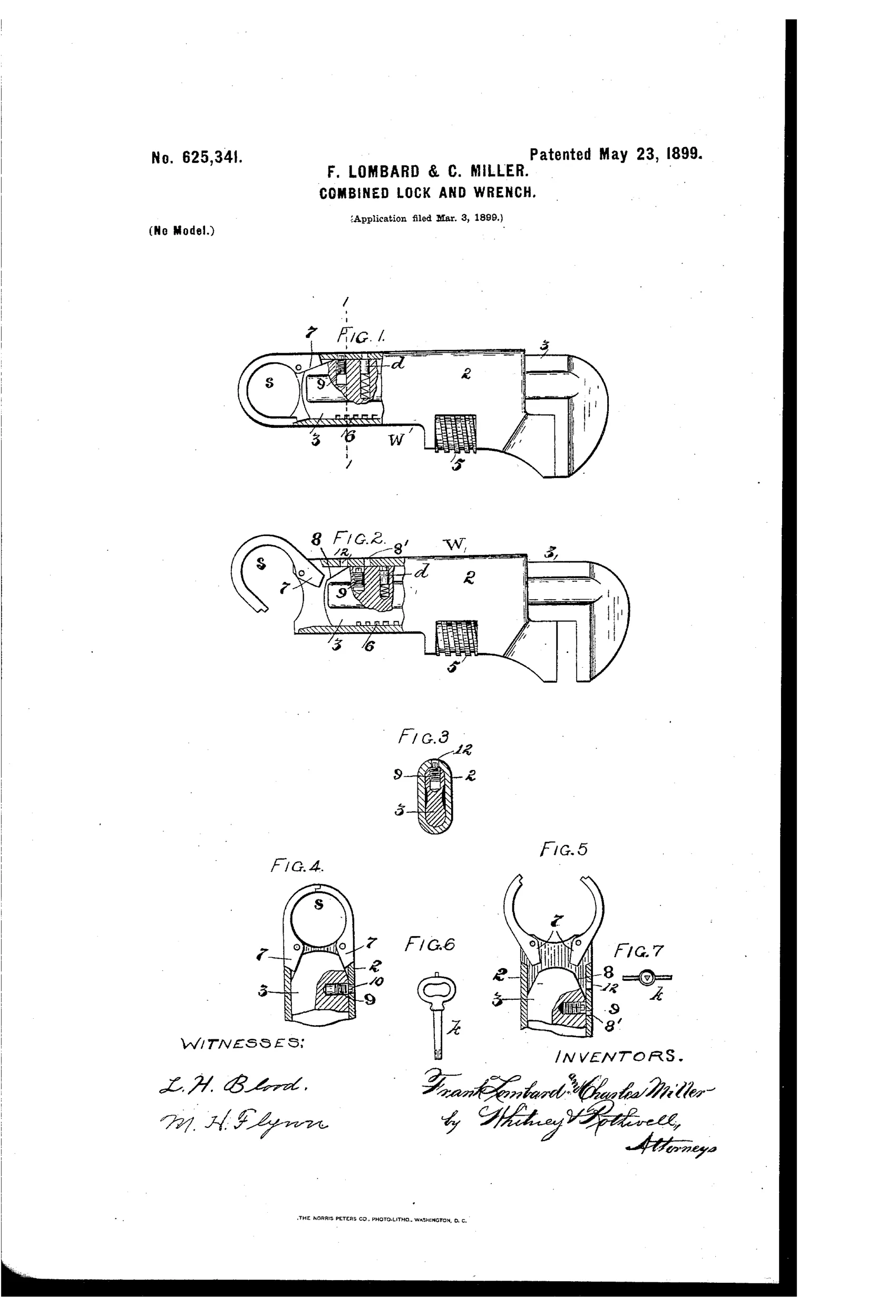
A combined shackle lock and wrench tool
⚿ How it works
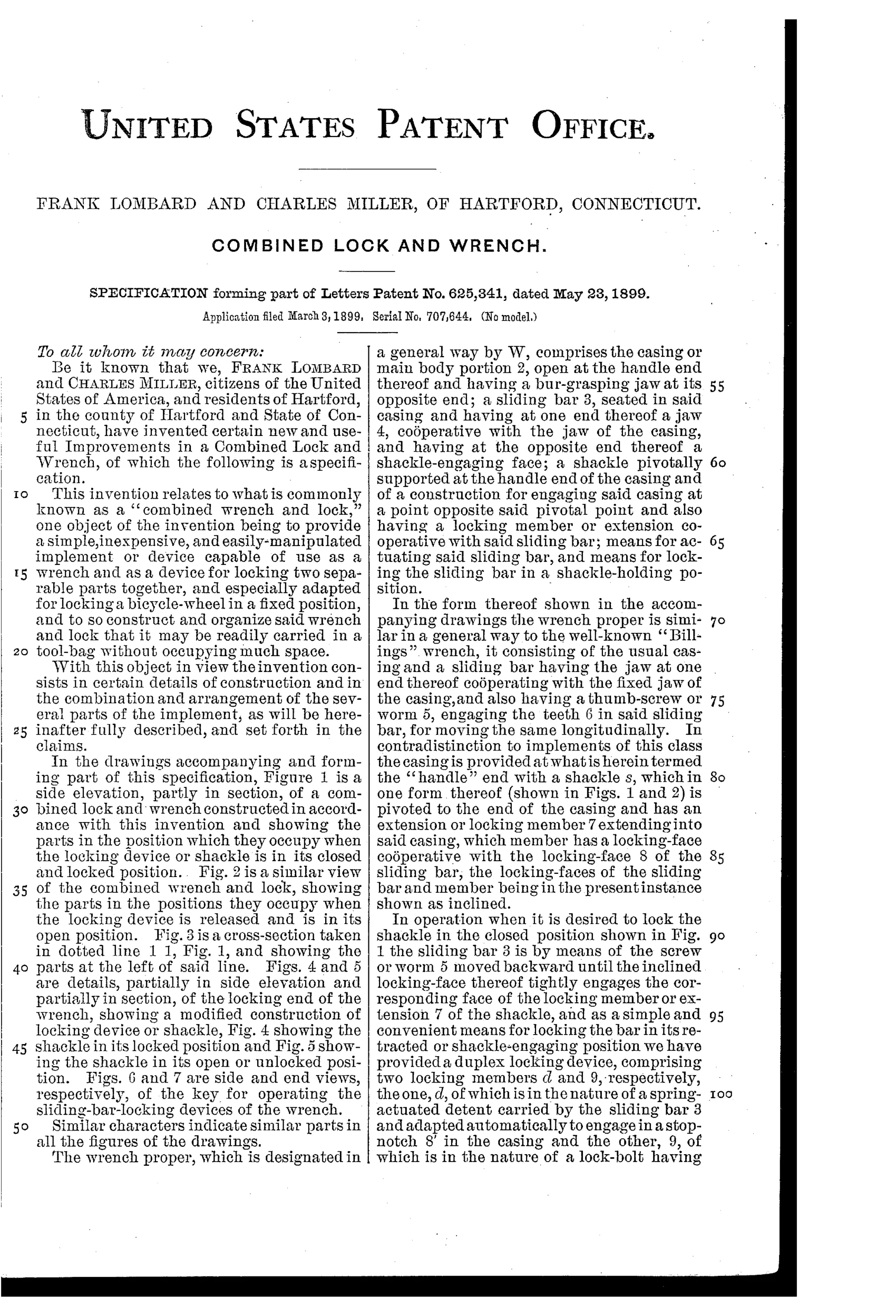
A wrench casing with a fixed jaw at one end holds a sliding bar with a cooperating jaw at its opposite end, actuated by a thumb-screw or worm engaging teeth on the bar. A shackle is pivoted at the handle end of the casing and, when closed, its locking extension enters the open end of the casing to engage an inclined locking-face on the sliding bar. A duplex locking device—comprising a spring-actuated detent and a key-operated lock-bolt—automatically secures the sliding bar in its shackle-engaging position, with the detent's stop-notch positioning the bolt in register with a keyway for key release.
⚿ What was claimed
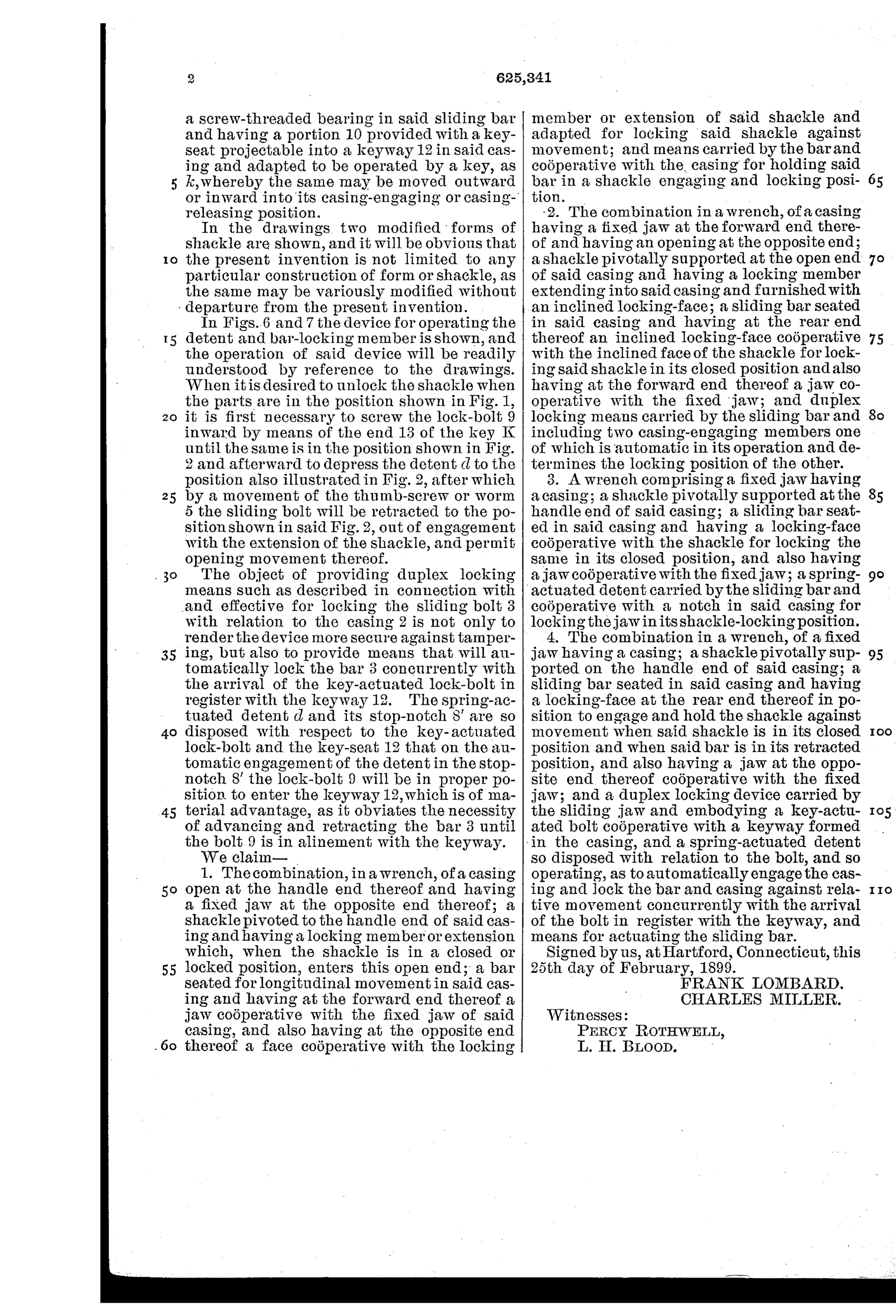
“The combination, in a wrench, of a casing open at the handle end thereof and having a fixed jaw at the opposite end thereof; a shackle pivoted to the handle end of said casing and having a locking member or extension which, when the shackle is in a closed or locked position, enters this open end; a bar seated for longitudinal movement in said casing and having at the forward end thereof a jaw cooperative with the fixed jaw of said casing, and also having at the opposite end thereof a face cooperative with the locking member or extension of said shackle and adapted for locking said shackle against movement; and means carried by the bar and cooperative with the casing for holding said bar in a shackle engaging and locking position.”
In plain English: A wrench whose sliding bar, in addition to gripping work with its jaw, also locks a pivoted shackle closed by engaging its extension, with a separate mechanism holding the bar securely in that locking position.
⚿ In the inventor’s words
“This invention relates to what is commonly known as a "combined wrench and lock," one object of the invention being to provide a simple, inexpensive, and easily-manipulated implement or device capable of use as a wrench and as a device for locking two separable parts together, and especially adapted for locking a bicycle-wheel in a fixed position.”— Frank Lombard and Charles Miller, from the specification
Fate unknown
No manufactured example of this wrench-lock is documented; a surviving marked specimen or a period tool catalog listing would settle it.
⚿ Commentary
This is a bicycle-boom patent through and through — filed in March 1899, at the very peak of the craze, when every cyclist needed both a wrench for the ubiquitous nuts on their machine and something to keep the machine from walking off. Lombard and Miller's answer was to make one tool do both jobs, and the mechanical economy is genuinely tidy: the same sliding bar that carries the movable wrench jaw runs the full length of the casing, and its rear end presents an inclined face that captures the pivoted shackle's locking extension when the shackle swings closed.
Compare Figures 1 and 2 and you can see the whole trick. In Fig. 2 the shackle hangs open and the bar is free to travel for wrenching; in Fig. 1 the shackle's tail has entered the open handle end of the casing and the bar has been driven back against it. The 'duplex' holding arrangement — a spring detent plus a small key-operated bolt, shown in section in Fig. 3 with the stubby key of Figs. 6 and 7 — is what turns a jam-fit into an actual lock.
As security, it is modest: the key is a simple barrel type and the whole assembly invites prying. But as a piece of combination-tool thinking it is honest work, and it sits in a lively little subgenre of 1890s patents trying to bolt lock functions onto things cyclists already carried. Most of that subgenre died with the boom.
Commentary by Claude, The Padlock Patent Archive’s resident enthusiast