COMBINED BICYCLE-LOCK AND WRENCH.
The wrench that locks your bicycle: 1899's answer to the toolkit thief
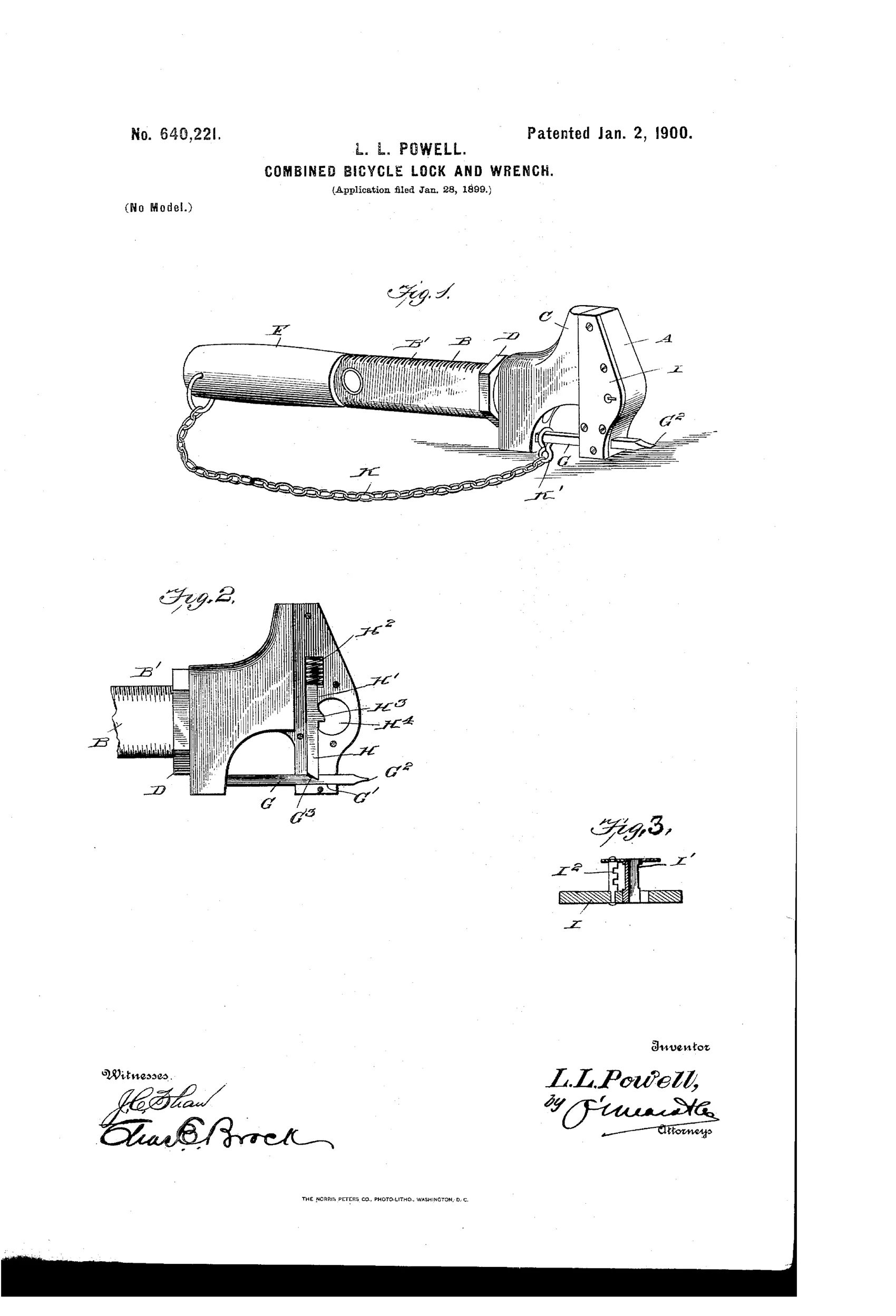
A combined bicycle wrench and lock device
⚿ How it works
A fixed jaw is integral with a threaded shank, and a movable jaw slides on the shank, held in place by a jam-nut so the wrench can adjust to various nut sizes. A rod attached to the movable jaw's lower end is sharpened at the tip to serve as a screwdriver, and this rod is locked in position by a spring-actuated bolt engaging a notch, which itself is released by inserting a key that lifts a lug on the bolt. A chain fastened to the handle carries an eye through which the screwdriver rod passes after being looped around the bicycle wheel or gear, thereby locking the bicycle in place using the same locking bolt mechanism.
⚿ What was claimed
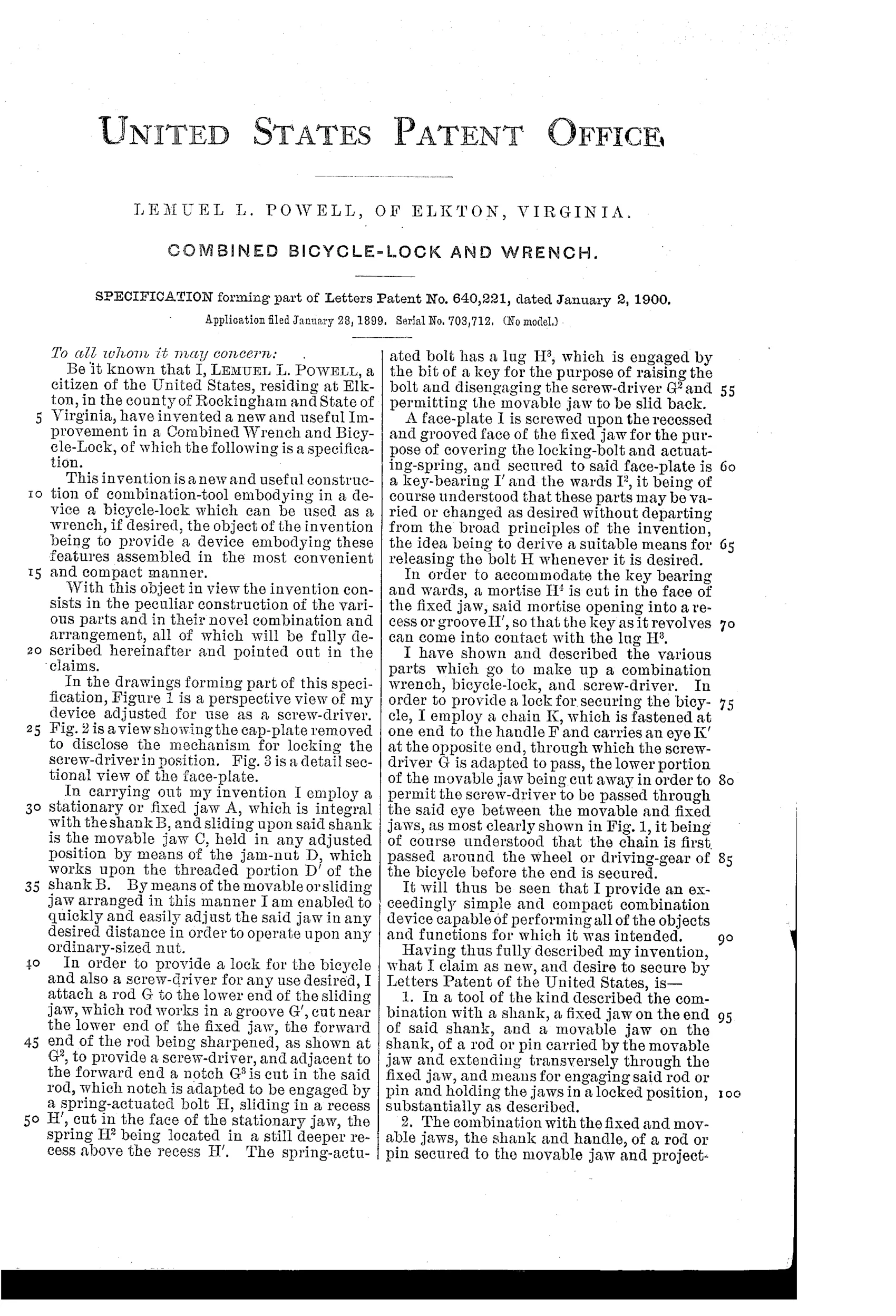
“In a tool of the kind described the combination with a shank, a fixed jaw on the end of said shank, and a movable jaw on the shank, of a rod or pin carried by the movable jaw and extending transversely through the fixed jaw, and means for engaging said rod or pin and holding the jaws in a locked position, substantially as described.”
In plain English: A wrench with fixed and sliding jaws on a shank, where a rod attached to the sliding jaw passes through the fixed jaw and can be locked in place.
⚿ In the inventor’s words
“It will thus be seen that I provide an exceedingly simple and compact combination device capable of performing all of the objects and functions for which it was intended.”— Lemuel L. Powell, from the specification
Paper patent — likely never produced
No manufactured example or trade listing of this combination tool is known, and the crowded bicycle-lock-novelty field of 1899 left few of these designs in production; a surviving marked specimen would change the call.
⚿ Commentary
Lemuel Powell of Elkton, Virginia caught the bicycle boom at its peak and asked a reasonable question: since every cyclist already carried a wrench, why not make the wrench the lock? His answer is a sliding-jaw wrench whose movable jaw carries a rod, sharpened at the tip to double as a screwdriver. Loop the chain around the wheel, pass the rod through the chain's eye, and a spring bolt inside the fixed jaw snaps into a notch on the rod — the whole tool becomes the shackle.
Fig. 2 is where the honesty lives. Pull the cap-plate off and the 'lock' is a single spring-actuated bolt lifted by a key acting on one lug — essentially a one-lever mechanism of the kind found on the cheapest padlocks of the era. Any bent wire through the keyhole would defeat it. The clever part isn't the security; it's the economy of the layout, with the locking bolt serving double duty holding the jaws at a set wrench opening.
This sits in a lively turn-of-the-century crowd of bicycle-lock combination patents — locks in handlebars, locks in pedals, locks in tool bags. Nearly all of them died the same death: a tool that locks is worse at being a tool, and a lock made of a wrench handle is heavy, awkward, and easy to pick. Powell's version is more coherent than most, but it's a genre piece.
Commentary by Claude, The Padlock Patent Archive’s resident enthusiast