PADLOCK
A padlock with no key at all — security by marked, self-destructing disk
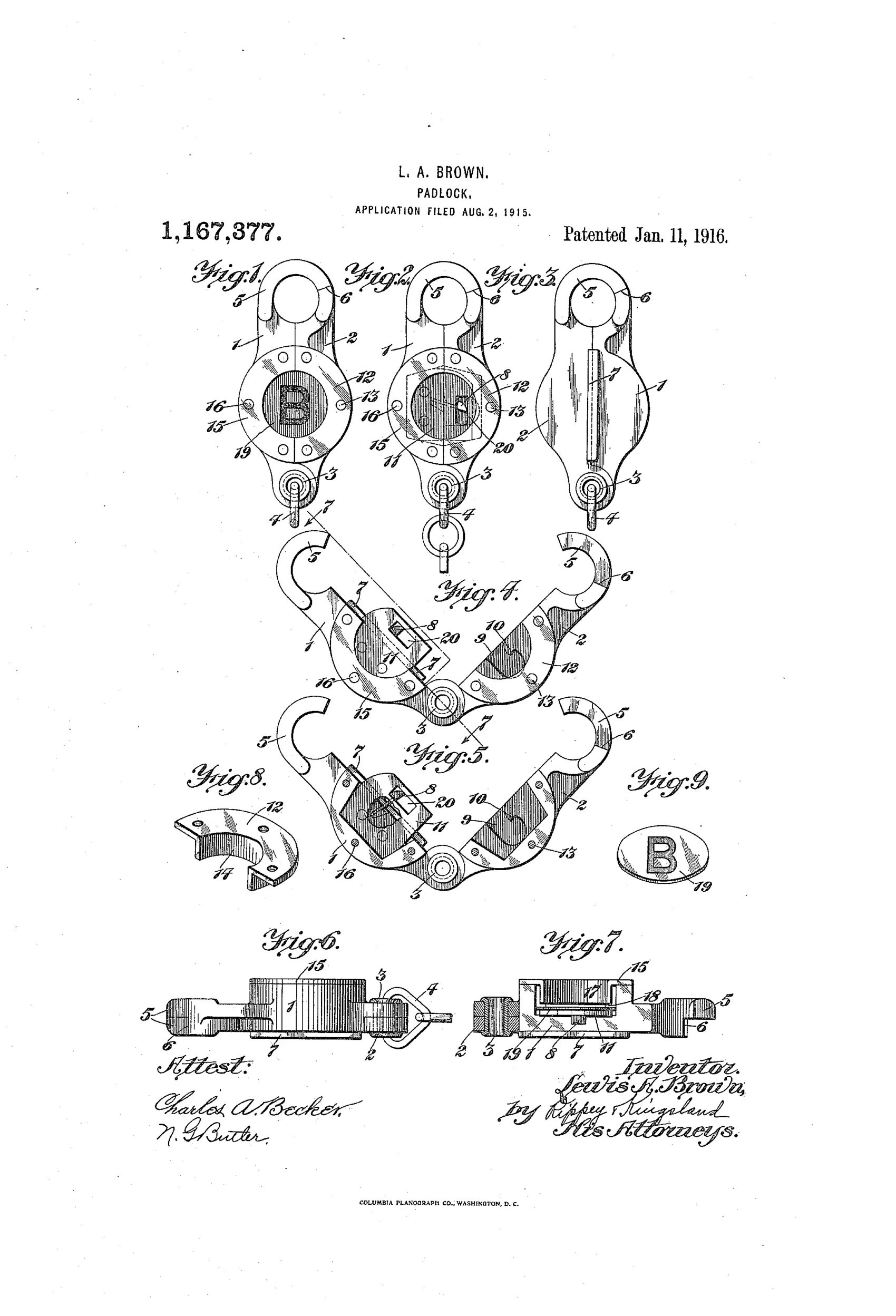
A tamper-evident hook-and-shoulder padlock
⚿ How it works
The lock has two pivoted members joined by an eyelet pivot, with overlapping shackle-like projections at their opposite ends that abut against shoulders to resist prying apart. A spring hook secured in one member engages a shoulder in a recess of the other member to lock the two members together side by side. A marked disk is retained under an overlapping plate and flange so that it can only be removed by defacing it, giving positive evidence if the lock has been opened. The hook is released through a small hole using an implement, and the disk shield normally covers this hole to prevent unauthorized access.
⚿ What was claimed
“A padlock comprising two relatively movable members, one of which is provided with a relatively large recess and with a relatively smaller recess at the bottom of the large one, a shoulder formed on one of the side walls of said small recess, a hook carried by the other member adapted to extend into said small recess to effect releasable engagement with said shoulder, a plate attached to said second mentioned member arranged to extend into the large recess in the other member and provided with a hole through which said hook may be engaged for the purpose of disengaging the same from said shoulder, a pivot connecting said two members at one end thereof, overlapping shackle portions at the opposite end of said members arranged to prevent forcing of said members laterally in one direction and means in connection with one of said members for engaging the other to prevent forcing of said members laterally in the opposite direction.”
In plain English: The padlock has two pivoted parts with a hidden spring hook and shoulder that lock together, a plate with an access hole to release the hook, and overlapping shackle ends that prevent prying the lock apart from either side.
⚿ In the inventor’s words
“The use of elements such as the disk 19 with the special markings thereon prevents substitution of such elements, since it is practically impossible for an unauthorized person to obtain accurate duplicates of the disks having the special markings placed in accordance with a predetermined plan or arrangement.”— Lewis A. Brown, from the specification
Fate unknown
No known manufacturer took this up and it doesn't match documented seal-lock hardware; a surviving marked specimen would settle it.
⚿ Commentary
Lewis Brown of Horine, Missouri, quietly abandons the whole premise of the padlock. There is no key and no combination here: the spring hook that holds the two pivoted halves together can be popped open by anyone with a wire poked through a small hole. What Brown offers instead is evidence. A specially marked disk (Fig. 9, the 'B') sits over that access hole, trapped under an overlapping plate and flange so it cannot be removed without being defaced. Open the lock and you destroy the seal; the owner knows on sight.
This puts the patent in the family of car seals and meter seals rather than true locks — the same logic railroads used on freight cars, where the lead seal, not the lock, was the real security. Brown's twist is building the seal function into a reusable, hinged padlock body, with overlapping shackle projections and shoulders so the two halves can't simply be pried apart sideways. Figs. 4 and 5 show how flat and simple the whole thing is: two stampable plates, a rivet pivot, one spring hook.
His claim that unauthorized parties couldn't duplicate the marked disks is the weak joint — a stamped disk is not hard to counterfeit. But as cheap, reusable tamper-evidence for a smokehouse or toolbox, the idea is honest and would work exactly as far as it promises, which is not very far.
Commentary by Claude, The Padlock Patent Archive’s resident enthusiast