LOCK
Two swiveling hasps, a keyhole hidden behind a spring-loaded trick cover
Padlock-style hasp lock with hinged cover
⚿ How it works
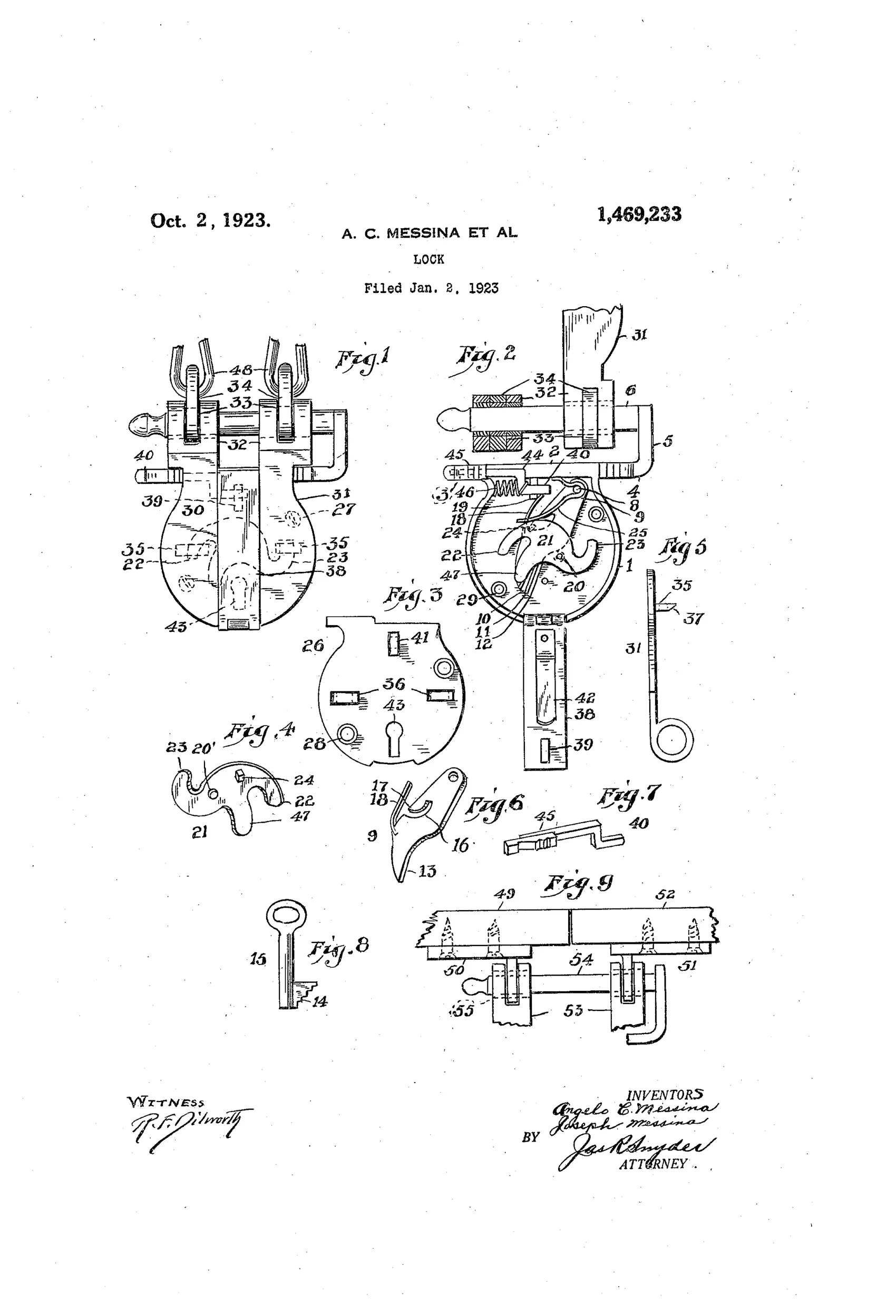
A circular casing carries an integral bar and fixed shackle, with hasp members slidably and hingedly mounted on the shackle via sleeves. A pivoted locking bolt, controlled by a spring, extends through resilient staples on the hasps to lock them to the casing. Superposed flat-metal tumblers with curved recesses and varying-width operating lips engage a pin on the locking bolt; a key with matching wards shifts the tumblers to align the recesses, freeing the bolt to unlock. A hinged cover plate conceals the keyhole and is secured by a disguised spring-loaded latching member operable only by those familiar with its hidden construction.
⚿ What was claimed
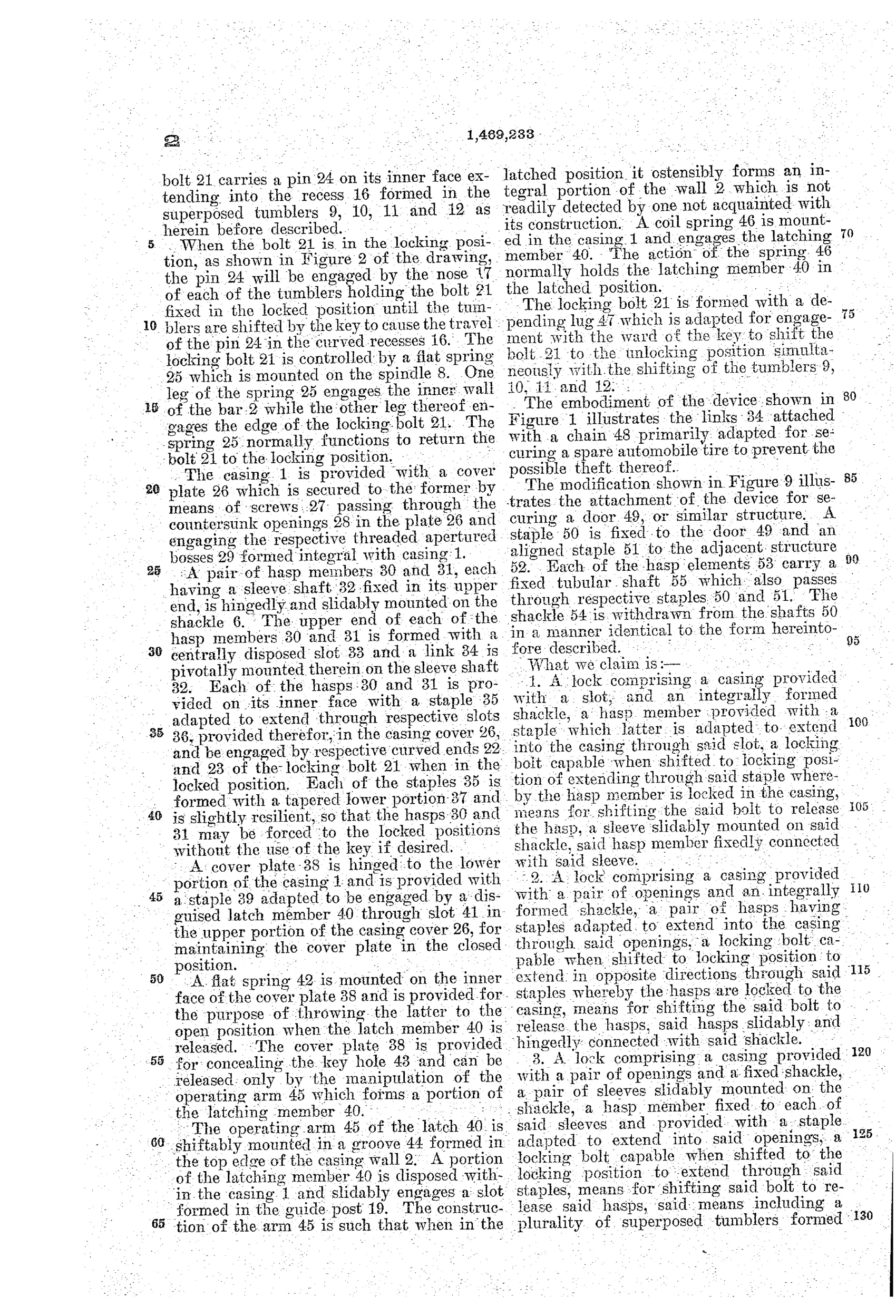
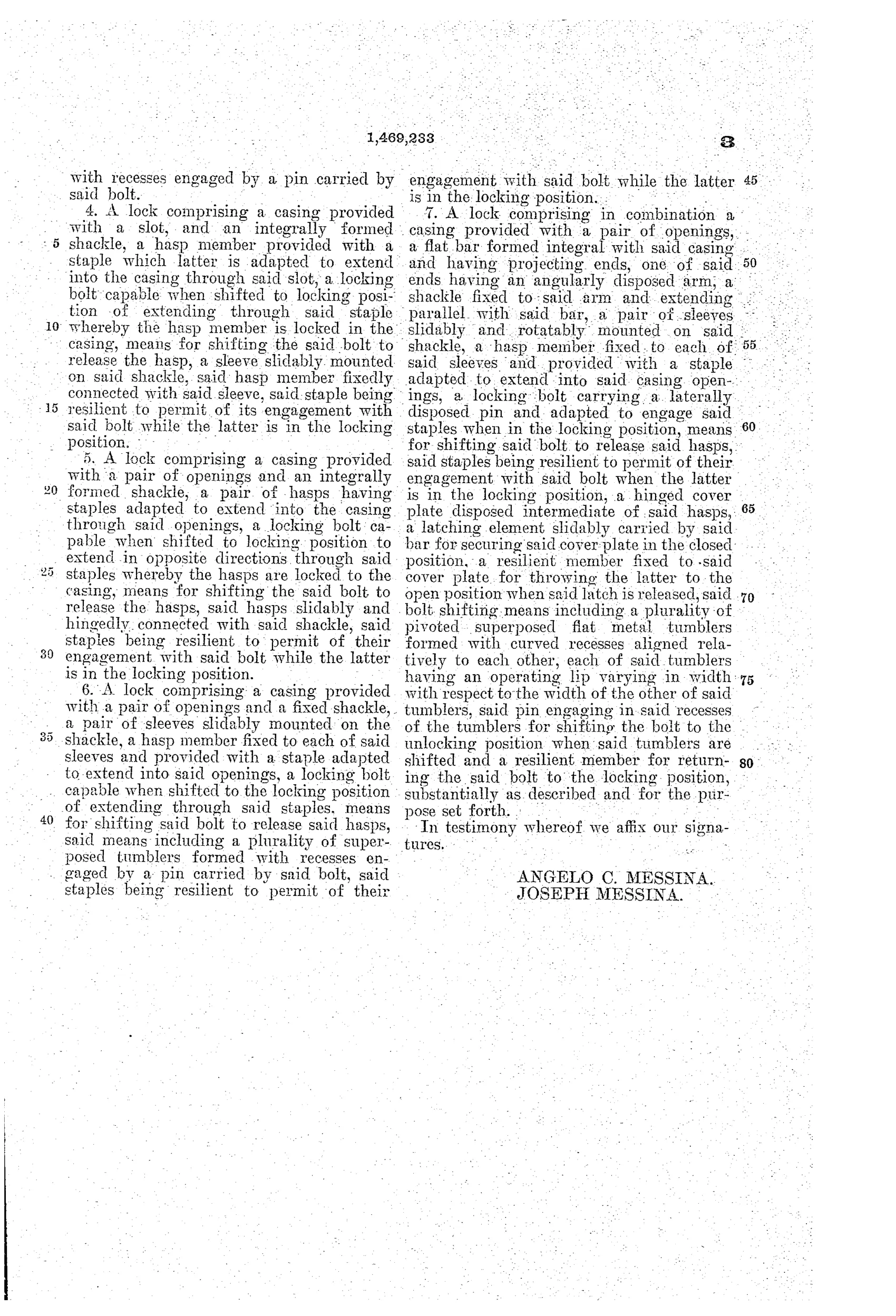
“7. A lock comprising in combination a casing provided with a pair of openings, a flat bar formed integral with said casing and having projecting ends, one of said ends having an angularly disposed arm, a shackle fixed to said arm and extending parallel with said bar, a pair of sleeves slidably and rotatably mounted on said shackle, a hasp member fixed to each of said sleeves and provided with a staple adapted to extend into said casing openings, a locking bolt carrying a laterally disposed pin and adapted to engage said staples when in the locking position, means for shifting said bolt to release said hasps, said staples being resilient to permit of their engagement with said bolt when the latter is in the locking position, a hinged cover plate disposed intermediate of said hasps, a latching element slidably carried by said bar for securing said cover plate in the closed position, a resilient member fixed to said cover plate for throwing the latter to the open position when said latch is released, said bolt shifting means including a plurality of pivoted superposed flat metal tumblers formed with curved recesses aligned relatively to each other, each of said tumblers having an operating lip varying in width with respect to the width of the other of said tumblers, said pin engaging in said recesses of the tumblers for shifting the bolt to the unlocking position when said tumblers are shifted and a resilient member for returning the said bolt to the locking position, substantially as described and for the purpose set forth.”
In plain English: The lock has a casing with a fixed shackle and two hasps that swivel and slide on it, each locked by a spring-loaded bolt engaging resilient staples; the bolt is controlled by stacked tumblers with differently sized lips that a matching key must align to release it, and a hidden spring-loaded latch secures a hinged cover plate over the keyhole.
⚿ In the inventor’s words
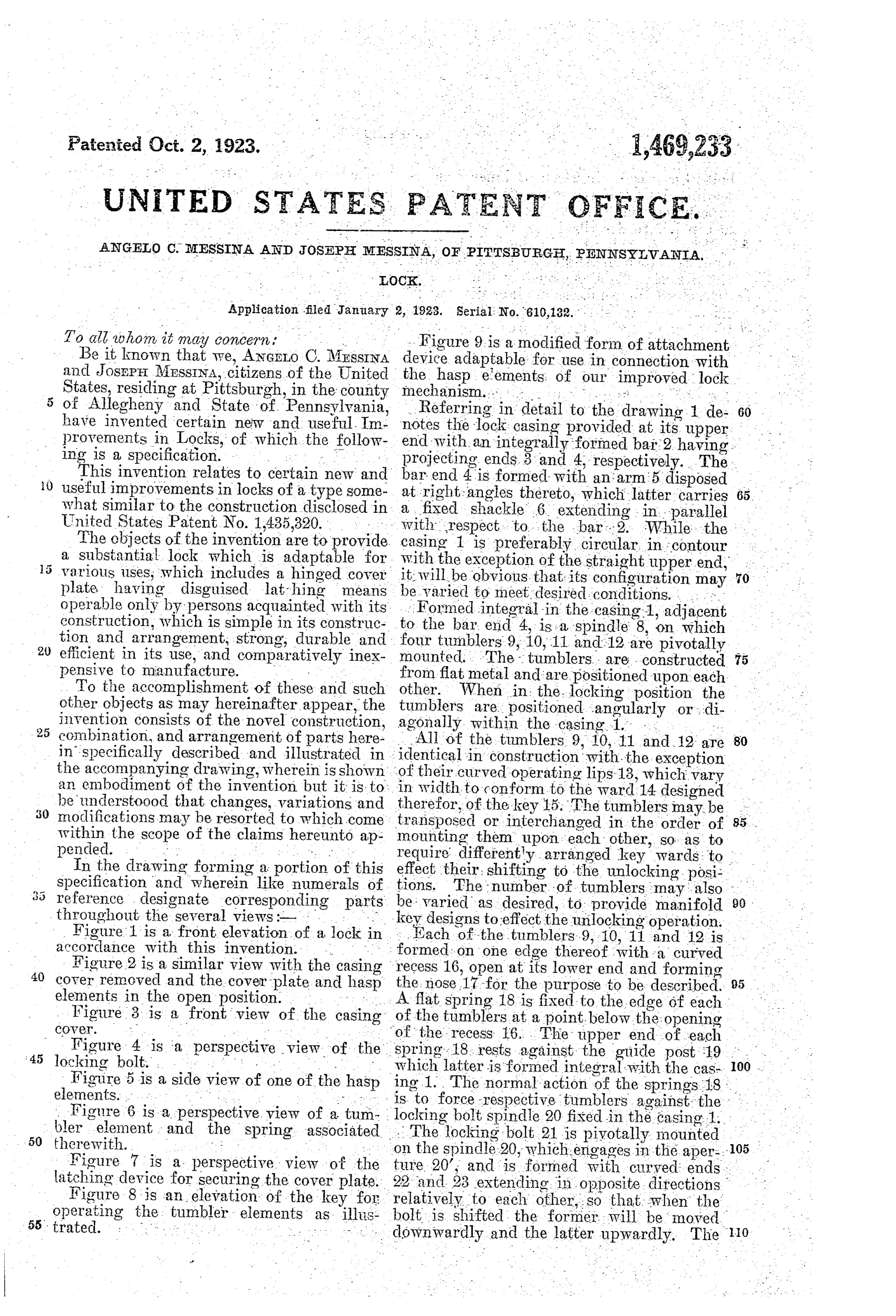
“A cover plate 26 is secured to the former by means of screws 27 passing through the countersunk openings 28 in the plate 26 and engaging the respective threaded apertured bosses 29 formed integral with casing 1... The construction of the arm 45 is such that when in the latched position it ostensibly forms an integral portion of the wall 2 which is not readily detected by one not acquainted with its construction.”— Angelo C. Messina and Joseph Messina, from the specification
Fate unknown
The complexity and obscure inventors suggest a paper patent, but no documentation either way; a surviving specimen with this twin-hasp layout would settle it.
⚿ Commentary
The Messina brothers of Pittsburgh crammed at least three lock-making traditions into one round case. The core is old technology: stacked flat tumblers with lips of graduated width, shifted by a warded key — a Scandinavian-pattern idea that was already sixty years behind the pin-tumbler curve by 1923. What's unusual is the architecture around it. Instead of one moving shackle, there's a fixed bar with two hasp members that slide and pivot on sleeves, each driving a resilient staple into the case, both caught by a single pivoted bolt. Fig. 2 shows the trick: the bolt's lateral pin rides in the curved recesses of the tumbler stack, so the key must line up every recess before the bolt can swing clear of both staples at once.
Then there's the keyhole cover — hinged, spring-thrown, and secured by a latch arm the patent says 'ostensibly forms an integral portion of the wall,' undetectable to anyone not in on the secret. That puts this squarely in trick-lock territory: security through a hidden step, layered over modest mechanical security.
As a piece of the padlock story it's a dead end, but an honest one. Two hasps on a common bolt is a genuinely uncommon layout, and Fig. 9's door-hasp variant shows they were thinking about real installation, not just novelty. Manufacturing all those sleeves, staples, and disguised latches for a warded-tumbler lock, though, was never going to compete with a fifty-cent Yale.
Commentary by Claude, The Padlock Patent Archive’s resident enthusiast