PADLOCK
An egg-shaped lock with no shackle to cut — attack resistance by geometry
Padlock with fully concealed staple housing
⚿ How it works
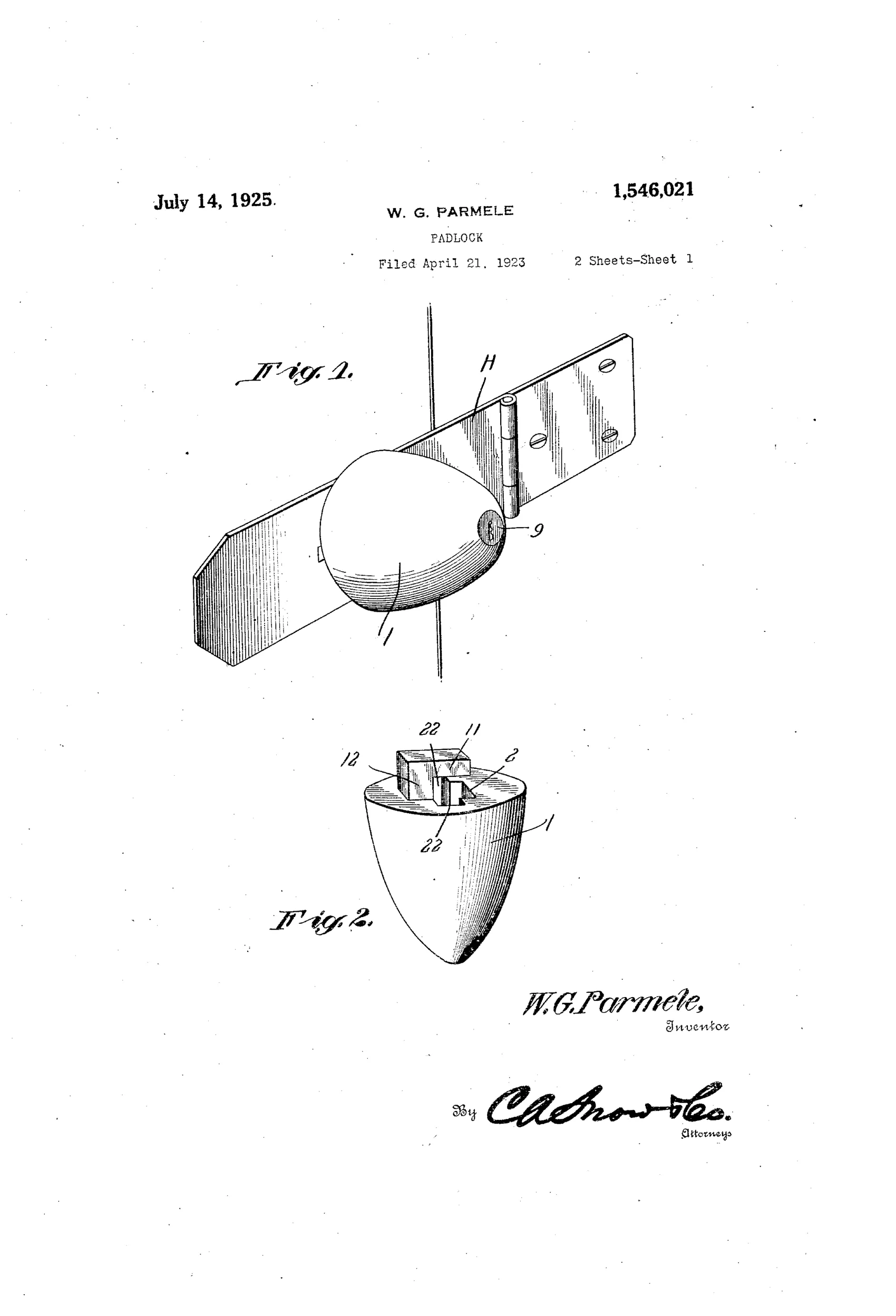
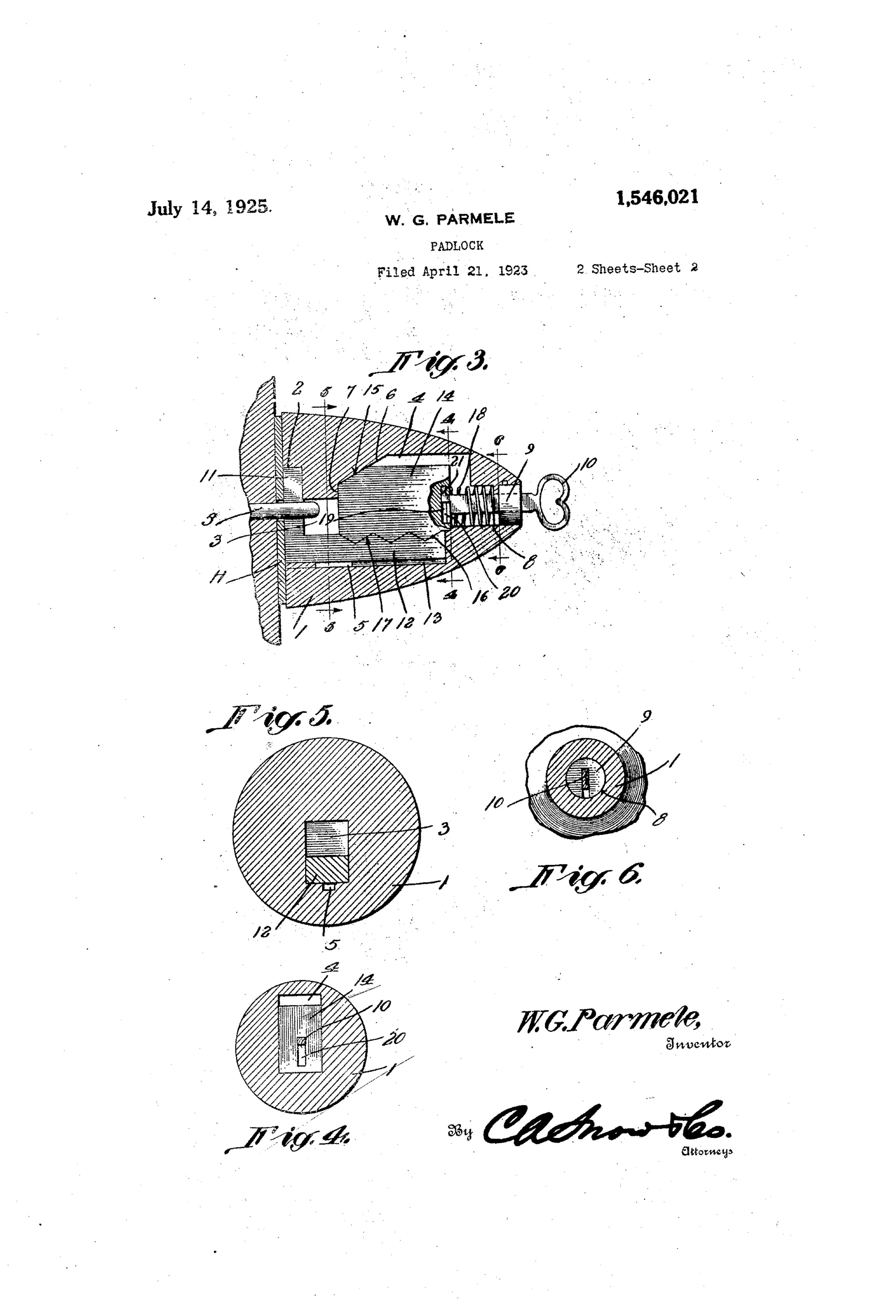
The rounded housing has a diametrical groove in its base that receives a staple, with a bolt normally seated in the groove to engage it. An arm extends from the bolt into an internal compartment where a spring-pressed tumbler with V-shaped teeth wedges against the arm to hold the bolt locked. A key inserted through an opening engages a slot and lug on the tumbler, allowing the user to pull the tumbler back, disengage the wedging teeth, and release the arm so the housing can be withdrawn from the staple. The housing's rounded, semiellipsoidal shape prevents it from being gripped or twisted to force it off the staple.
⚿ What was claimed
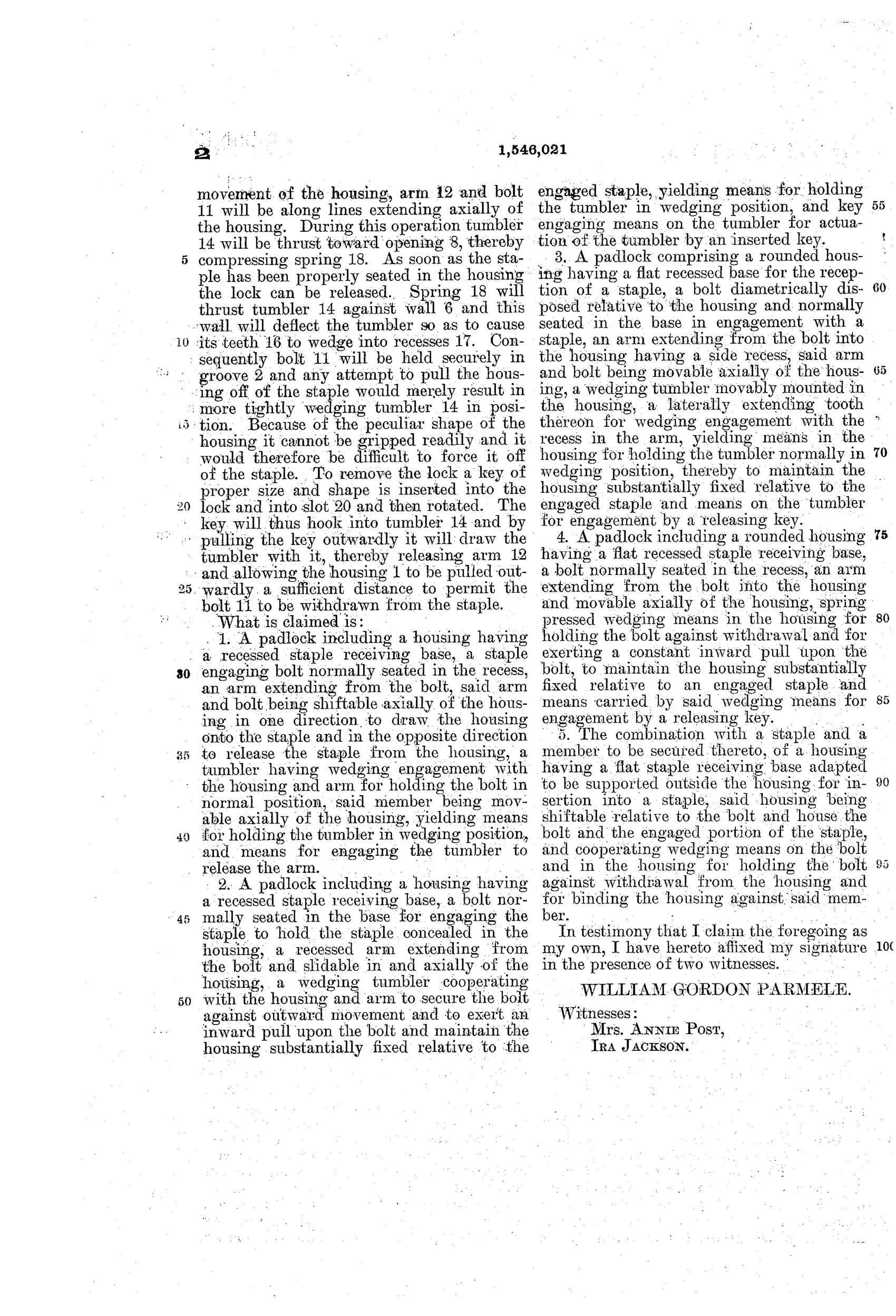
“A padlock comprising a rounded housing having a flat recessed base for the reception of a staple, a bolt diametrically disposed relative to the housing and normally seated in the base in engagement with a staple, an arm extending from the bolt into the housing having a side recess, said arm and bolt being movable axially of the housing, a wedging tumbler movably mounted in the housing, a laterally extending tooth thereon for wedging engagement with the recess in the arm, yielding means in the housing for holding the tumbler normally in wedging position, thereby to maintain the housing substantially fixed relative to the engaged staple and means on the tumbler for engagement by a releasing key.”
In plain English: The padlock has a rounded housing with a bolt that slides in a base groove to grip a staple, and a spring-loaded tumbler with a tooth that wedges into a notch on the bolt's arm to lock it in place until a key pulls the tumbler back to release it.
⚿ In the inventor’s words
“Because of the peculiar shape of the housing it cannot be gripped readily and it would therefore be difficult to force it off of the staple.”— William Gordon Parmele, from the specification
Paper patent — likely never produced
No manufacturer, assignee, or surviving specimen is known, and the single wedging tumbler would have been a hard sell; a marked example would change the call.
⚿ Commentary
Parmele's idea is disarmingly simple: eliminate the shackle entirely. The whole lock is a smooth, semiellipsoidal shell that swallows the staple through a groove in its flat base, leaving nothing exposed but a slick rounded dome and a small keyhole. Fig. 1 tells the story better than the claims do — the hasp passes behind the egg, and the only purchase a thief gets is a shape designed to shed every wrench, hammer, and pry bar. His own line says it plainly: the housing 'cannot be gripped readily.'
Inside, the mechanism is cruder than the exterior suggests. A bolt slides across the base groove to trap the staple, and its arm is held by a spring-pressed tumbler with V-shaped wedging teeth. The key doesn't rotate anything; it hooks the tumbler and pulls it back out of the wedge. That's a one-tumbler lock — the security lives almost entirely in the case, not the keying. A determined picker with a bent wire would find little to defeat once past the keyhole.
Still, the concept was sound and eventually vindicated: shackleless 'hockey puck' padlocks built on exactly this principle became standard for trucks and vending machines decades later. Parmele's 1923 filing is an early, honest stab at the idea, hobbled by a mechanism too simple to match the ambition of the shell.
Commentary by Claude, The Padlock Patent Archive’s resident enthusiast