Lock
Flip the case over and the lock becomes a plain door button
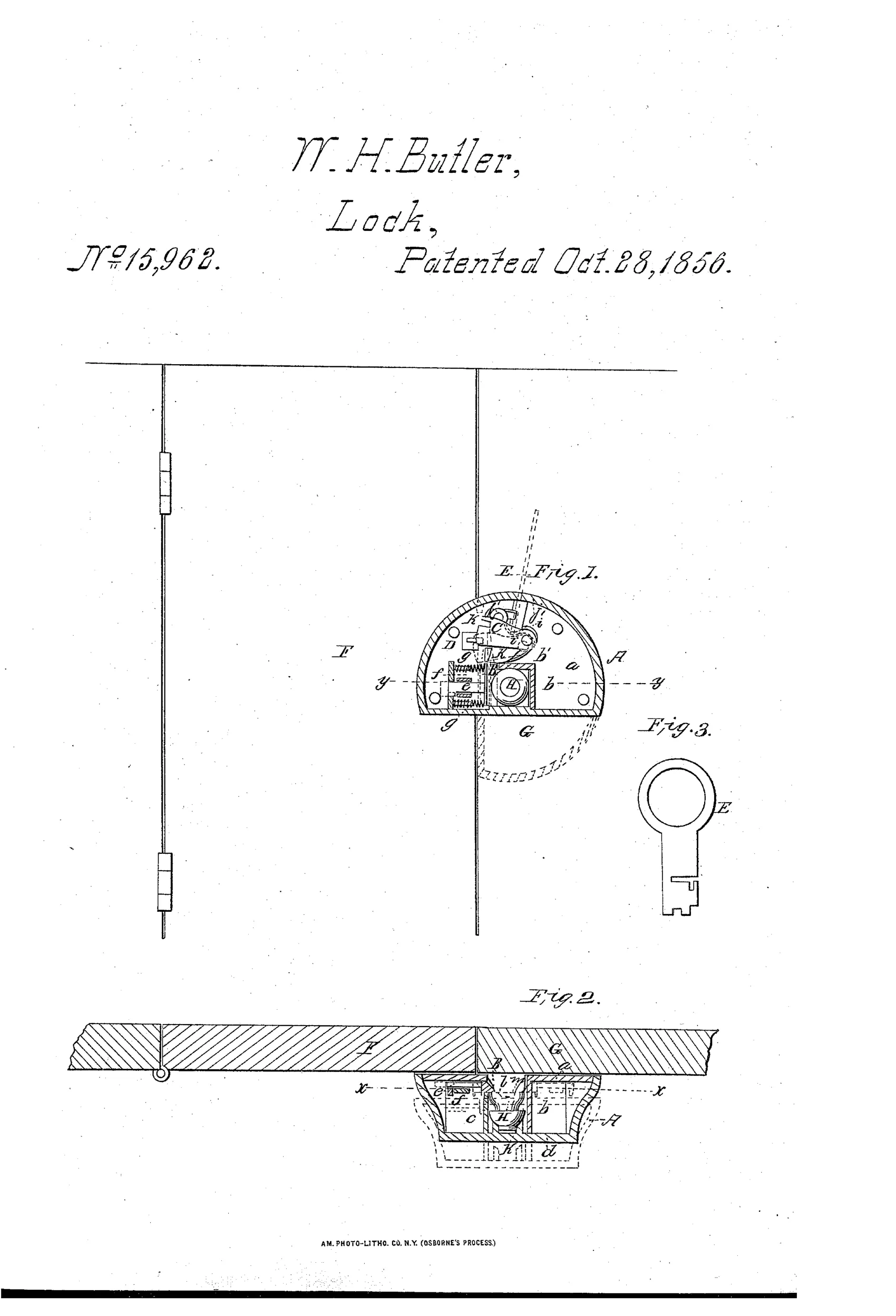
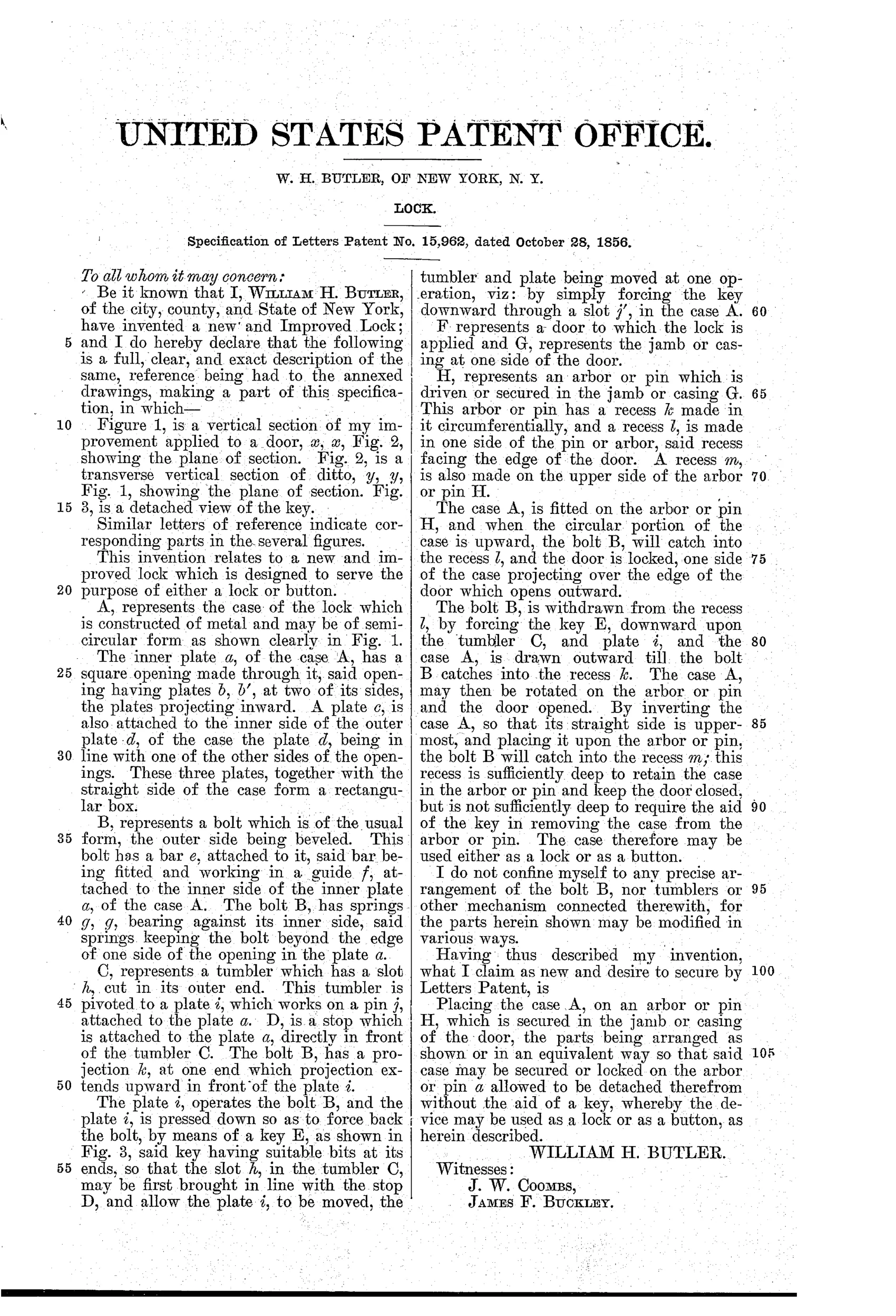
Combination door lock and button device
⚿ How it works
The lock case fits onto an arbor or pin fixed in the door jamb, with a bolt engaging recesses cut into the pin to secure the door. A key pressed downward through a slot forces a tumbler and plate to withdraw the bolt from its locking recess in one operation. When the case is inverted so its straight side faces upward, the bolt catches a shallower recess that holds the door shut without requiring a key, allowing the device to serve as a simple button. Springs bear against the bolt to keep it engaged beyond the edge of the case opening until deliberately released.
⚿ What was claimed
“Placing the case A, on an arbor or pin H, which is secured in the jamb or casing of the door, the parts being arranged as shown or in an equivalent way so that said case may be secured or locked on the arbor or pin H allowed to be detached therefrom without the aid of a key, whereby the device may be used as a lock or as a button, as herein described.”
In plain English: The lock case mounts on a jamb-mounted pin so it can be locked with a key or simply secured without one, letting it function as either a lock or a plain button.
⚿ In the inventor’s words
“I do not confine myself to any precise arrangement of the bolt B, nor tumblers or other mechanism connected therewith, for the parts herein shown may be modified in various ways.”— William H. Butler, from the specification
Paper patent — likely never produced
No production example of this jamb-pin convertible lock is known, and its niche was quickly filled by cheap standardized rim locks; a marked specimen would be a surprise.
⚿ Commentary
Butler's 1856 patent is not quite a padlock and not quite a door lock — it lives in the interesting middle ground of detachable hardware. The semicircular case slips over an arbor pin fixed in the door jamb, and a spring-loaded bolt catches recesses cut into that pin. Press the key down through the slot and tumbler, plate, and bolt all retract in one stroke. That downward push-key action, visible in Fig. 3's stubby bit key, anticipates the push-key lever padlocks that flooded the market decades later.
The genuinely clever bit is the dual-mode trick that forms the actual claim: invert the case so the flat side faces up, and the bolt engages a shallower recess that holds without locking. Same piece of hardware, now a keyless button for a pantry or shed door. Fig. 2 shows how the whole assembly hangs off the jamb rather than mortising into the door — cheap to install, easy to move.
Butler's disclaimer that he does not confine himself to any precise bolt arrangement is telling. The claim is really about the mounting-pin concept, not the tumbler work, which is rudimentary. As security it is modest — the recessed pin is the weak point, and prying the case off the arbor looks temptingly easy. It reads as an honest attempt at convertible convenience hardware in an era before standardized rim locks made such improvisations unnecessary.
Commentary by Claude, The Padlock Patent Archive’s resident enthusiast