IMPROVEMENT IN KEY-HOLE GUARDS
A Philadelphia maker patents only the dust cover, disclaiming the whole lock
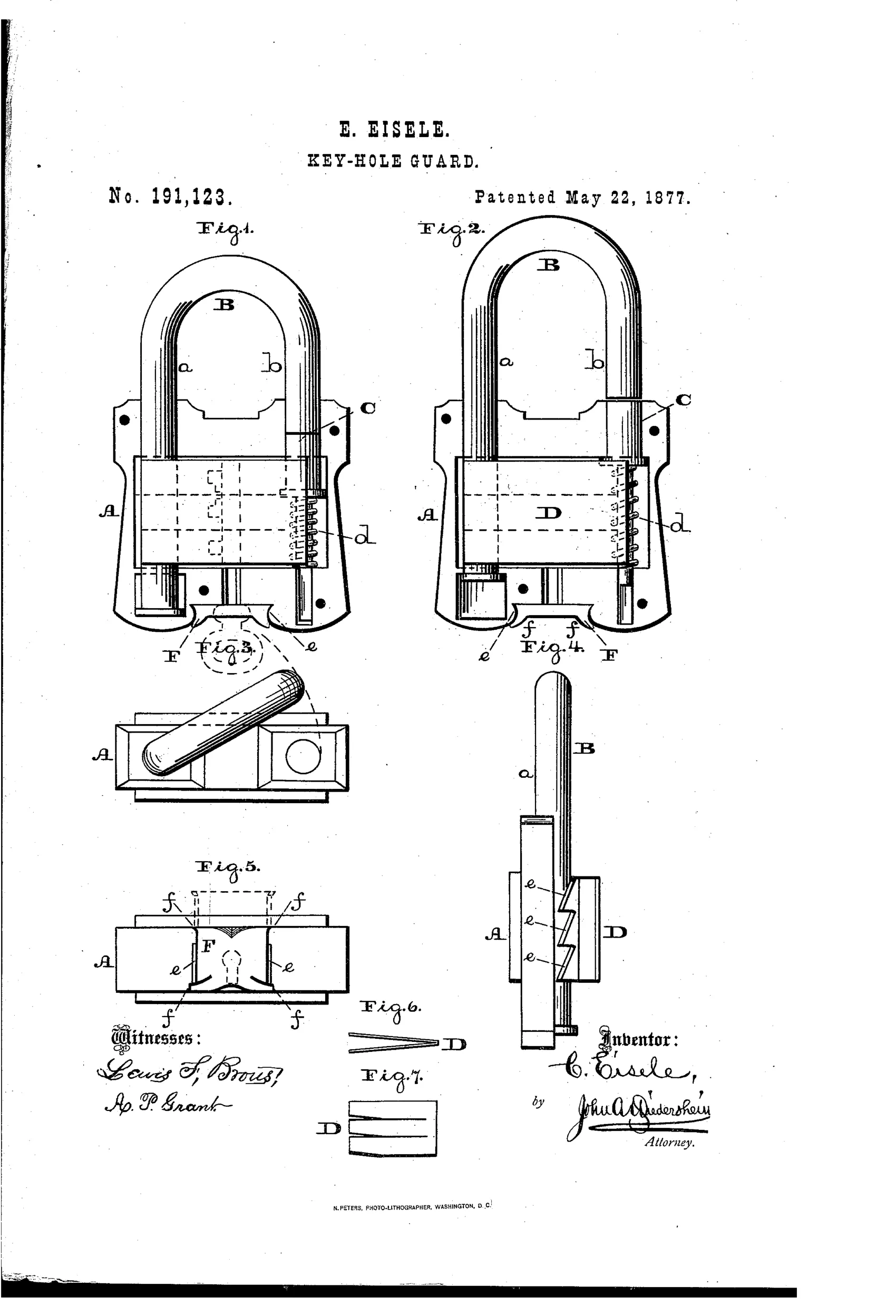
Padlock with dovetailed sliding key-hole guard
⚿ How it works
The padlock has a bow-shaped shackle B, one leg (a) fixed to the case A and the other leg (b) able to slide and rotate out of the case. A spring-loaded plug C presses against portion b, while a V-shaped spring bolt D with cut teeth engages notches on portion a to lock the shackle. Inserting and rotating a key against the bolt's teeth releases them from the notches, allowing spring d to push portion b out and rotate it free of the staple. A separate guard F, fitted in a dovetail groove on the bottom of the case, slides to cover or expose the key-hole and is held in place by lips f at its ends that catch on shoulders of the case, preventing lateral displacement.
⚿ What was claimed
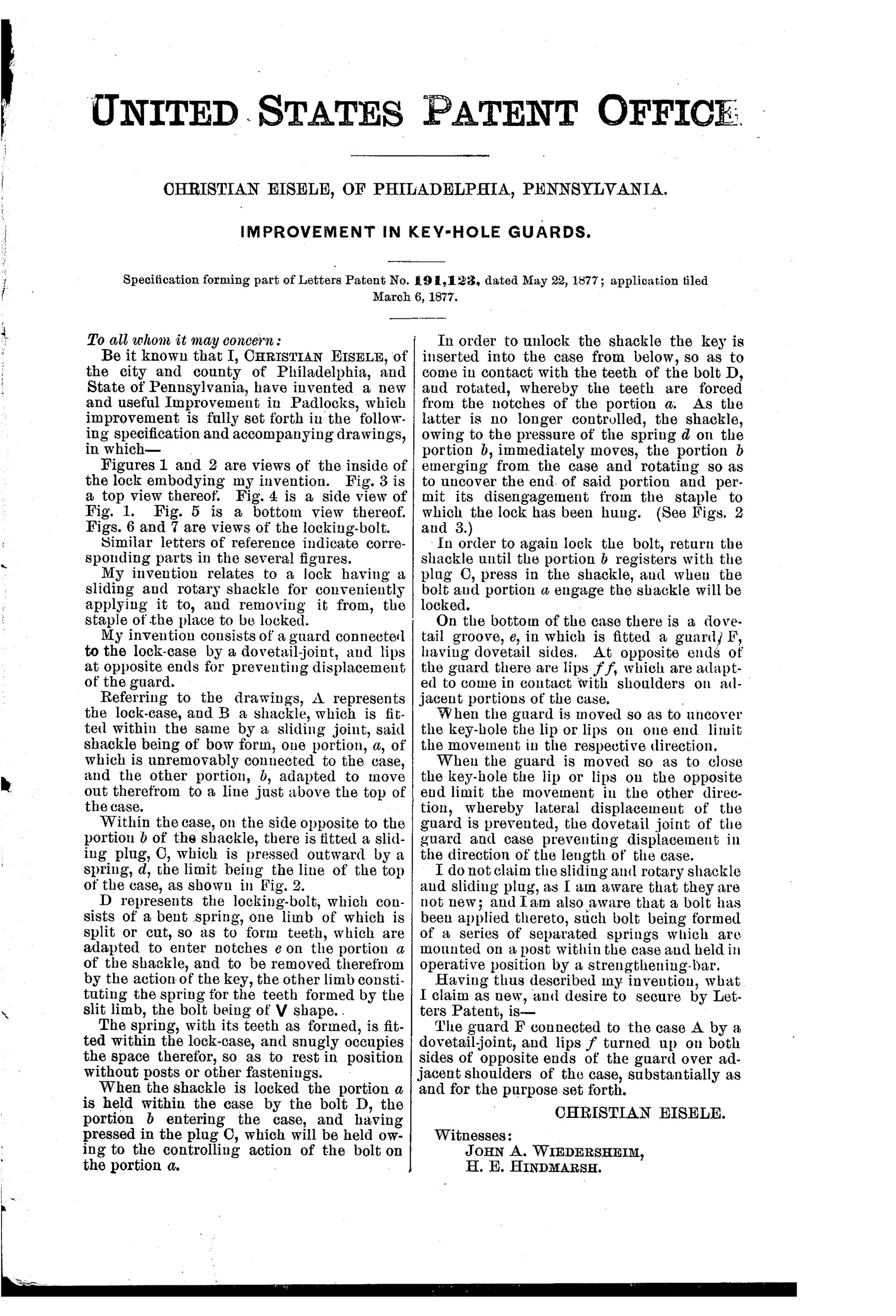
“The guard F connected to the case A by a dovetail-joint, and lips f turned up on both sides of opposite ends of the guard over adjacent shoulders of the case, substantially as and for the purpose set forth.”
In plain English: The claimed invention is a sliding key-hole cover held by a dovetail joint with turned-up lips at both ends that hook over shoulders on the lock case to keep it from sliding off sideways.
⚿ In the inventor’s words
“I do not claim the sliding and rotary shackle and sliding plug, as I am aware that they are not new; and I am also aware that a bolt has been applied thereto, such bolt being formed of a series of separated springs which are mounted on a post within the case and held in operative position by a strengthening-bar.”— Christian Eisele, from the specification
Fate unknown
Eisele was a working Philadelphia lock name and Scandinavian-pattern locks of this type were common, but a surviving specimen showing this dovetailed guard would be needed to confirm this specific design reached production.
⚿ Commentary
Read the claim and you find something refreshing: Eisele explicitly disclaims the sliding-and-rotating shackle, the spring plug, even the toothed spring bolt — he knows they're old news, and he says so. What's left is a single, modest invention: a keyhole shutter that slides in a dovetail groove on the bottom of the case, with little lips turned up at each end to hook over shoulders and keep it from wandering sideways. This is a patent for a dust cover, and an honest one.
The lock itself, shown in Figs. 1 and 2, is worth a look anyway. It's the Scandinavian-pattern idea in miniature: one shackle leg fixed, the other free to slide out and swing clear, held by a V-shaped bolt whose cut teeth (Figs. 6 and 7) engage notches on the fixed leg. The key doesn't throw a bolt; it compresses those spring leaves out of their notches, and the coil spring d ejects the free leg. Self-relocking, few parts, cheap to make — exactly why this pattern hung on so long against fancier mechanisms.
The guard matters more than it looks. These locks lived outdoors on barns, gates, and boxcars, and a fouled keyway killed them faster than any picker. A shutter that can't be knocked off — because the dovetail carries it and the lips retain it — is the kind of small refinement that separates hardware that survives weather from hardware that doesn't.
Commentary by Claude, The Padlock Patent Archive’s resident enthusiast