IMPROVEMENT IN PADLOCKS
A key with its own moving part: Dodge's pivoted pawl unlocks a ring-bolt
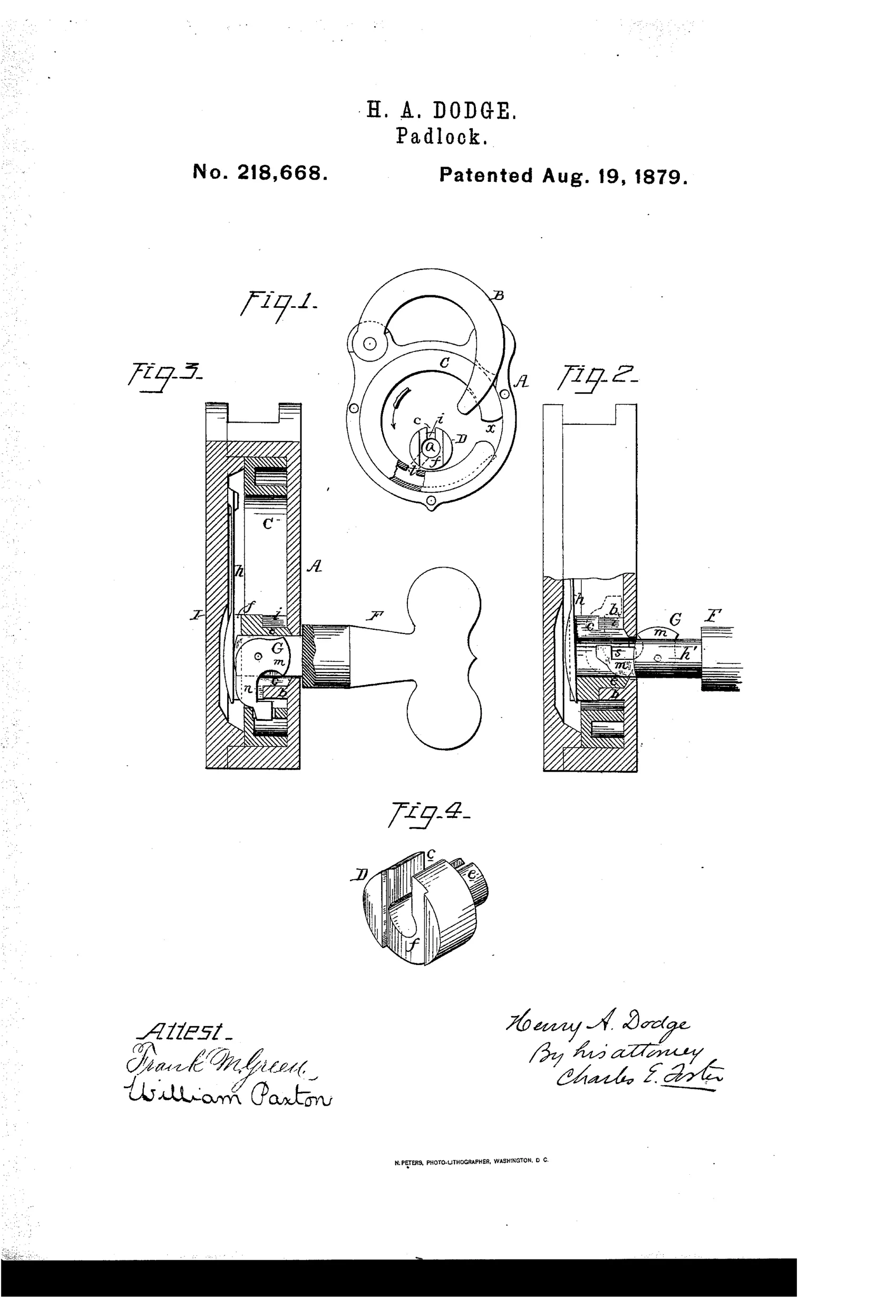
A key-operated padlock with pivoted hasp bolt
⚿ How it works
The lock case contains a ring-bolt broken at one point that engages a notch in the hasp end to secure it. A cylinder with a longitudinal slot and rear recess sits in a notched collar inside the case, held in position by a spring. The key has a cylindrical end fitted to the keyhole and a pivoted L-shaped pawl with two arms; inserting and turning the key drives the pawl into a recess in the bolt, rotating the bolt to align its break with the hasp end so it can swing open, while further insertion forces the pawl against a spring to prevent premature withdrawal of the key.
⚿ What was claimed
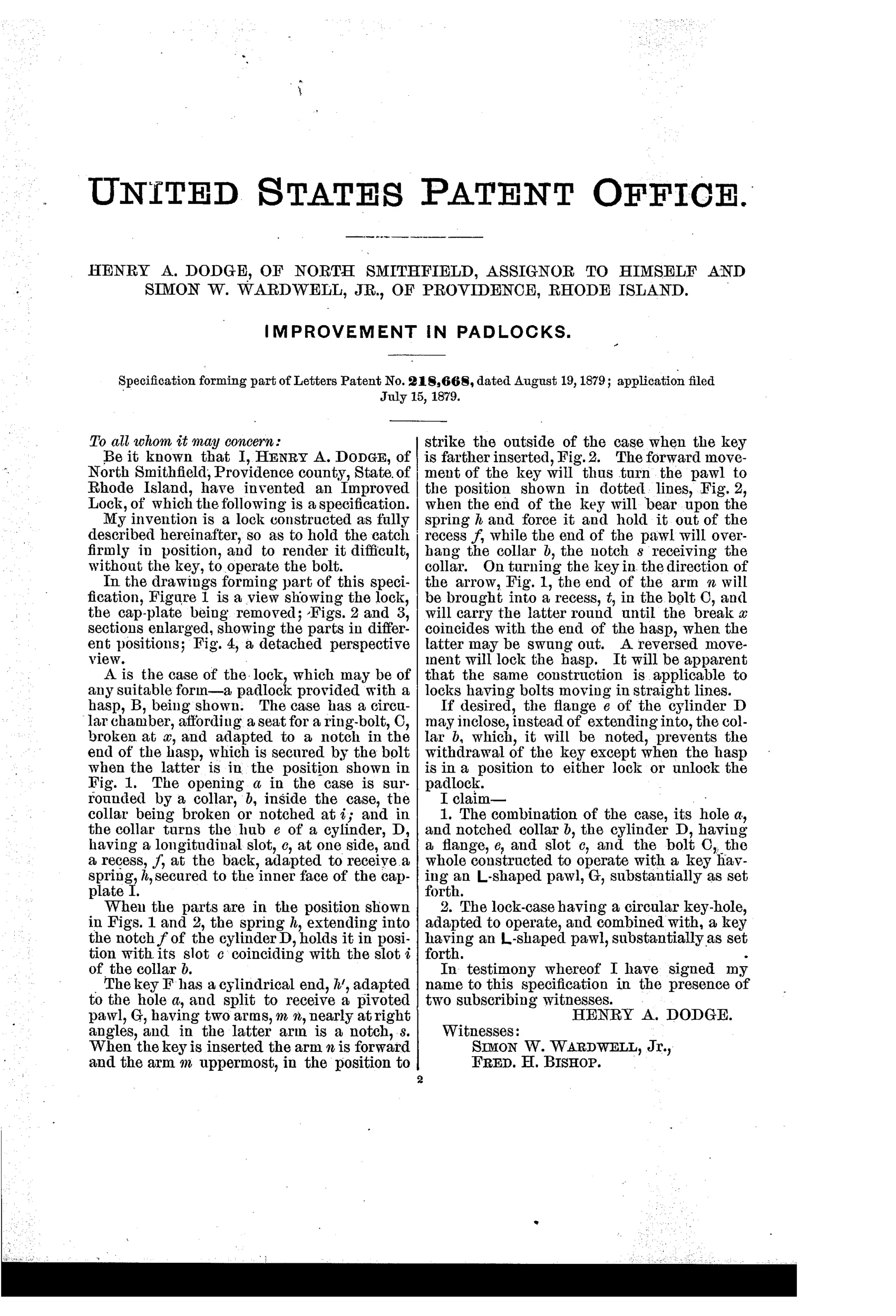
“The combination of the case, its hole a, and notched collar b, the cylinder D, having a flange, e, and slot c, and the bolt C, the whole constructed to operate with a key having an L-shaped pawl, G, substantially as set forth.”
In plain English: The claim covers the padlock's case, notched collar, slotted cylinder, and ring-bolt working together with a key that has a special L-shaped pawl to lock and unlock the hasp.
⚿ In the inventor’s words
“My invention is a lock constructed as fully described hereinafter, so as to hold the catch firmly in position, and to render it difficult, without the key, to operate the bolt.”— Henry A. Dodge, from the specification
Paper patent — likely never produced
No marked Dodge or Wardwell padlock of this pattern is documented, and the articulated key would have been costly to produce; a surviving specimen would change the call.
⚿ Commentary
Most padlock patents of the 1870s put the cleverness inside the case and leave the key a dumb piece of stamped steel. Dodge inverts that. His key carries a pivoted L-shaped pawl — a small hinged finger on the key bit itself — that must ride through a slotted cylinder, drop into a recess in the bolt, and only then transmit rotation. The bolt is a broken ring surrounding the hasp end; turn it until the break lines up and the hasp swings free. Fig. 4 is the piece to study: that notched cylinder is really a crude ward system, but instead of filtering key shapes it demands a key that can fold and unfold on cue.
There's a nice secondary touch a casual reader will miss in Figs. 2 and 3: once the key is partly turned, the pawl is sprung against the mechanism so the key can't be withdrawn mid-operation. That's a genuine anti-fumbling (and mildly anti-picking) feature, since a probe without a hinged tip has nothing to push the bolt with.
The cost is the usual one for trick keys: a key with a pivot and spring is expensive, fragile, and easy to lose to grit. This sits in the crowd of pre-Yale-dominance attempts to make security out of geometric obstruction rather than tumblers — ingenious, but a lineage that the pin tumbler was about to end.
Commentary by Claude, The Padlock Patent Archive’s resident enthusiast