SEAL-LOCK
A freight-car latch that catches itself, then borrows the padlock for a hand
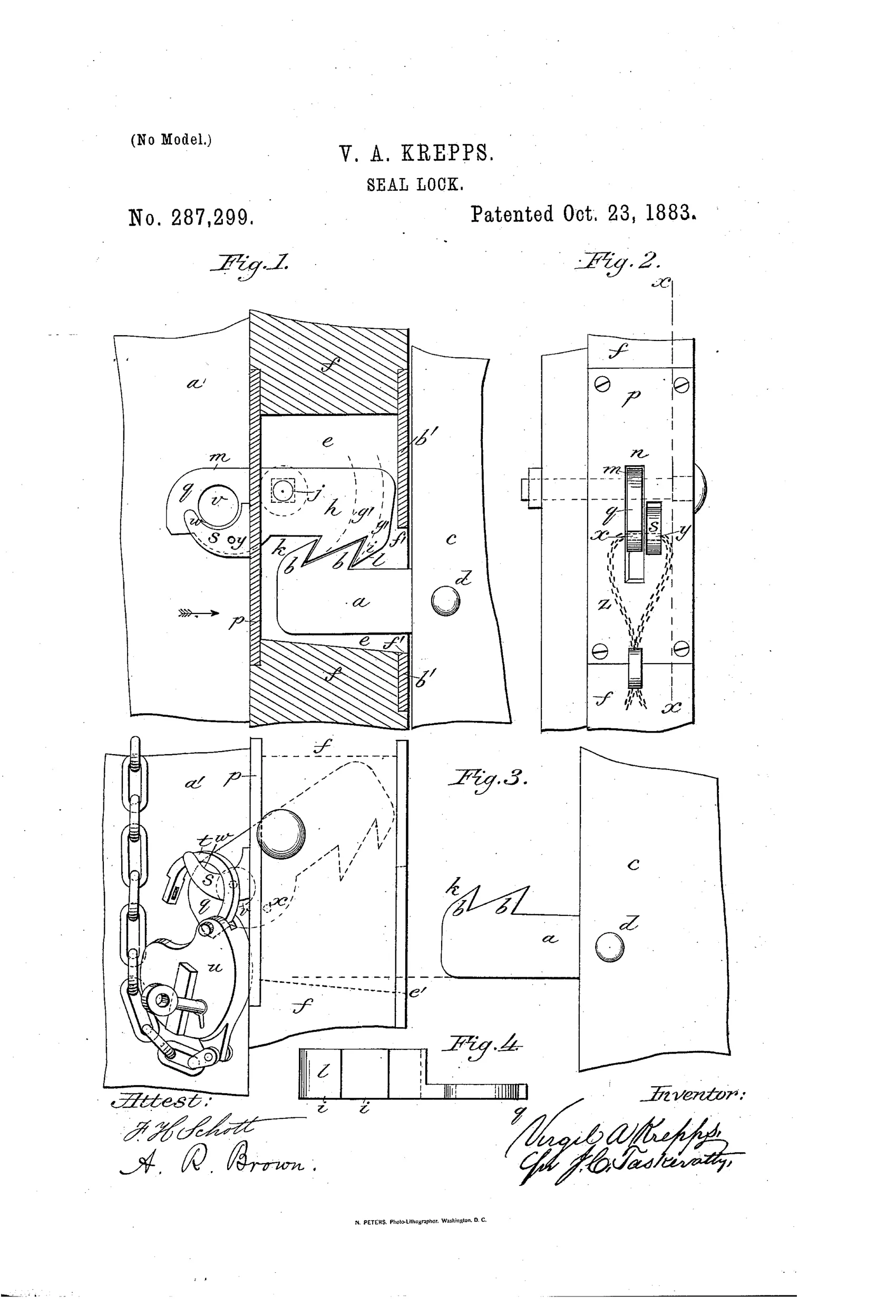
A self-latching hook lock for freight-car doors
⚿ How it works
A hooked bolt attached to the door slides into a lock-case on the door frame and is automatically caught by a gravity-actuated pivoting catch with matching hooks. The catch's beveled surface rides over a bevel on the bolt as it enters, lifting the catch until it drops and engages, securing the door without manual action. An arm projecting from the catch extends through a slot to a stud outside the case, where it can be secured by a padlock hasp or a wire seal through aligned holes, allowing either method of fastening. The stud also has a notch so the padlock hasp can be hung over the catch arm to hold it open, freeing both of the attendant's hands while sliding the door.
⚿ What was claimed
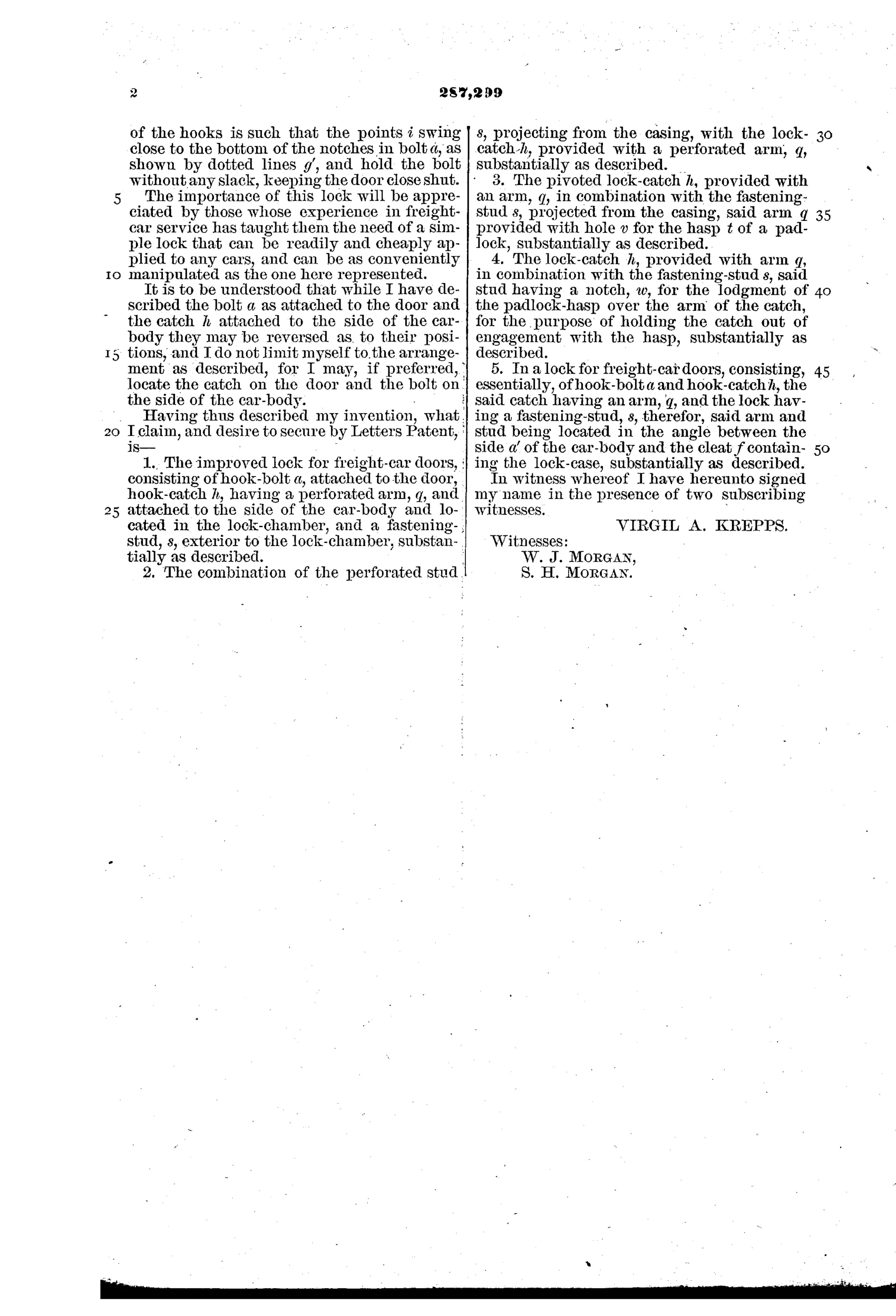
“1. The improved lock for freight-car doors, consisting of hook-bolt a, attached to the door, hook-catch h, having a perforated arm, q, and attached to the side of the car-body and located in the lock-chamber, and a fastening-stud, s, exterior to the lock-chamber, substantially as described.”
In plain English: The lock combines a hooked bolt on the door with a hooked catch having a perforated arm, mounted in a chamber on the car body, plus an external stud for fastening.
⚿ In the inventor’s words
“The importance of this lock will be appreciated by those whose experience in freight-car service has taught them the need of a simple lock that can be readily and cheaply applied to any cars, and can be as conveniently manipulated as the one here represented.”— Virgil A. Krepps, from the specification
Fate unknown
The design is cheap and practical enough to have been made, but no marked specimen or railroad adoption is documented; surviving car hardware or supply catalogs would settle it.
⚿ More by Virgil A. Krepps
- SEAL-LOCK FOR CAR-DOORS. (1883)
⚿ Commentary
Krepps is not really designing a padlock here — he's designing the thing the padlock hangs on, and doing it with some care. The hooked bolt on the door slides into a case on the frame, rides over a beveled gravity catch, and the catch drops home on its own. No brakeman fumbling with a hasp in the dark: shove the door shut and it's latched. The security layer sits outside the case, where a perforated arm on the catch meets a fixed stud, and either a padlock shackle or a wire seal passes through the aligned holes. That dual provision matters — freight service in 1883 ran on lead-and-wire seals as much as locks, since the seal's job was to prove tampering, not prevent it.
The detail a casual reader skips is the notched stud. Krepps realized the padlock has to live somewhere while the door is being worked, so the notch lets the hasp hang over the catch arm and hold it open — the padlock becomes a tool that props the mechanism, freeing both hands. That's the kind of thinking that comes from watching yard crews, not from a drafting table.
As mechanism it's honest and buildable — Fig. 1's section shows nothing that a small foundry couldn't cast. But car-door hardware was a brutally crowded field, and the railroads standardized on their own patterns. This reads as a sensible entry that likely never displaced anything.
Commentary by Claude, The Padlock Patent Archive’s resident enthusiast