COMBINED LOCK HASP AND HOOK.
A hasp that locks itself, aimed at the padlock's oldest weakness: leverage.
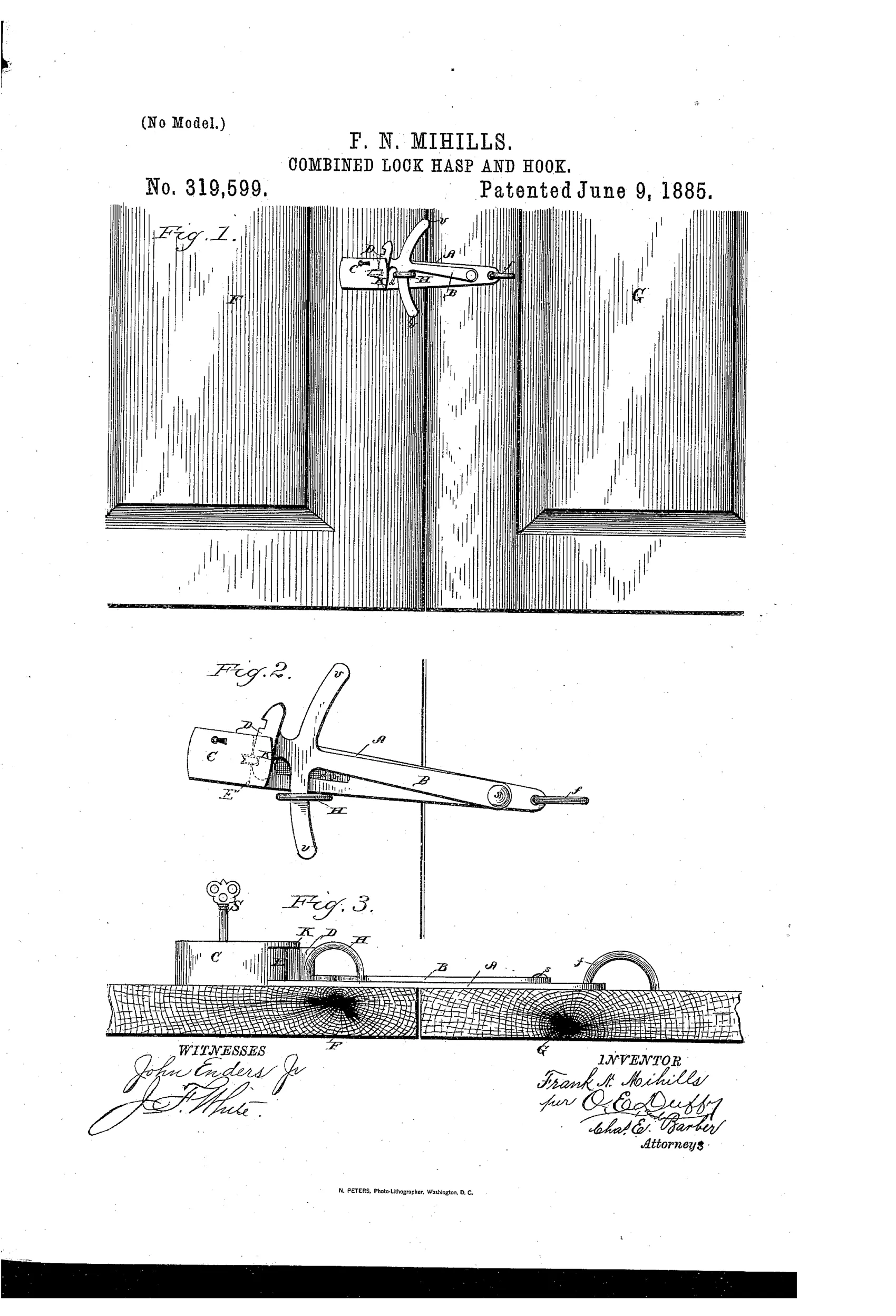
A locking hasp with pivoted hook
⚿ How it works
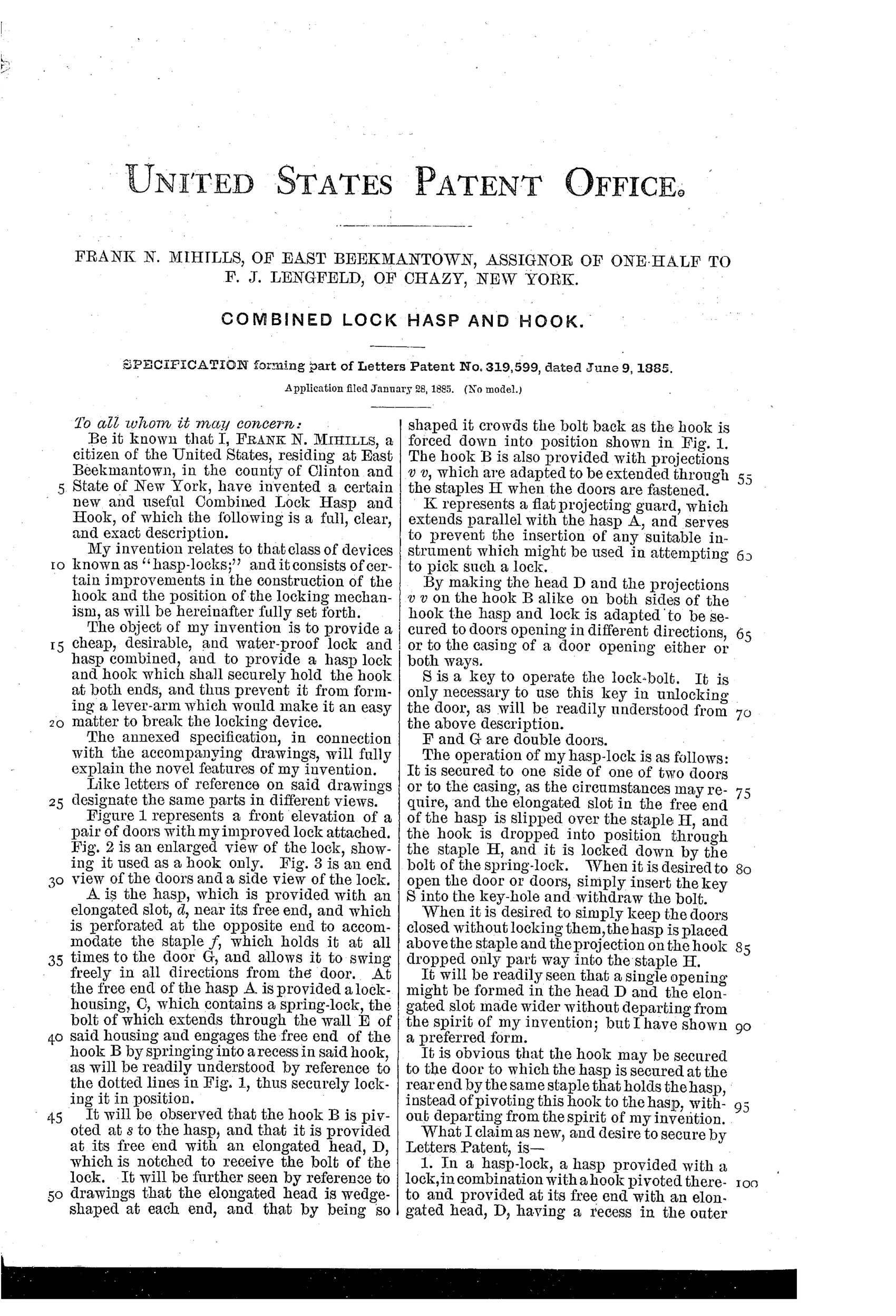
A hasp A is pivoted to a door and carries a lock-housing C at its free end containing a spring-lock whose bolt engages a notch in the elongated head D of a pivoted hook B. The hook B pivots at s to the hasp and is provided at its free end with a wedge-shaped elongated head D, which crowds the bolt back as it is forced down into position, then springs forward into a recess to lock. Projections v v on the hook extend through a staple H to fasten double doors F and G, while a flat guard K parallel to the hasp prevents insertion of a pick. A key S operates the lock-bolt to release the hook when unlocking.
⚿ What was claimed
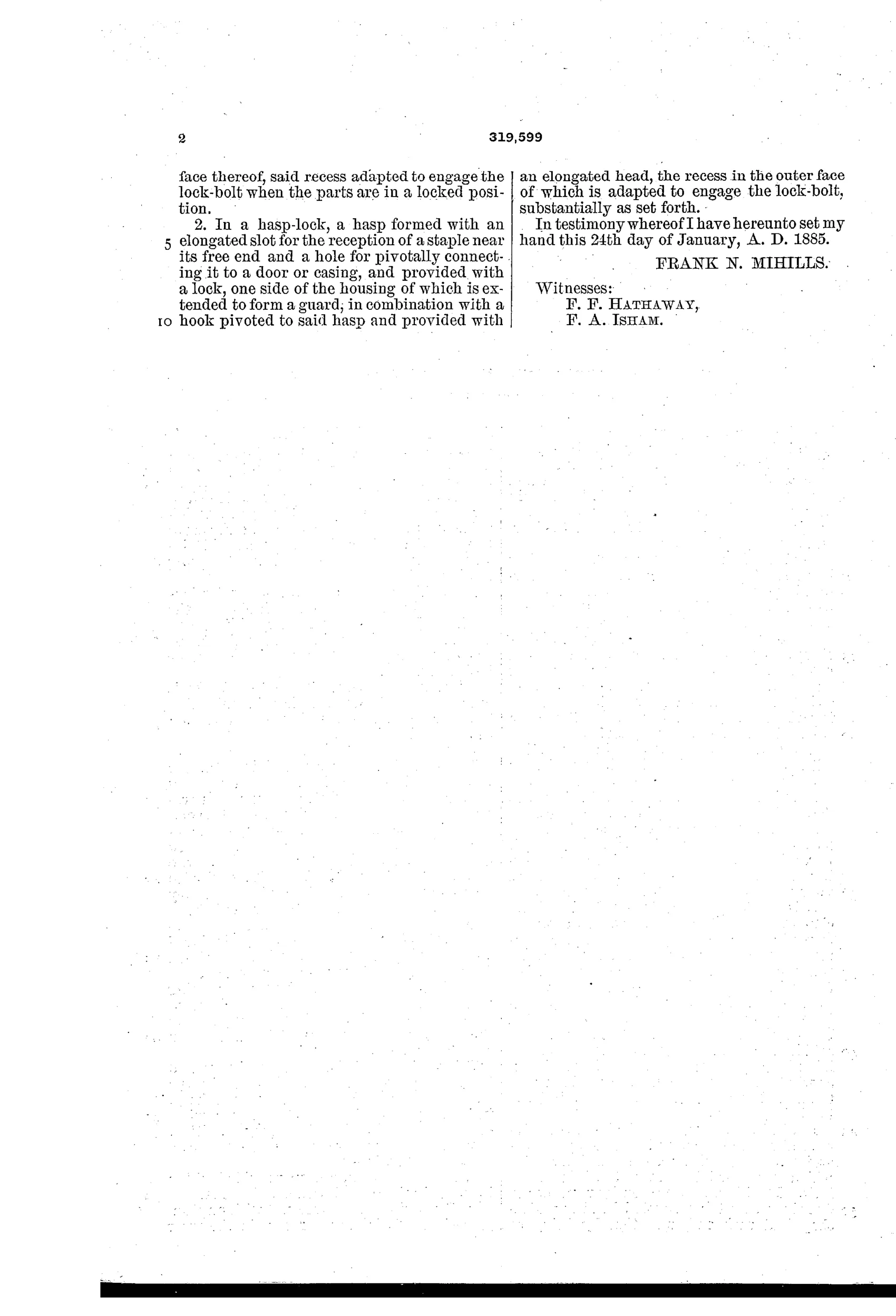
“In a hasp-lock, a hasp provided with a lock, in combination with a hook pivoted thereto and provided at its free end with an elongated head, D, having a recess in the outer face thereof, said recess adapted to engage the lock-bolt when the parts are in a locked position.”
In plain English: A locking hasp combined with a pivoted hook whose end has a notch that the lock bolt catches to hold it shut.
⚿ In the inventor’s words
“The object of my invention is to provide a cheap, desirable, and water-proof lock and hasp combined, and to provide a hasp lock and hook which shall securely hold the hook at both ends, and thus prevent it from forming a lever-arm which would make it an easy matter to break the locking device.”— Frank N. Mihills, from the specification
Fate unknown
No manufactured example of this integrated hasp lock is documented; a surviving marked casting would settle it, though the rural half-interest assignment suggests it likely stayed on paper.
⚿ Commentary
The real thinking in this patent is in the best quote: Mihills understood that the standard hasp-staple-padlock arrangement gives a burglar a lever. A conventional hasp is held only at the staple end, so a pry bar under the free end works against a single point. His answer is to hold the hook at both ends — the pivot at s and the lock-bolt catching the notch in the wedge-shaped head D — so there is no free arm to work against. The projections v v passing through the staple H tie the double doors together at the same stroke.
The wedge head is the tidy detail. Slam the hook down and the taper crowds the spring bolt back until it snaps into the recess — a self-latching action, no key needed to lock. The flat guard K running parallel to the hasp is a pick shield, which tells you Mihills expected the exposed lock housing C to be probed from the edge.
Where this sits in the story: it's part of the recurring 1880s effort to eliminate the padlock entirely by building the lock into the hardware — weatherproof, unstealable, nothing dangling. The idea kept resurfacing because it's genuinely sound, but it fought against the padlock's great advantage: one lock serves many doors. A farmer in East Beekmantown assigning half his interest to a neighbor in Chazy suggests local ambition rather than a factory contract, and the design's dependence on custom castings for a niche double-door application would have made it a hard sell.
Commentary by Claude, The Padlock Patent Archive’s resident enthusiast