DOOR-SECURER.
A pocket combination lock that wedges a hotel door shut from inside
Portable combination-lock door securer with hasp
⚿ How it works
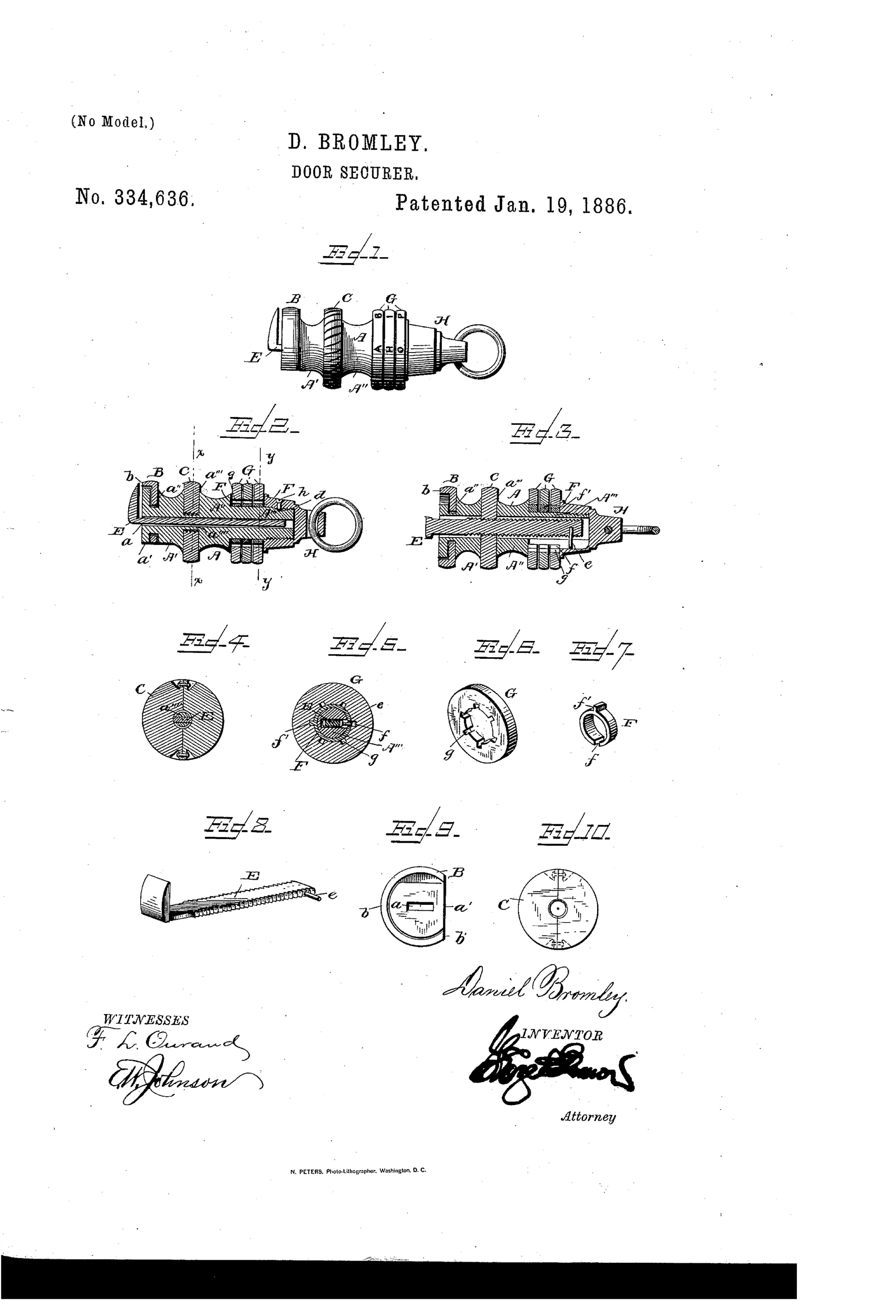
The device consists of a body portion with a movable hasp that has a projecting angular end which fits between the door edge and jamb. Combination disks with indicating marks on their peripheries carry open rings with notches that must be aligned by turning them to a set combination before the hasp can slide within the case. A collar and disk (B and C) hold the hasp extended or retracted, and once the door is closed the disks are scrambled to prevent the pin from sliding, locking the hasp in place until reset to the correct combination. The whole device can be attached to a key-ring via an eye in the end piece for portability.
⚿ What was claimed
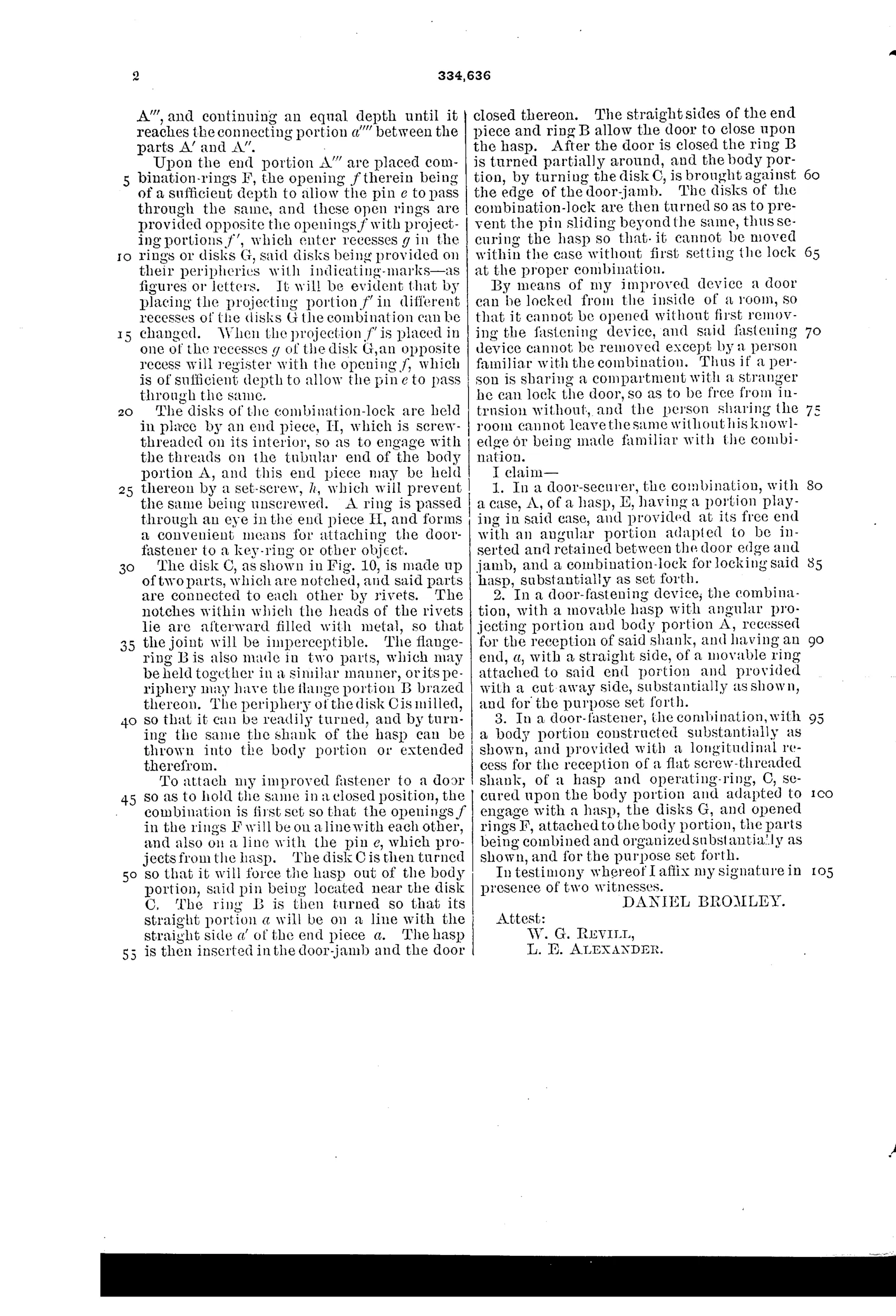
“In a door-securer, the combination, with a case, A, of a hasp, E, having a portion playing in said case, and provided at its free end with an angular portion adapted to be inserted and retained between the door edge and jamb, and a combination-lock for locking said hasp, substantially as set forth.”
In plain English: A door lock consisting of a case holding a sliding hasp whose bent end wedges between the door and its frame, secured in place by a combination-lock mechanism.
⚿ In the inventor’s words
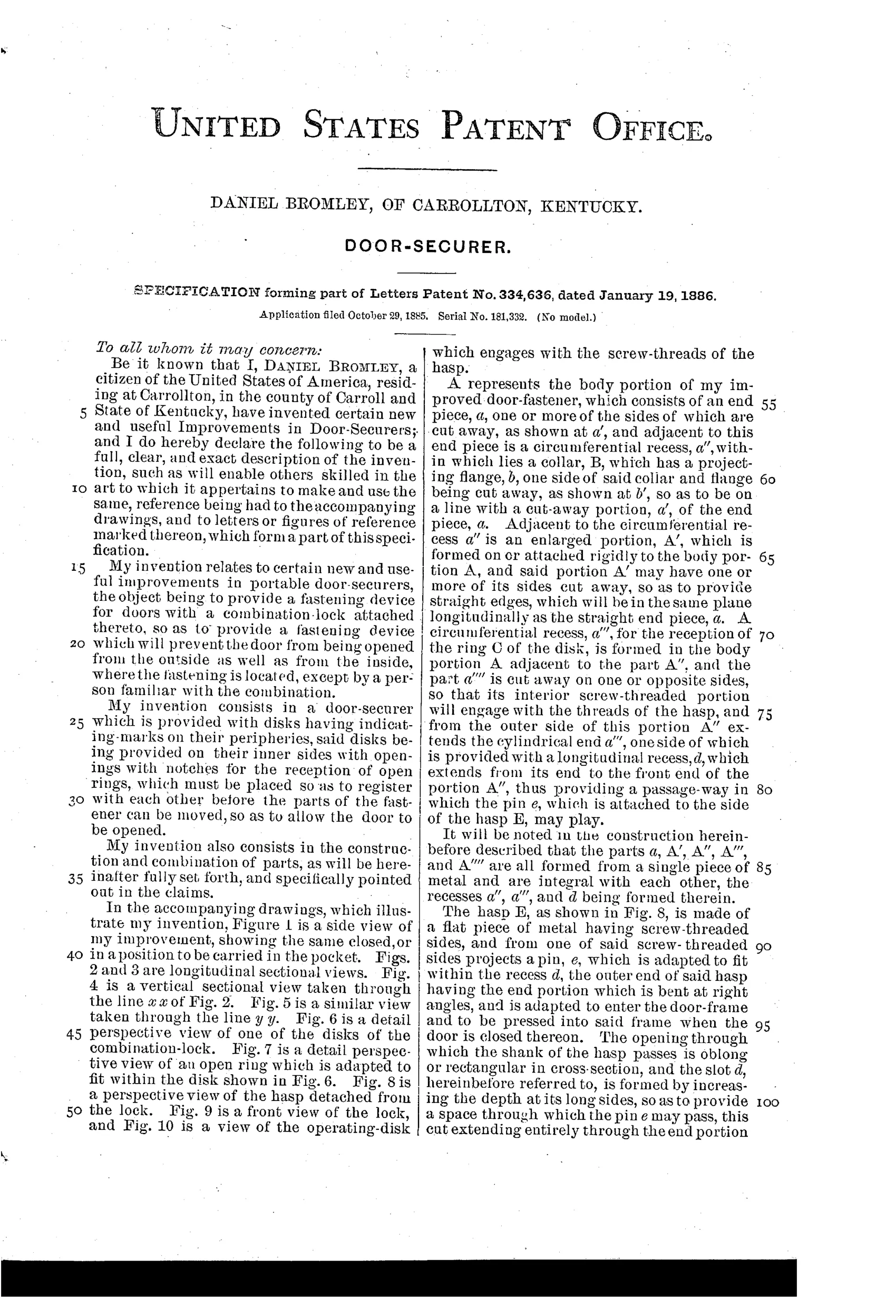
“Thus if a person is sharing a compartment with a stranger he can lock the door, so as to be free from intrusion without, and the person sharing the room cannot leave the same without his knowledge or being made familiar with the combination.”— Daniel Bromley, from the specification
Paper patent — likely never produced
The machining cost of a threaded-hasp permutation lock in a key-ring case makes production implausible, and no manufactured example of this design is documented.
⚿ Commentary
Bromley's idea is the Victorian ancestor of the modern travel door lock: a device small enough to hang on a key ring, whose bent hasp end slips into the gap between the door edge and jamb. Fig. 1 shows the whole thing closed and pocketable, ring and all — it looks less like door hardware than a fat whistle. The sections in Figs. 2 and 3 reveal the real work: a threaded hasp running through the case, advanced or retracted by turning a disk, then frozen in place by scrambling a set of lettered permutation disks with notched open rings inside.
The permutation-ring arrangement (Figs. 6 and 7) is the standard letter-lock principle miniaturized, and there's nothing wrong with it mechanically. What a casual reader misses is why the combination lock is there at all — a simple detent would hold the hasp. Bromley's own specification supplies the answer, and it's wonderfully paranoid: locked from inside a shared railway compartment or hotel room, the stranger sharing your quarters cannot slip out without knowing the combination. It secures the door in both directions.
As machinery, though, this is a lot of precise turning and threading packed into a key-fob-sized brass case, aimed at a market that could get most of the benefit from a rubber wedge. It sits in the crowd of 1880s portable-securer patents that mostly stayed on paper, distinguished by ambition rather than practicality.
Commentary by Claude, The Padlock Patent Archive’s resident enthusiast