PADLOCK.
Three Cincinnati men hide a second lock behind the first, for mail bags
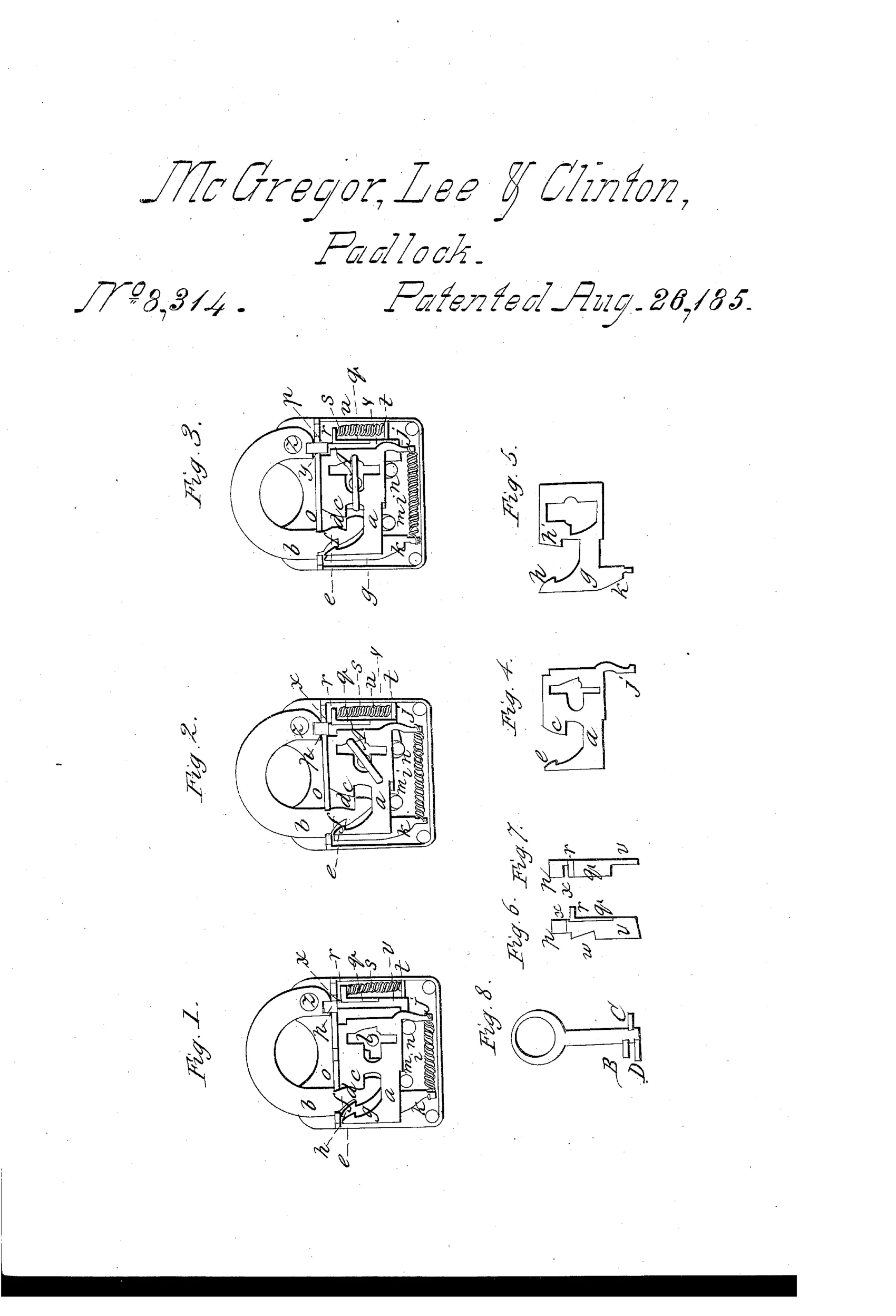
Padlock with hidden safety bolt for mail bags
⚿ How it works
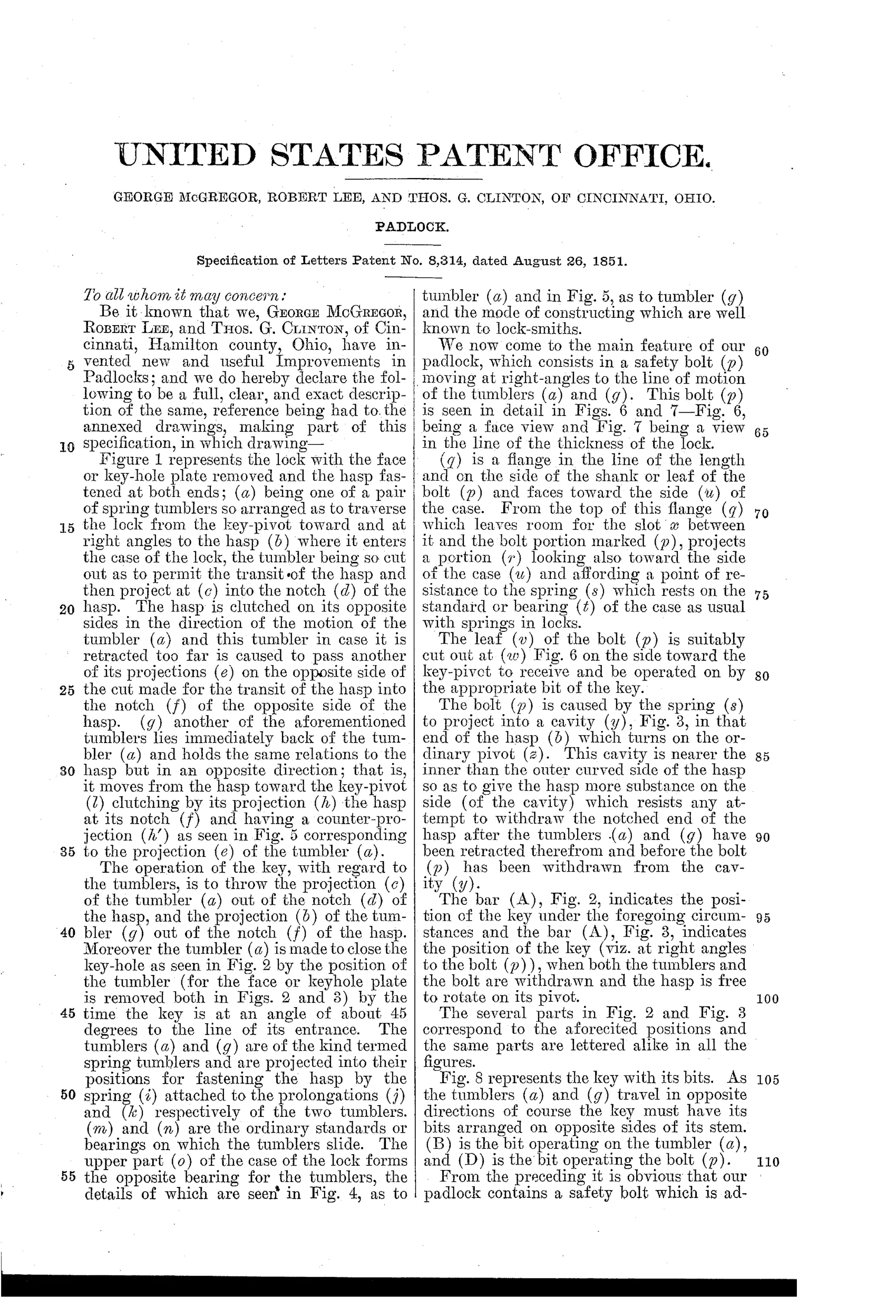
A pair of spring tumblers (a) and (g) travel at right angles into notches on the hasp to lock it, and a separate safety bolt (p) moves at right angles to the tumblers' motion, projecting into a cavity (y) on the rotating end of the hasp. The bolt has a flange (q) and a spring (s) resting on a bearing (t) to keep it engaged, and its leaf (v) is cut out to be operated by a bit of the key. Because the tumblers and bolt move in different directions and are hidden behind the face plate, the lock is designed to resist picking even if the tumblers are bypassed. The key has bits on opposite sides of its stem, one (B) to operate the tumbler (a) and another (D) to operate the bolt (p).
⚿ What was claimed
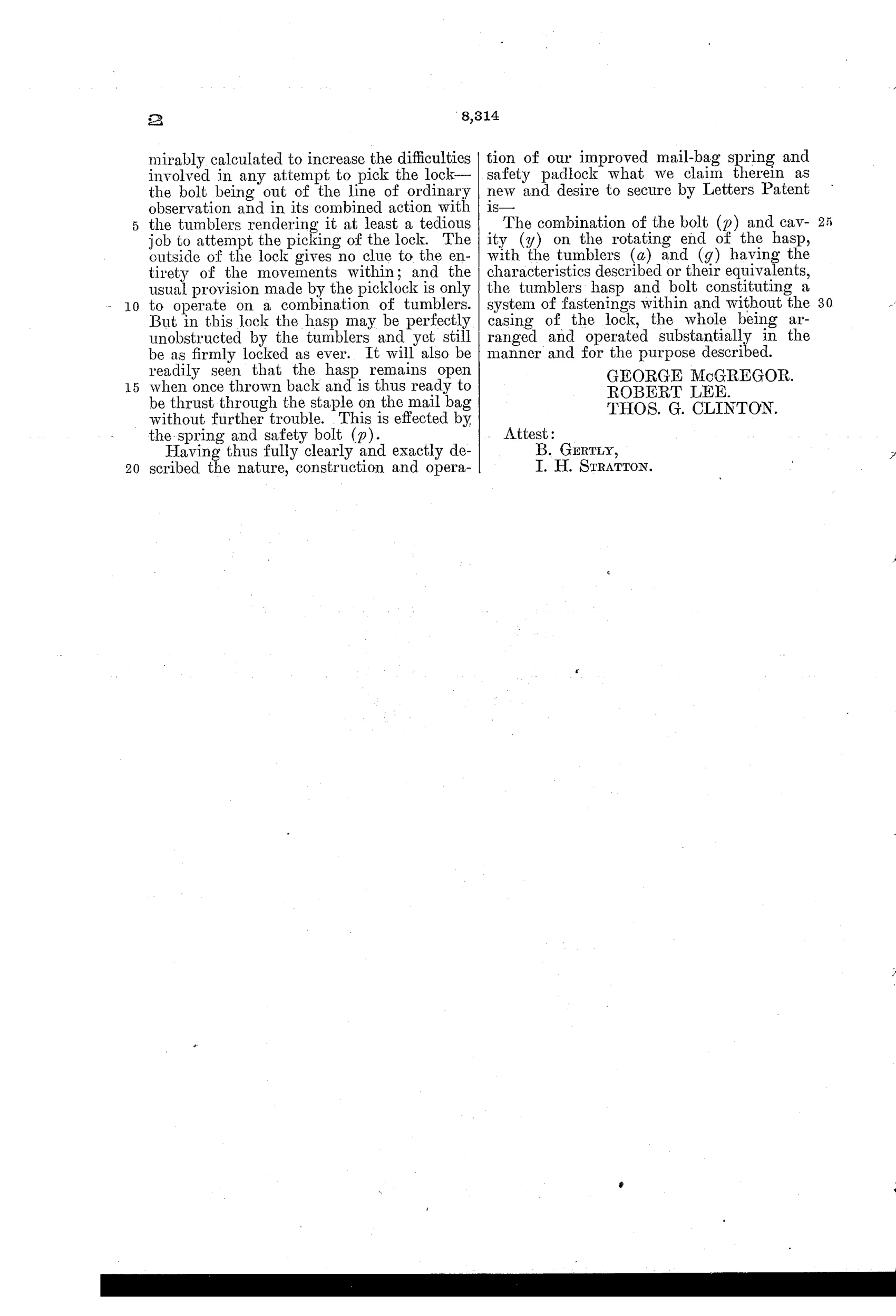
“The combination of the bolt (p) and cavity (y) on the rotating end of the hasp, with the tumblers (a) and (g) having the characteristics described or their equivalents, the tumblers hasp and bolt constituting a system of fastenings within and without the casing of the lock, the whole being arranged and operated substantially in the manner and for the purpose described.”
In plain English: The claim covers the combined system of a hidden safety bolt engaging a cavity in the hasp together with the two tumblers, all working together as a single locking mechanism inside and outside the case.
⚿ In the inventor’s words
“But in this lock the hasp may be perfectly unobstructed by the tumblers and yet still be as firmly locked as ever.”— George McGregor, Robert Lee, and Thos. G. Clinton, from the specification
Fate unknown
No production example from these inventors is documented; a surviving mail-bag lock matching the double-bitted key and hasp-cavity bolt would settle it.
⚿ Commentary
The trick here is separation of duties. Most padlocks of 1851 relied on a spring tumbler or two dropping into a notch on the hasp — and a picker who could lift those tumblers had the whole lock. McGregor, Lee, and Clinton added a safety bolt (p) that moves at right angles to the tumblers and slides into a cavity (y) bored into the pivoting end of the hasp itself. Their own line says it best: the hasp may be 'perfectly unobstructed by the tumblers and yet still be as firmly locked as ever.' Lift the tumblers all you like; the hasp still won't budge.
The key in Fig. 8 tells the story in miniature — bits B and D on opposite sides of the stem, one for the tumblers, one for the bolt, so a single turn works both fastenings in sequence. That's a real complication for a would-be picker working blind through a keyhole, since the two mechanisms move in different directions and neither gives feedback about the other.
Aimed at mail bags, this sits in the pre-Yale era when security meant piling on wards and hidden bolts rather than precision pins. It's a dead-end branch in hindsight, but an honest and mechanically sound one — the sequential double-fastening idea would echo later in high-security hasp designs.
Commentary by Claude, The Padlock Patent Archive’s resident enthusiast