LOCK
The whole shackle rotates: a hidden arc bolt instead of a swinging bail
A padlock with rotating actuator plate mechanism
⚿ How it works
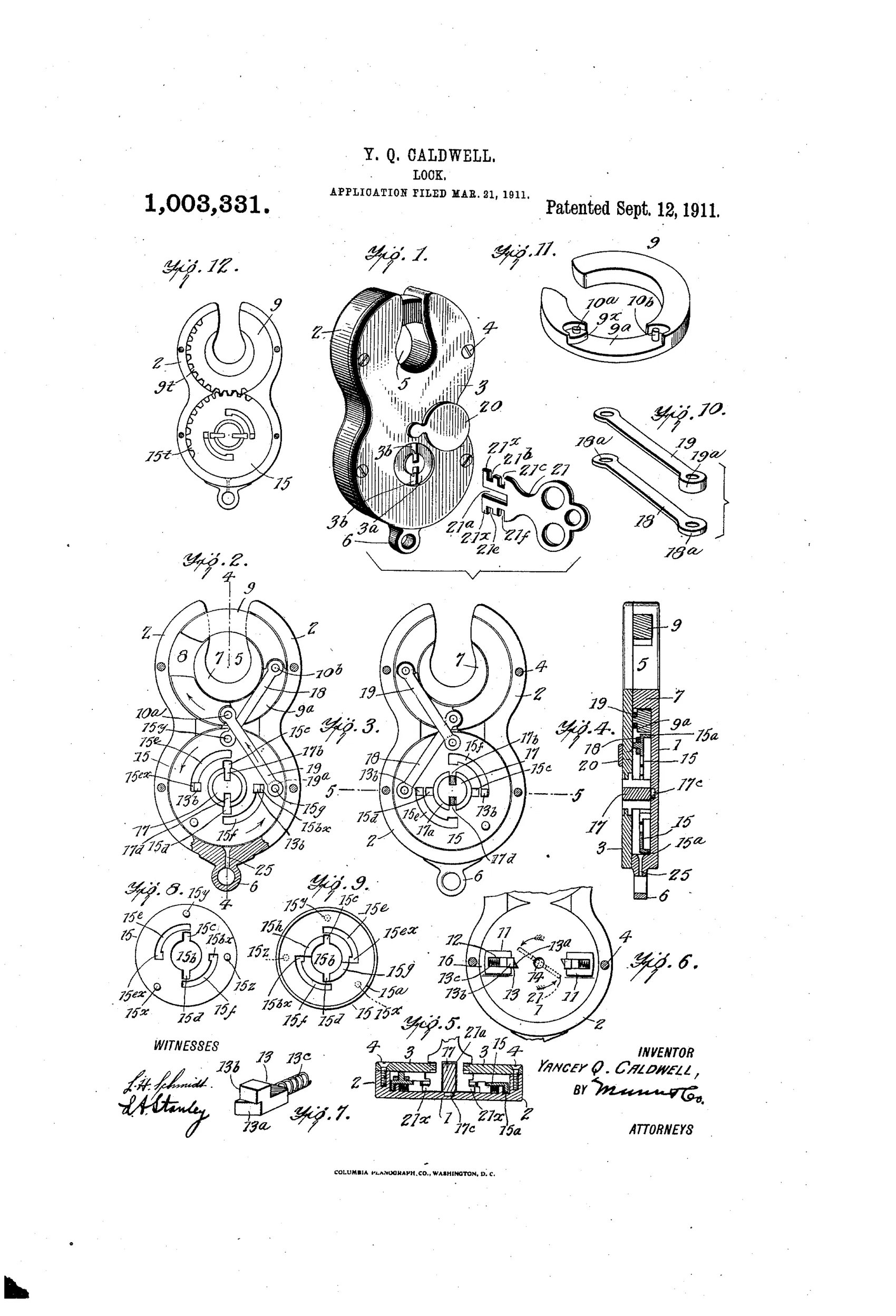
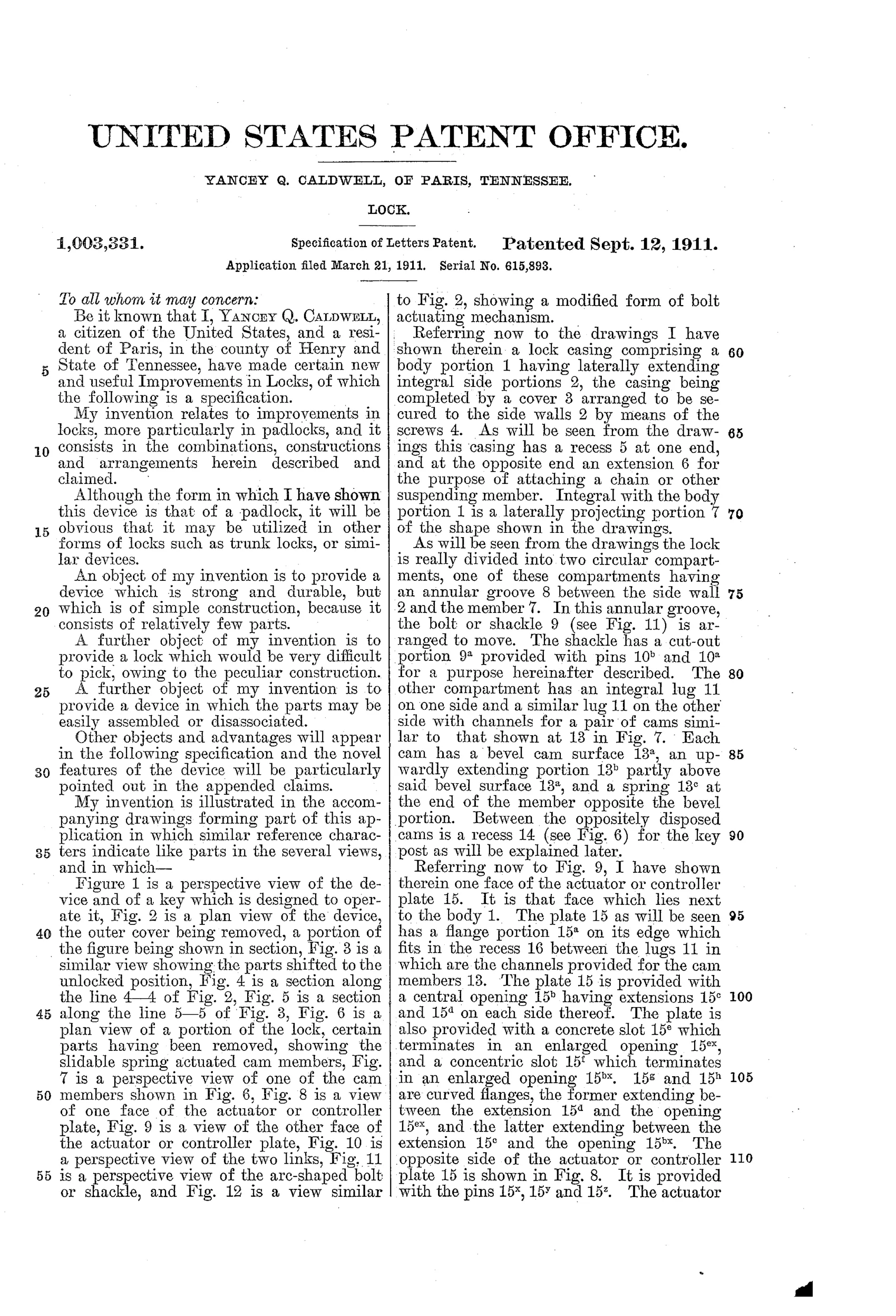
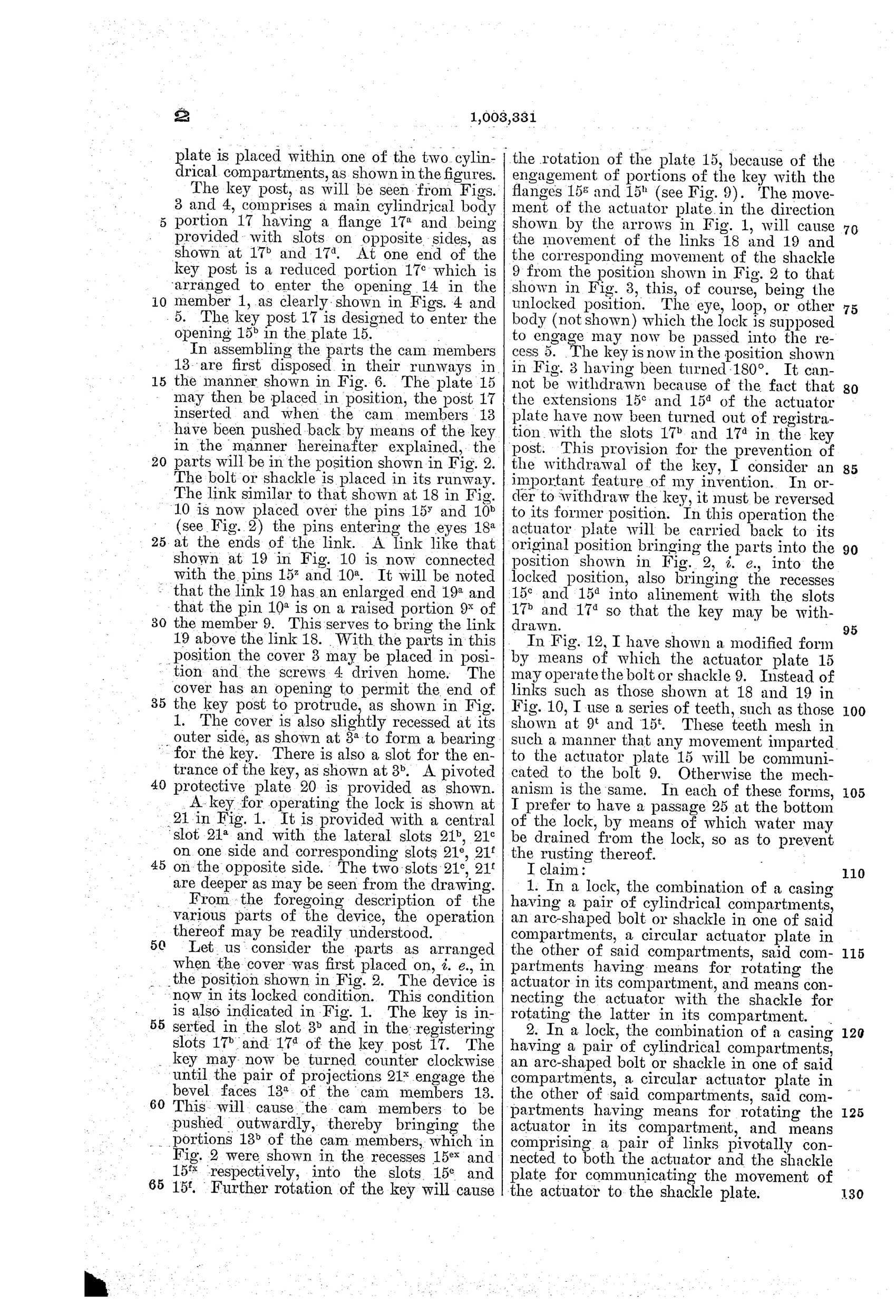
The lock casing has two cylindrical compartments, one holding an arc-shaped bolt or shackle that moves in an annular groove, the other holding a circular actuator plate. A key engages spring-actuated cam members to shift the actuator plate, which via a pair of pivoted links (or, in a modified form, meshing teeth) rotates the shackle between locked and unlocked positions. The key cannot be withdrawn once turned because the actuator plate's rotation moves its slots out of registration with the key post's slots, requiring the key to be reversed to its original position before withdrawal.
⚿ What was claimed
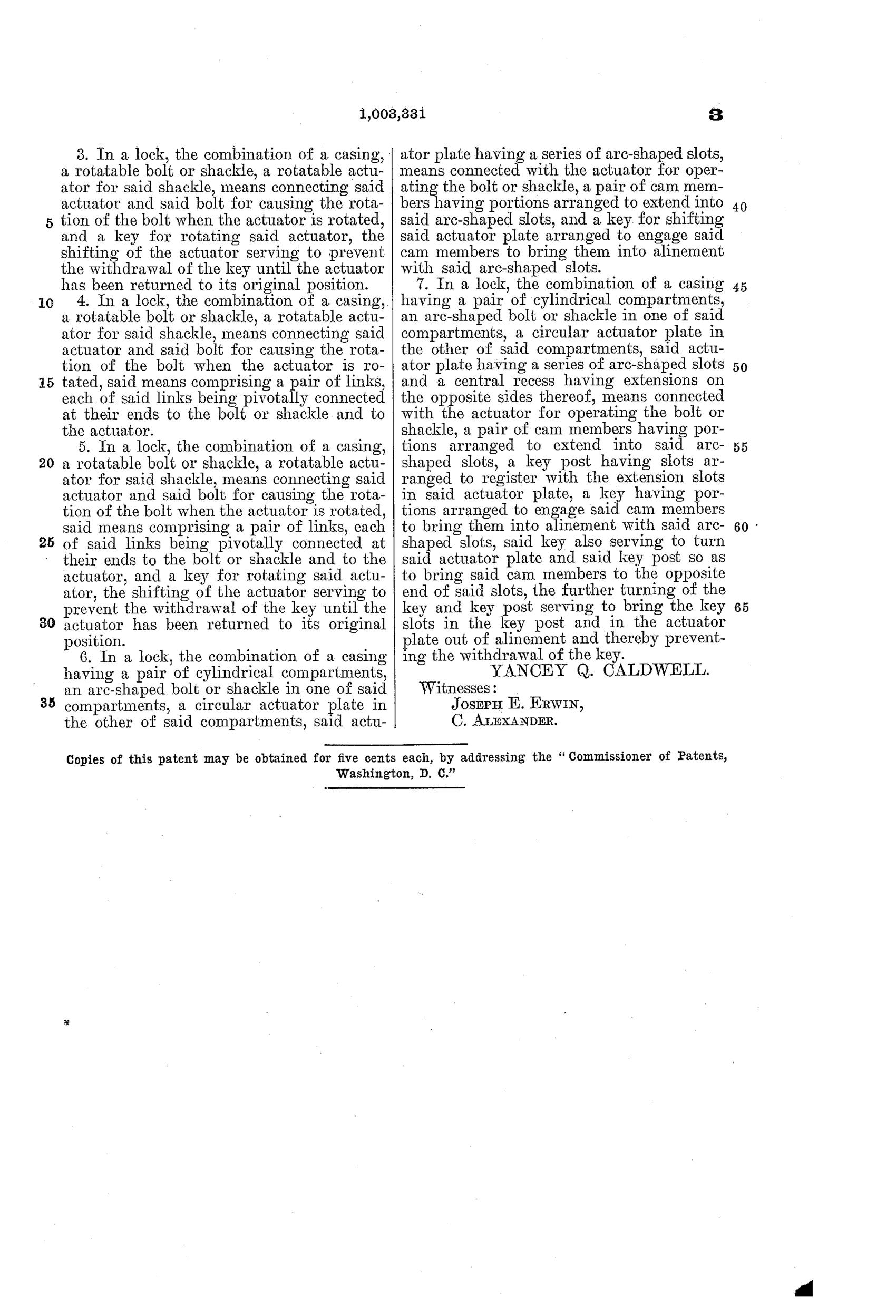
“In a lock, the combination of a casing, a rotatable bolt or shackle, a rotatable actuator for said shackle, means connecting said actuator and said bolt for causing the rotation of the bolt when the actuator is rotated, and a key for rotating said actuator, the shifting of the actuator serving to prevent the withdrawal of the key until the actuator has been returned to its original position.”
In plain English: The lock's key cannot be pulled out until the internal rotating plate that moves the shackle is turned back to its starting position.
⚿ In the inventor’s words
“A further object of my invention is to provide a lock which would be very difficult to pick, owing to the peculiar construction.”— Yancey Q. Caldwell, from the specification
Paper patent — likely never produced
The machining cost and lack of any assignee or known production example make manufacture implausible, though a surviving marked specimen would overturn this.
⚿ Commentary
Most padlocks lock a shackle that swings or slides; Caldwell does away with the shackle as a separate part almost entirely. His "shackle" is an arc-shaped bolt (Fig. 11) that travels in an annular groove inside the case, rotating around to close the gap in the horseshoe-shaped opening at the top. Nothing pops open, nothing hinges — the lock's mouth simply opens and shuts like a rotary gate. It is the same instinct that later gave us quarter-turn cam mechanisms, worked out here with a key-driven actuator plate and a pair of pivoted links (Fig. 10), or in the alternate form, meshing gear teeth (Fig. 12).
The detail worth lingering on is the key-trap claim. Turning the key rotates the actuator plate, moving its slots out of registration with the key post — so the key physically cannot come out while the lock is open. That is a genuinely useful discipline feature, the same logic railroads prized in switch stands: the key in your hand proves the lock is closed. Whether Caldwell knew of that market or arrived at it independently, it is the strongest idea on the sheet.
The weakness is manufacturing. Two machined cylindrical compartments, an annular groove, a double-faced slotted actuator plate, sliding spring cams, and a three-pronged key add up to a costly lock competing against stamped-lever hardware selling for pennies. The anti-pick boast rests more on unfamiliarity than on real keying variation.
Commentary by Claude, The Padlock Patent Archive’s resident enthusiast