Padlock
One spring does everything: slam-shut hasp, three-way bolt lock, and pop-open action
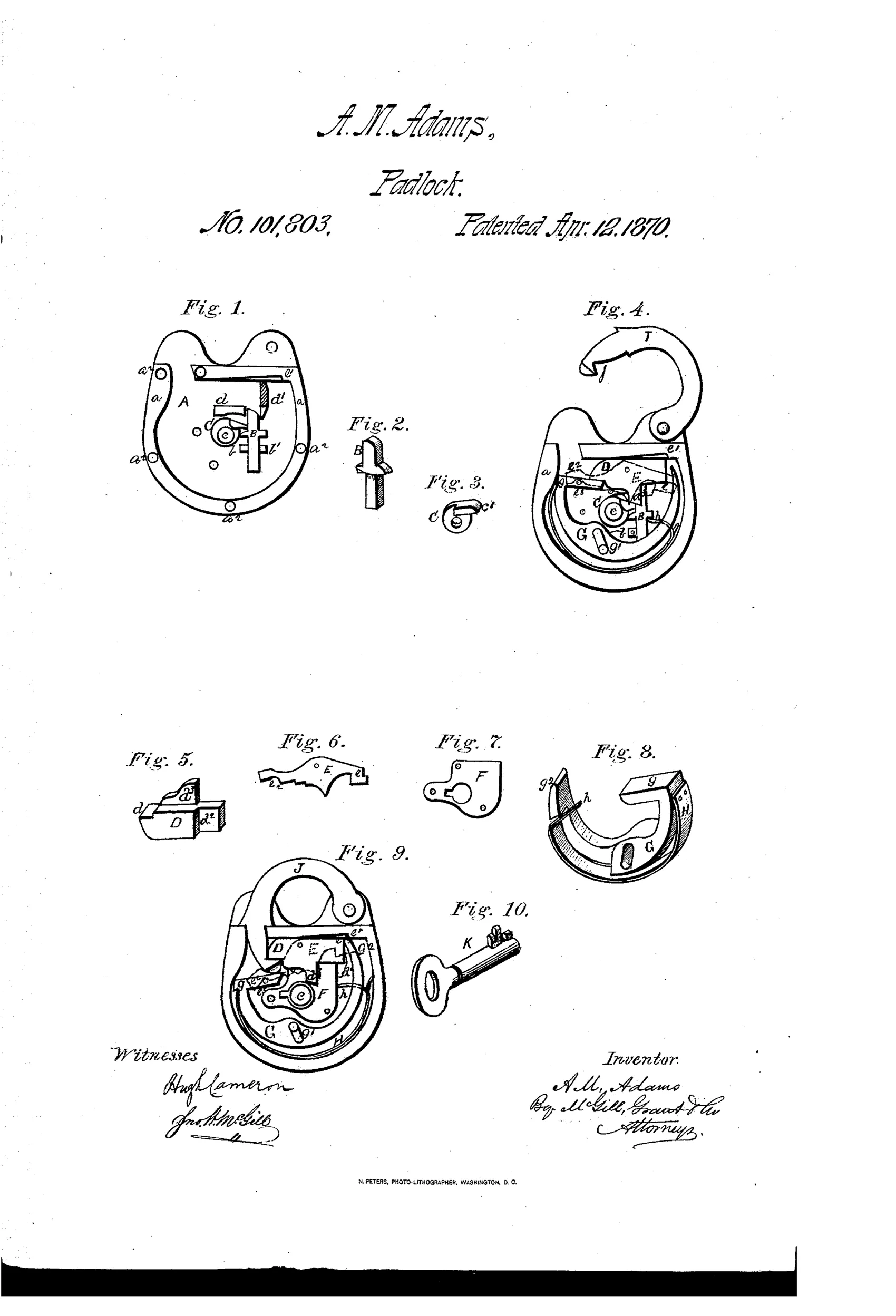
Single-spring, self-fastening padlock mechanism
⚿ How it works
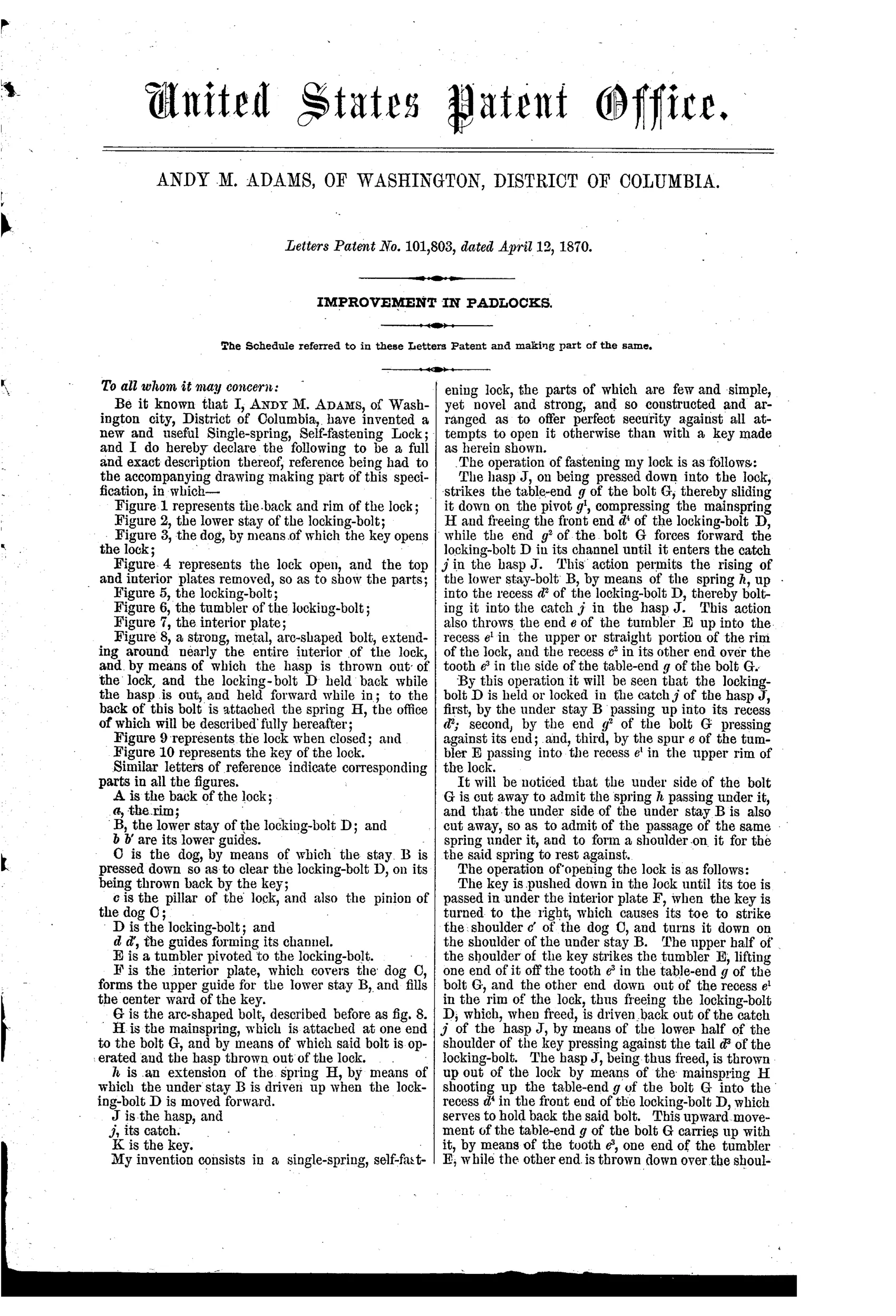
Pressing the hasp J down strikes the table-end g of bolt G, compressing mainspring H and sliding locking-bolt D forward into the hasp's catch j. This also raises under stay B and tumbler E into locking recesses, securing the bolt from three directions at once. To open, the key's toe strikes dog C, turning it onto stay B, while the key's shoulder lifts tumbler E off bolt G, freeing locking-bolt D and allowing the mainspring to shoot the hasp back out.
⚿ What was claimed
“1. The bolt G, formed as shown, and provided with slot and pivot g', and pivot e2, and spring H, constructed, arranged, and operating in the manner and for the purpose herein set forth and described.”
In plain English: A claim covering the specially shaped arc bolt G with its slots, pivots, and attached mainspring H that automatically throws the hasp open and closed.
⚿ In the inventor’s words
“My invention consists in a single-spring, self-fastening lock, the parts of which are few and simple, yet novel and strong, and so constructed and arranged as to offer perfect security against all attempts to open it otherwise than with a key made as herein shown.”— Andy M. Adams, from the specification
Fate unknown
No production padlock is documented matching Adams's arc-bolt mechanism; a surviving specimen or trade listing would settle it.
⚿ Commentary
Adams's whole idea rides on the arc-shaped bolt G (Fig. 8) and its single mainspring H. Slam the hasp down and it strikes the table-end of that bolt, which does three jobs in one stroke: compresses the spring, drives the locking-bolt D forward into the hasp's catch, and lifts both the under stay and the tumbler into their locking recesses. The hasp is thus held from three directions, and the same compressed spring is what shoots the shackle open again when the key releases everything. No spring for the tumbler, no spring for the dog — one energy source, cleverly routed.
The key action is worth a look too: its toe kicks the dog C over onto the stay while its shoulder simultaneously lifts the tumbler off the bolt. Two release motions from one turn, and the lock does the rest by itself. This is the classic self-locking (or 'slam shut') pattern that railroad and warehouse users prized — no key needed to lock, hard to leave unsecured by accident.
That said, the security claim of 'perfect security' rests on a single lever tumbler and a warded key, which was already thin protection by 1870, the very year Yale's pin tumbler was gaining ground. This is a refinement in the crowded self-fastening genre, not a turning point — but the economy of the one-spring layout is genuinely elegant, and the heart-shaped case in Fig. 9 is pure period style.
Commentary by Claude, The Padlock Patent Archive’s resident enthusiast