IMPROVEMENT IN PADLOCKS
A Philadelphia jail padlock that snaps itself shut and spits out its shackle
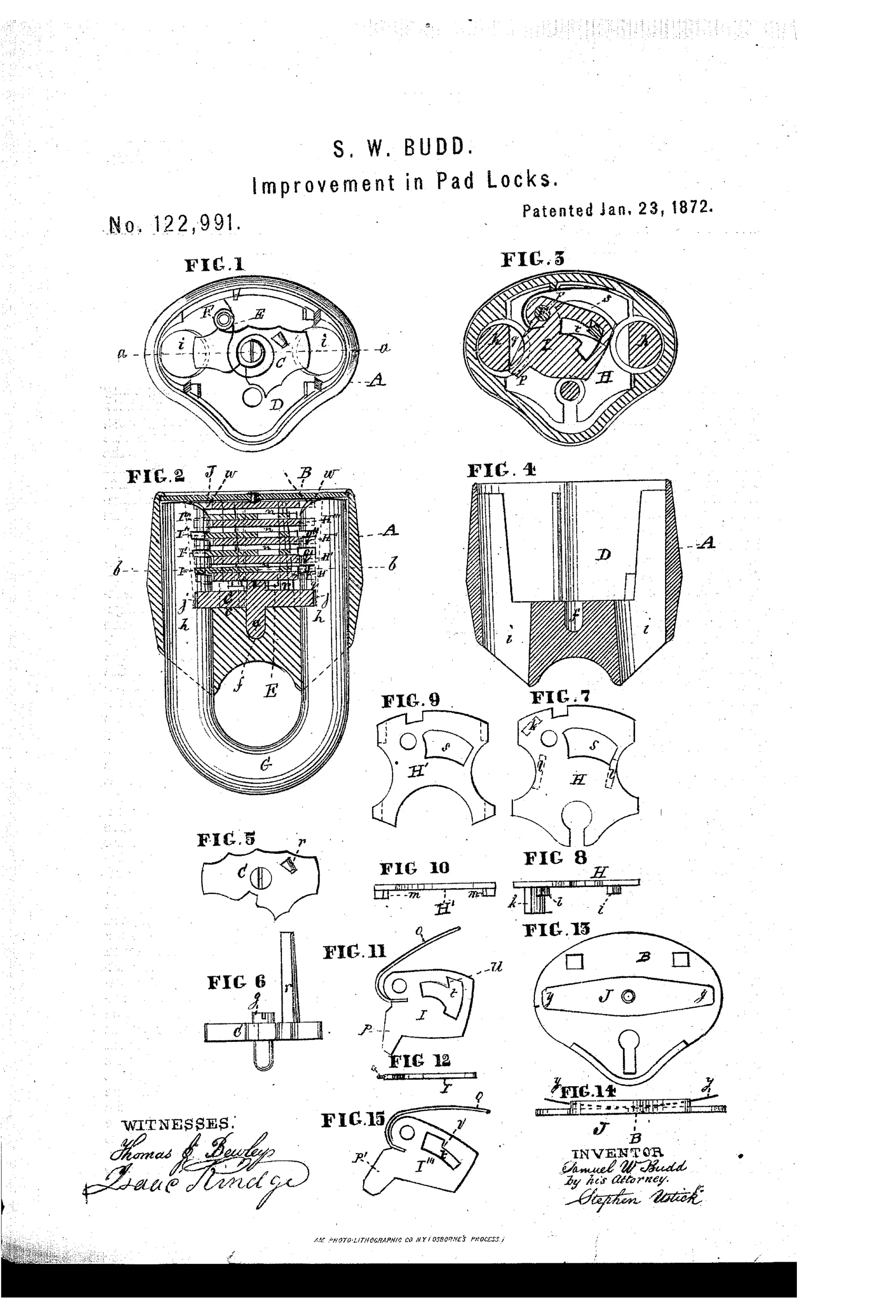
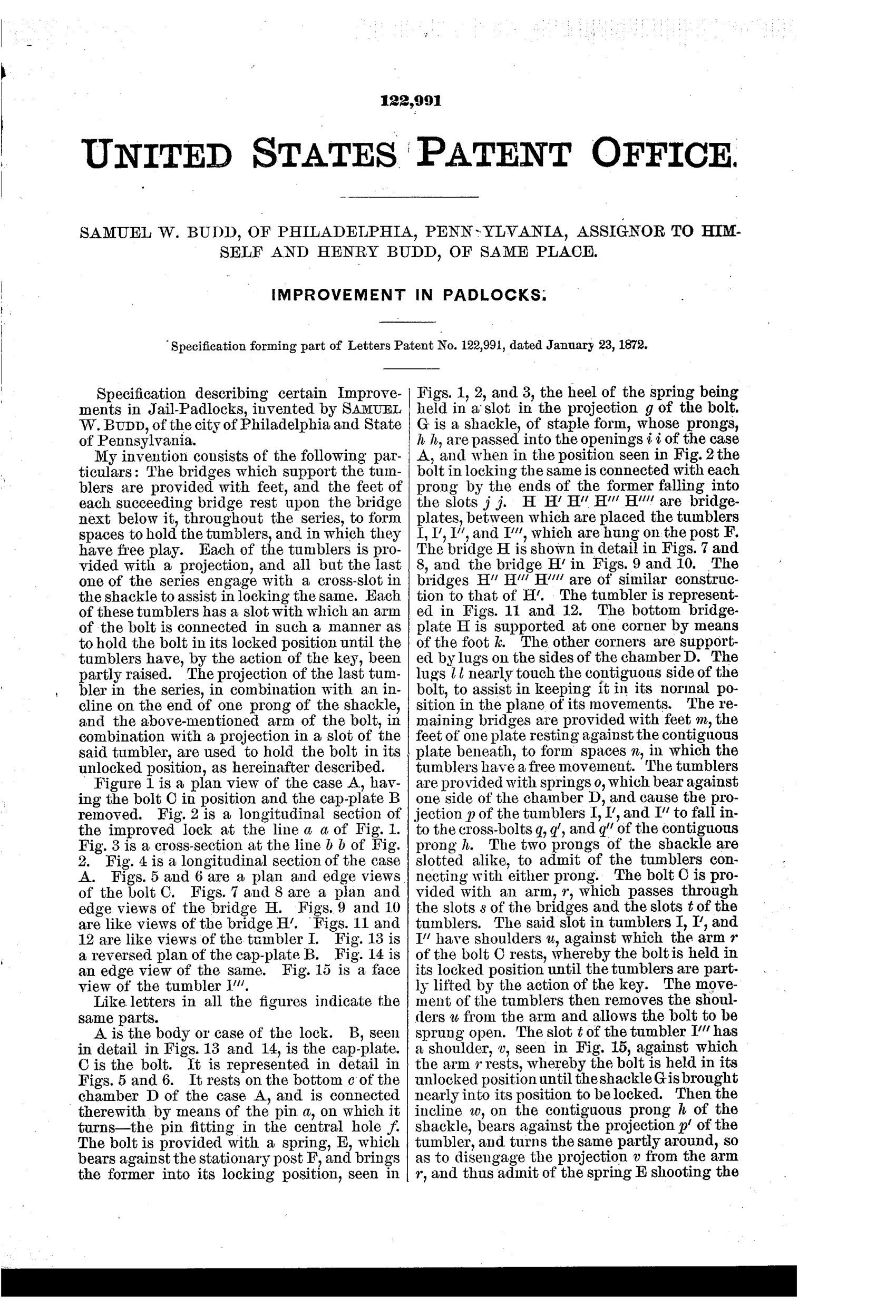
Improved multi-tumbler jail padlock mechanism
⚿ How it works
The lock uses a series of stacked bridge-plates, each fitted with feet resting on the plate below, forming spaces that give free play to a series of pivoted lever tumblers. Each tumbler bears a projection and a slotted shoulder that engages an arm on the bolt, holding the bolt locked until the key partially lifts the tumblers to clear the shoulders. A spring drives the bolt closed when the shackle prongs enter the case, while a special tumbler with an incline-actuated shoulder holds the bolt open until the shackle is nearly reseated, at which point an incline on the shackle prong disengages that tumbler and lets the spring snap the bolt shut. When the shackle is released from the bolt and tumblers, a separate spring in the cap-plate ejects the shackle from the case.
⚿ What was claimed
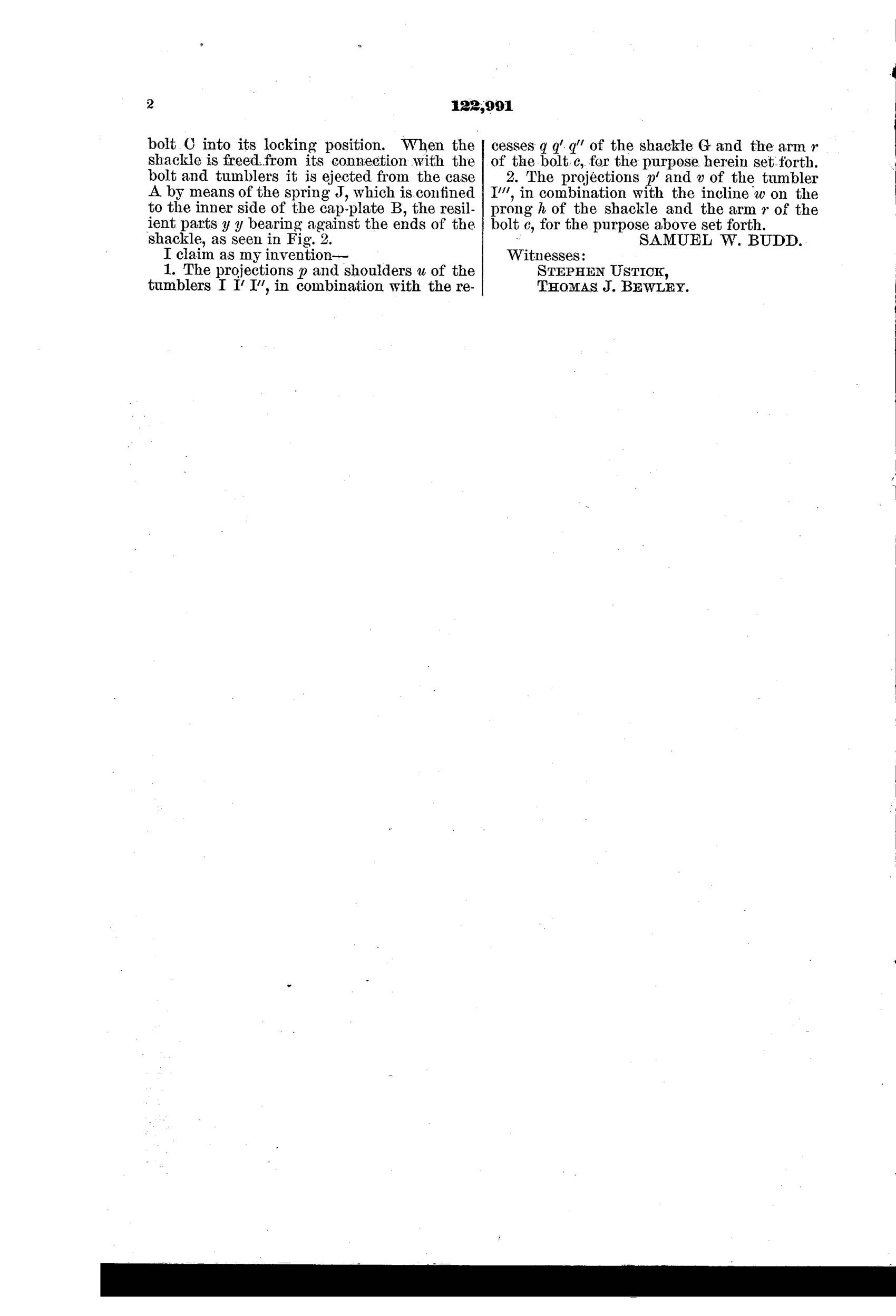
“1. The projections p and shoulders u of the tumblers I I' I'', in combination with the recesses q q' q'' of the shackle G and the arm r of the bolt c, for the purpose herein set forth. 2. The projections p' and v of the tumbler I''', in combination with the incline w on the prong h of the shackle and the arm r of the bolt c, for the purpose above set forth.”
In plain English: The claimed invention covers the specific arrangement of tumbler projections, shoulders, shackle recesses, and bolt arm that lock the bolt, plus the extra tumbler feature that uses an incline on the shackle prong to release the bolt from its open (unlocked) position as the shackle is reinserted.
⚿ In the inventor’s words
“My invention consists of the following particulars: The bridges which support the tumblers are provided with feet, and the feet of each succeeding bridge rest upon the bridge next below it, throughout the series, to form spaces to hold the tumblers, and in which they have free play.”— Samuel W. Budd, from the specification
Manufactured and sold
Budd of Philadelphia was a working jail-lock maker, and heavy heart-shaped iron jail padlocks of this pattern marked with the Budd name survive in collections.
⚿ Commentary
Samuel Budd's patent is about the interior architecture as much as the tumblers. Instead of riveting each lever bridge to the case separately, he stacks the bridge-plates so that each one's feet stand on the plate below, self-spacing the whole tumbler pack. Figs. 7 through 10 show the trick: two bridge shapes with cast feet that assemble like a layer cake, each layer giving one pivoted lever its own working chamber. For a heavy cast-iron lock built in a shop rather than a precision factory, that is a genuinely practical idea — the spacing comes from the parts themselves, not from fixturing.
The cleverer feature is the self-locking cycle. A spring drives the bolt closed, but a fourth tumbler with its own shoulder holds the bolt open after the key is withdrawn. Only when the shackle prong is nearly seated does an incline on the prong (the w in Fig. 2) kick that tumbler aside and let the bolt snap home. So a jailer can lock a cell one-handed, without the key, and can't leave the lock half-engaged. A cap-plate spring then ejects the shackle on opening — a small courtesy that matters when you're working by lantern light.
This is the jail-lock branch of the padlock story: massive, lever-based, deliberately ignoring the pin-tumbler revolution then underway, because prison hardware prized brute robustness and one-handed slam-shut operation over key compactness.
Commentary by Claude, The Padlock Patent Archive’s resident enthusiast