IMPROVEMENT IN PADLOCKS
Egge puts the tumblers inside the shackle arm and lets springs pop it open
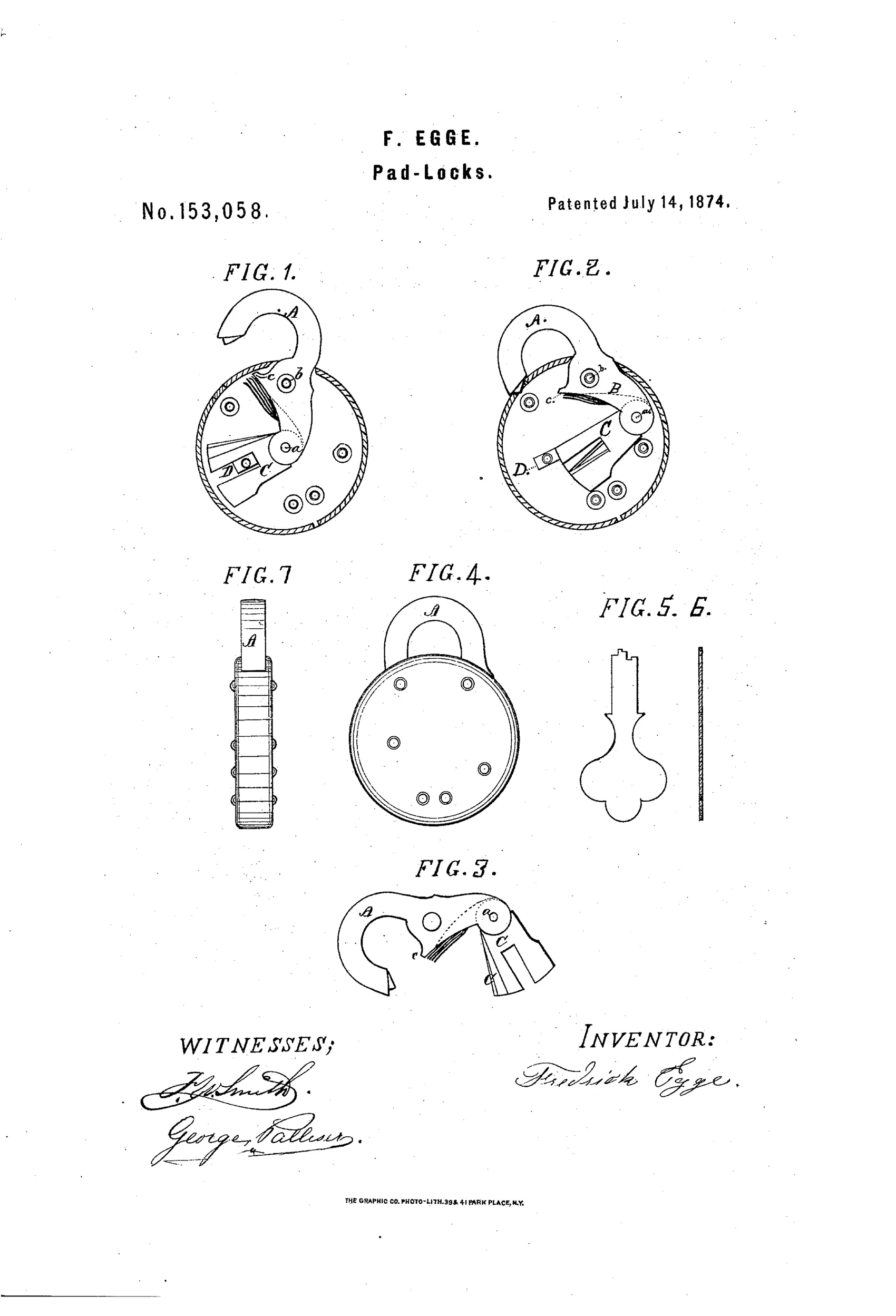
Improved spring-tumbler padlock with pivoted shackle
⚿ How it works
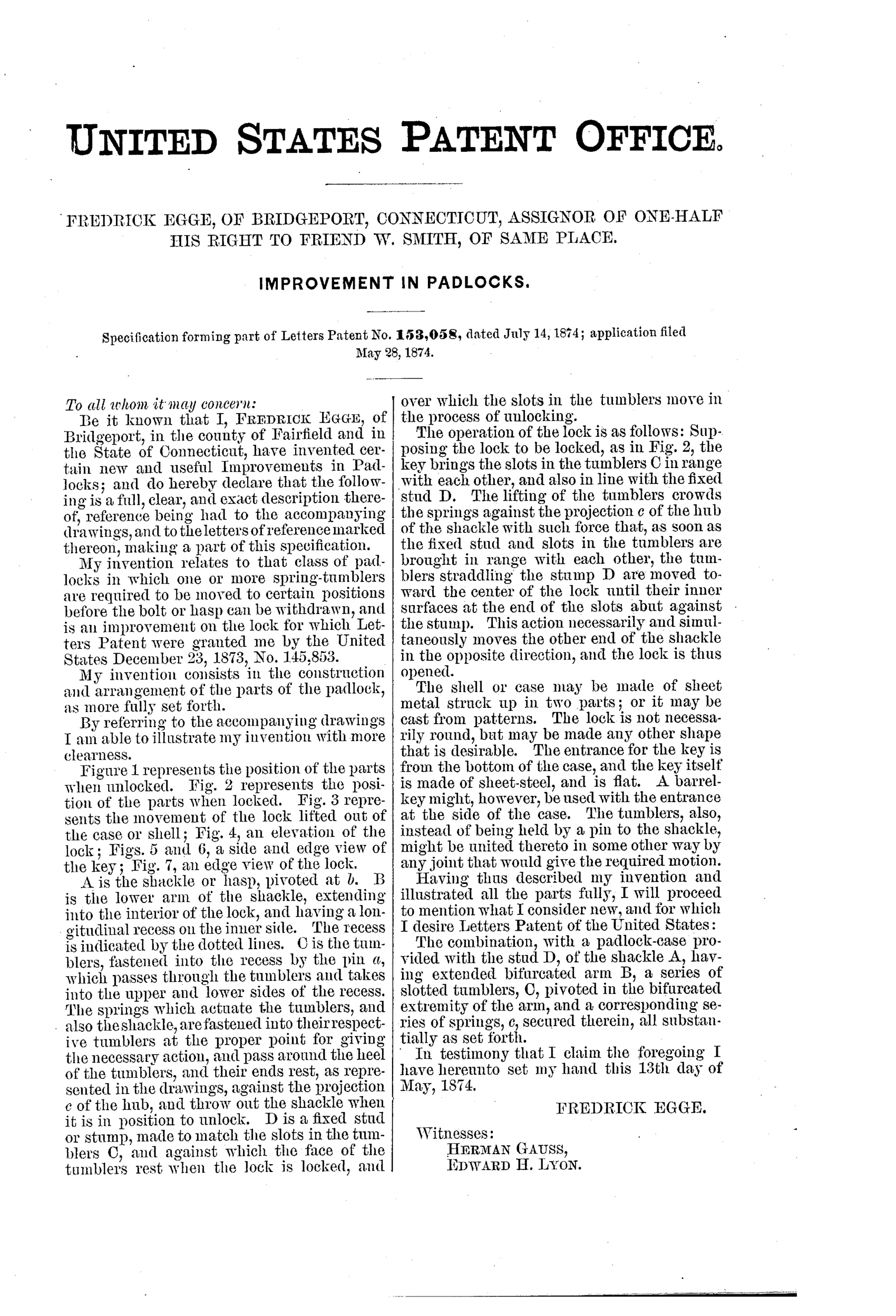
The shackle A is pivoted at b and has a bifurcated lower arm B extending into the lock case with a longitudinal recess on its inner side. Slotted tumblers C are pinned into this recess and pivot in the bifurcated arm, with springs pressing against a projection on the shackle hub to throw the shackle open when tumblers align. A fixed stud D matches the slots in the tumblers; when the flat sheet-steel key lifts the tumblers so their slots range with the stud and with each other, the springs force the tumblers toward the center until they abut the stud, simultaneously moving the shackle ends in opposite directions to unlock. The case may be sheet metal or cast, round or another shape, with the key entering from the bottom.
⚿ What was claimed
“The combination, with a padlock-case provided with the stud D, of the shackle A, having extended bifurcated arm B, a series of slotted tumblers, C, pivoted in the bifurcated extremity of the arm, and a corresponding series of springs, c, secured therein, all substantially as set forth.”
In plain English: The lock combines a case with a fixed stud, a pivoted shackle with a forked arm holding a set of slotted tumblers, and matching springs, all working together to lock and unlock the padlock.
⚿ In the inventor’s words
“My invention relates to that class of padlocks in which one or more spring-tumblers are required to be moved to certain positions before the bolt or hasp can be withdrawn, and is an improvement on the lock for which Letters Patent were granted me by the United States December 23, 1873, No. 145,853.”— Fredrick Egge, from the specification
Fate unknown
Smith & Egge of Bridgeport manufactured flat-key padlocks in quantity from the late 1870s, but I cannot confirm this specific 1874 mechanism reached production; a specimen matching the pivoted-shackle internals would settle it.
⚿ More by Fredrick Egge
- IMPROVEMENT IN PADLOCKS (1873)
⚿ Commentary
Most padlocks of the 1870s work the same way: tumblers gate a bolt, the bolt grips the shackle, and the key does the lifting. Egge inverts the architecture. Here the pivoted shackle carries its own tumblers — a stack of slotted plates pinned inside a forked arm that reaches down into the case — and the fixed part is just a stud on the case wall. The flat sheet-steel key lifts the tumblers until their slots line up with the stud, and then the tumbler springs themselves shove the whole assembly across and throw the shackle open. The lock literally springs open at the moment of alignment; there is no separate bolt to withdraw at all.
Compare Figures 1 and 2 and you can watch it happen: the shackle rocks on its pivot so both ends swing in opposite directions, one clearing the case notch as the other tucks in. Figure 3, with the mechanism lifted out whole, shows how few parts there really are — shackle, tumblers, springs, stud. That economy is the point. This is Egge refining his own patent of the previous December, and the half-interest assigned to Friend W. Smith is a clue to where it was headed: Smith and Egge would shortly go into the hardware business together in Bridgeport, and flat-key padlocks of exactly this stamped, cheap-to-build character were their stock in trade.
The weakness is the usual one for self-opening designs — those springs must fight dirt and frost for the life of the lock — but as a low-parts-count answer to the era's demand for inexpensive secure padlocks, it is a genuinely elegant piece of thinking.
Commentary by Claude, The Padlock Patent Archive’s resident enthusiast