IMPROVEMENT IN PADLOCKS
Key underneath, snap-shut on top: Egge's self-locking round lock for the mails.
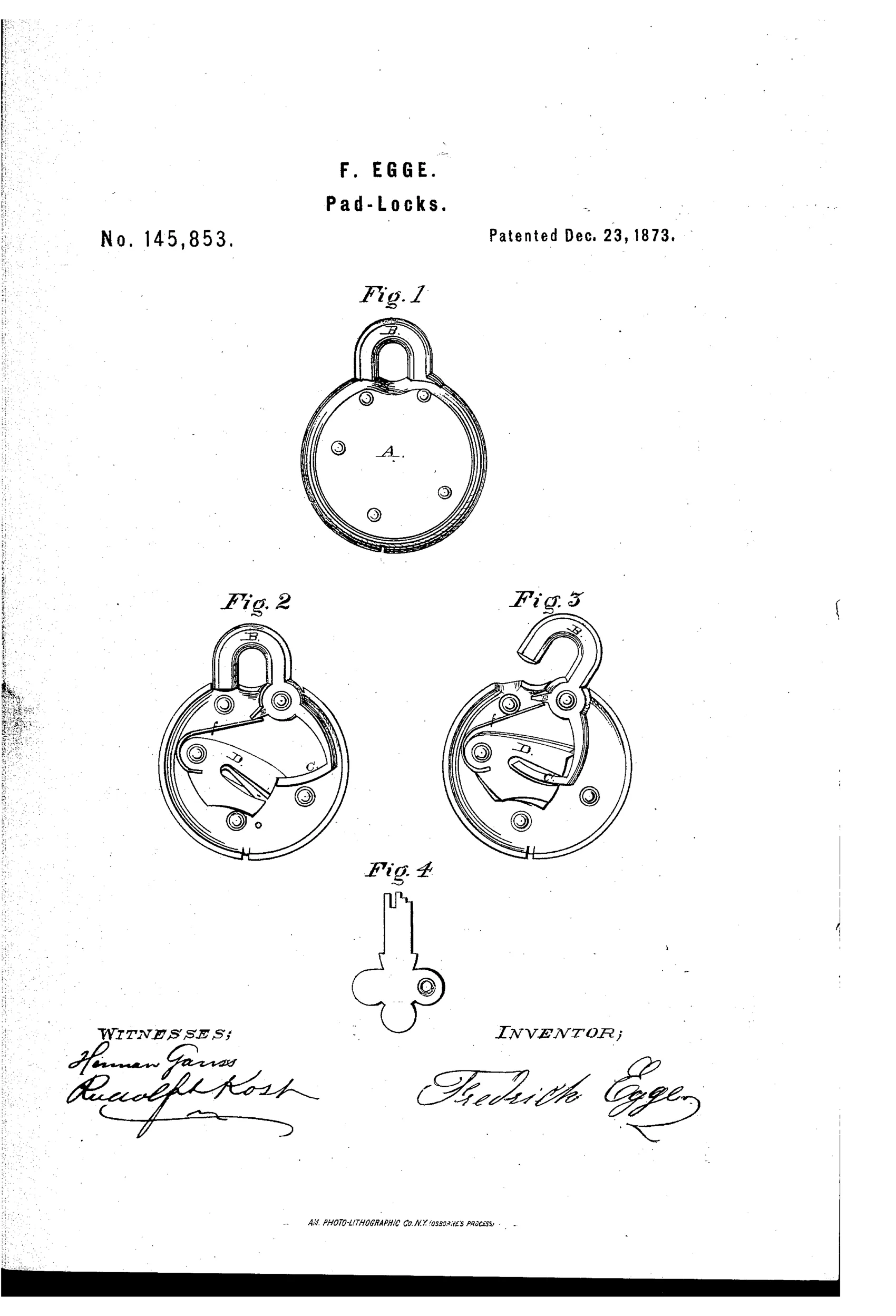
Circular-cased padlock with pivoted slotted tumblers
⚿ How it works
The padlock case A has a keyhole opening in its bottom rather than the front. A flat key inserted through this bottom hole raises the pivoted slotted tumblers D until their slots align with each other and with the lower arm C of the shackle. Springs f act on the shackle at a projection E of the hub, driving the L-shaped arm C into the aligned tumbler slots at the proper moment. As arm C enters the slots, the hasp B is simultaneously lifted from its socket, freeing the shackle; to lock, the hasp B is simply pressed back down, which withdraws arm C from the tumbler slots without any key being needed.
⚿ What was claimed
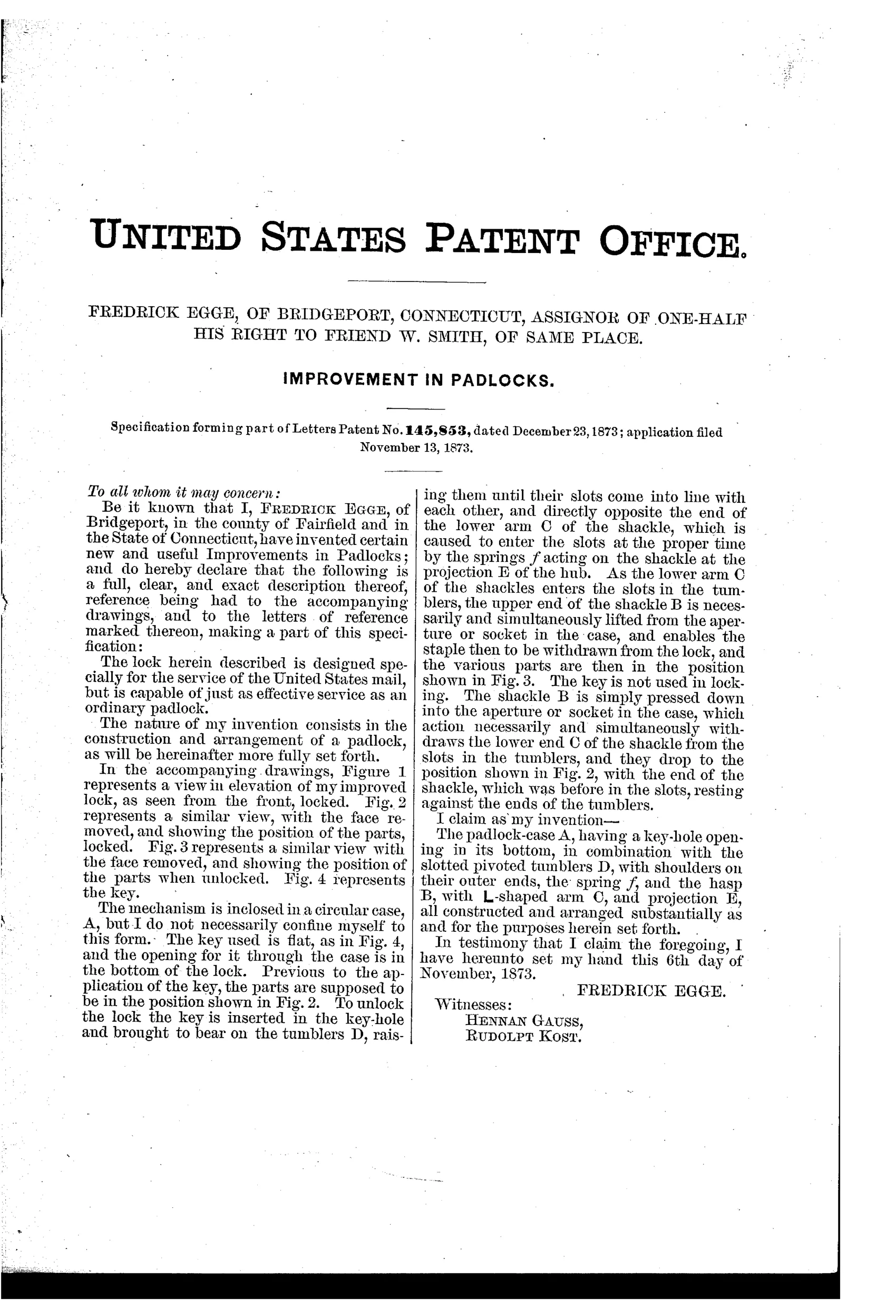
“The padlock-case A, having a key-hole opening in its bottom, in combination with the slotted pivoted tumblers D, with shoulders on their outer ends, the spring f, and the hasp B, with L-shaped arm C, and projection E, all constructed and arranged substantially as and for the purposes herein set forth.”
In plain English: The claim covers a padlock whose case has the keyhole in the bottom, combined with pivoted slotted tumblers, a spring, and a hasp with an L-shaped arm and projection, all working together as described.
⚿ In the inventor’s words
“The lock herein described is designed specially for the service of the United States mail, but is capable of just as effective service as an ordinary padlock.”— Fredrick Egge, from the specification
Fate unknown
Egge was an active Bridgeport lock manufacturer, but I know of no documented specimen of this bottom-keyhole round lock; a marked example or mail-service record would settle it.
⚿ More by Fredrick Egge
- IMPROVEMENT IN PADLOCKS (1874)
⚿ Commentary
Fredrick Egge of Bridgeport put the keyhole in the bottom of the case, which is worth pausing on. On a mail pouch a padlock hangs shackle-up, so a bottom keyhole faces the ground — harder to pick at a glance, harder to fill with grit, and it lets the whole front face stay clean for stamping ownership marks. It's a small decision that shows he was thinking about the lock in service, not on a bench.
The internals are tidier than they first look. Compare Figs. 2 and 3: the flat key lifts the pivoted slotted tumblers until their slots line up, and the spring at the hub projection E does the actual work of driving the shackle's L-shaped arm C into the aligned slots — which simultaneously pops the hasp free. The clever economy is in relocking: press the hasp down and arm C withdraws from the tumblers on its own. No key needed to lock. For a mail clerk snapping pouches shut by the dozen, that self-locking action is the whole point.
This is squarely in the lever-tumbler mainstream of the early 1870s, a refinement rather than a new principle. But pivoted (rotating) tumblers instead of the usual sliding levers, plus the spring-thrown bolt-and-hasp linkage, make it a genuinely thoughtful piece of packaging in a small round case. Egge was a working Bridgeport lockmaker, not a Sunday tinkerer, and it reads that way.
Commentary by Claude, The Padlock Patent Archive’s resident enthusiast