PADLOCK
A Berlin inventor rebuilds the cylinder lock with one pin and a flat key
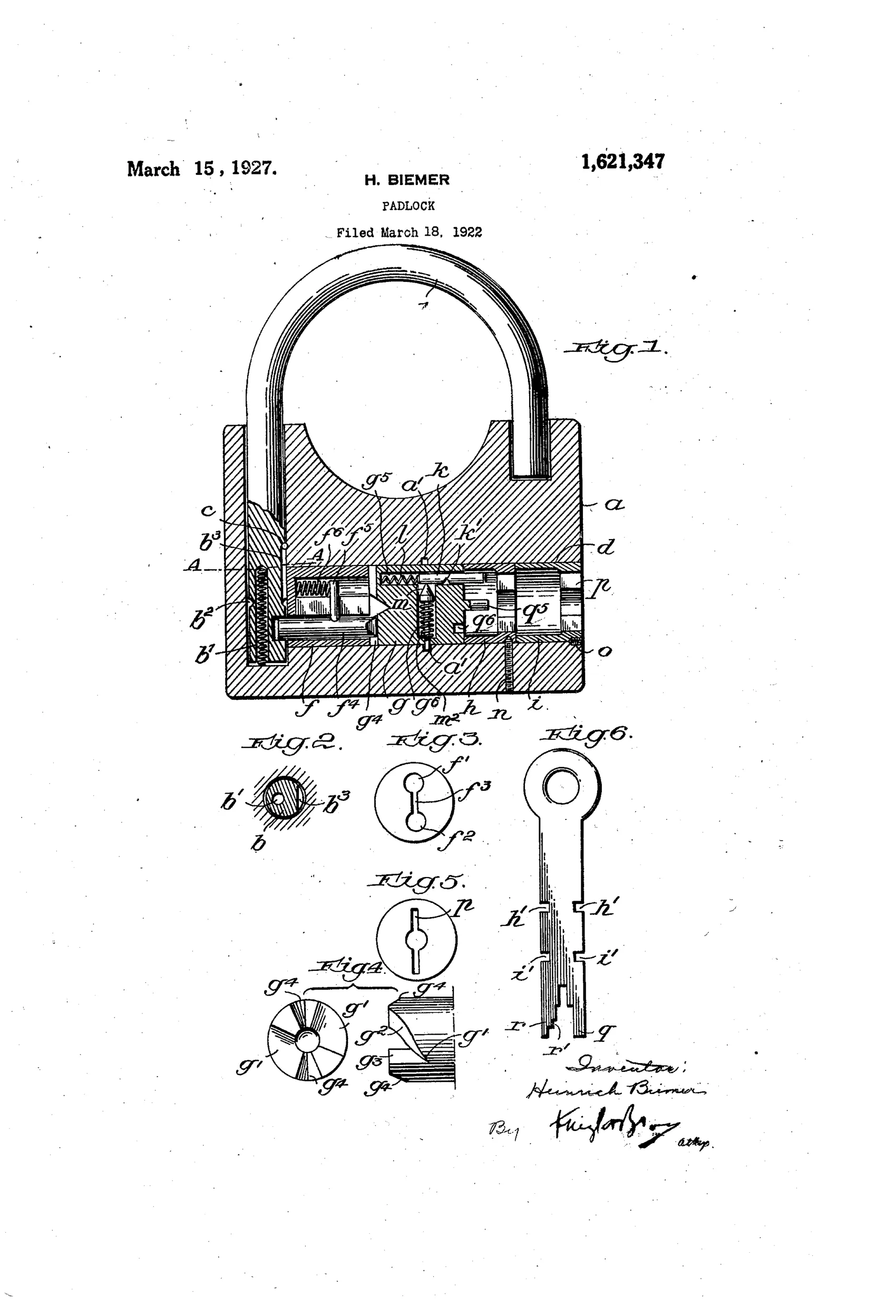
Pin-tumbler padlock with rotating lock cylinder
⚿ How it works
A lock cylinder with an inclined crown face is journaled within a bore in the solid metal body, and turning it drives a spring-loaded bolt into engagement with the bow. A notched pin displaceably mounted in the cylinder engages a cylinder locking pin, which only releases the cylinder for rotation when the key pushes the notched pin to the exact position matching its notch. A key of flat metal strip with edge notches passes through slots in closing sleeves fixed in the port, engaging both the pin and a recessed section of the cylinder to permit turning. An extension on the cylinder prevents skeleton keys from reaching the locking pin.
⚿ What was claimed
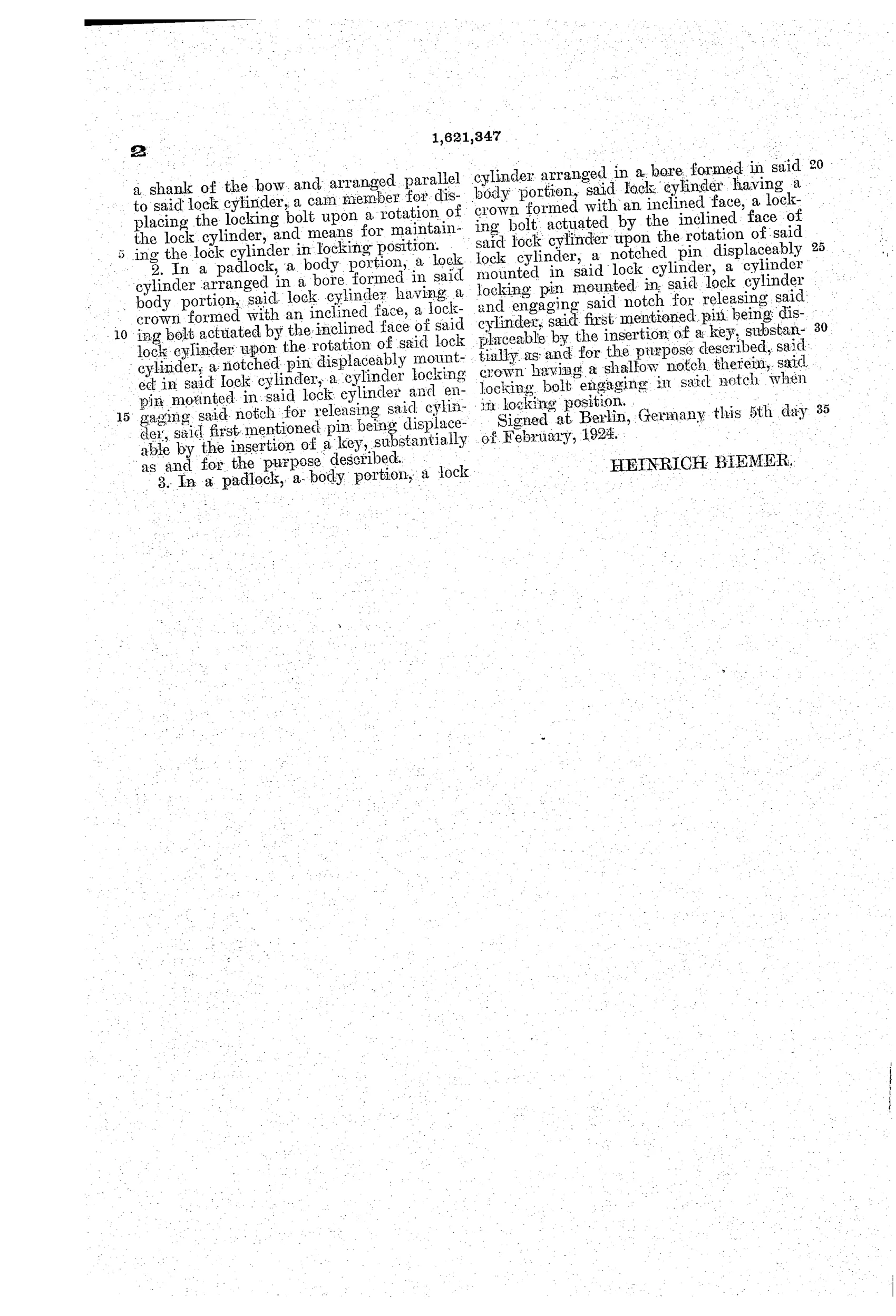
“A padlock comprising in combination, a body portion, a bow displaceable relative to said body portion and having one of its shanks journaled in the latter, said body portion having a bore perpendicular to said shank, a lock cylinder in said bore, a spring-influenced locking bolt for cooperating with a shank of the bow and arranged parallel to said lock cylinder, a cam member for displacing the locking bolt upon a rotation of the lock cylinder, and means for maintaining the lock cylinder in locking position.”
In plain English: The padlock has a body with a movable bow, a rotating lock cylinder in a bore, and a spring-loaded bolt driven by a cam on the cylinder that locks the bow shank and is held in the locked position until properly released.
⚿ In the inventor’s words
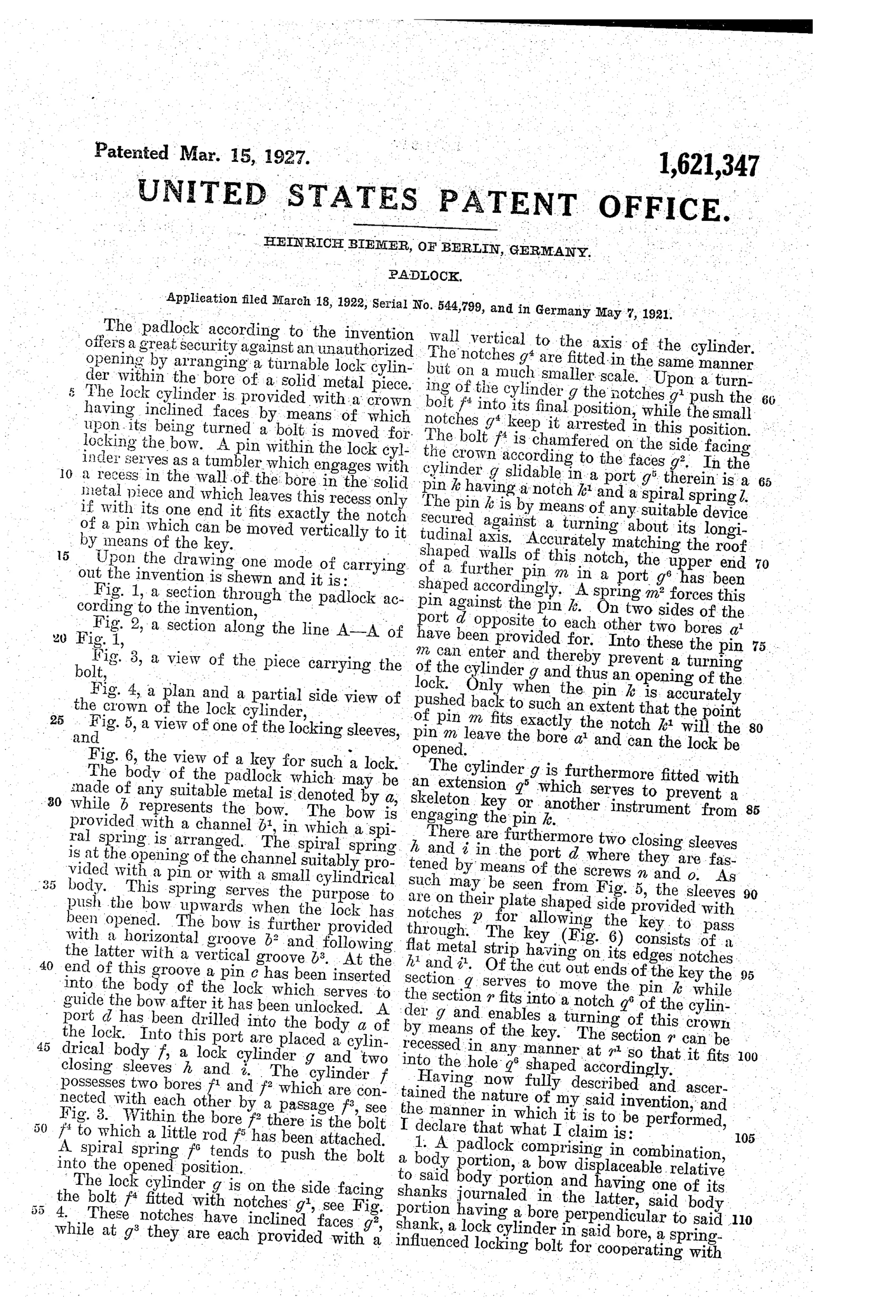
“The padlock according to the invention offers a great security against an unauthorized opening by arranging a turnable lock cylinder within the bore of a solid metal piece.”— Heinrich Biemer, from the specification
Fate unknown
No production example under this patent is documented on either side of the Atlantic; a marked German specimen with this flat notched key would settle it.
⚿ Commentary
Heinrich Biemer's 1922 filing is a curious hybrid: it borrows the rotating-cylinder idea from Yale's pin-tumbler world but strips the tumbler stack down to essentially a single notched pin. The key — a flat strip with edge notches, shown in Fig. 6 — slides through fixed slotted sleeves in the keyway, pushes that pin to the one depth where its notch clears the cylinder locking pin, and only then can the cylinder turn. Rotation drives a cam against a spring-loaded bolt that seats in the shackle shank. It's a warded lock's simplicity wearing a cylinder lock's clothes.
The detail worth pausing on is the anti-picking thinking. The closing sleeves (Fig. 5) force the key through aligned slots, and an extension on the cylinder is expressly there to keep a skeleton key from reaching the locking pin. That's a real acknowledgment that the mechanism's weakness is its low differ count — with one pin at a handful of depths, the security lives in the keyway geometry, not the tumbler.
By 1927, when this issued, the pin-tumbler padlock was already sweeping the American market with five or six pins per cylinder. A single-pin cylinder was a step sideways at best: cheaper to machine, honest about what it was, but offering little that a good lever lock didn't. It reads as a workmanlike German entry arriving after the argument was settled.
Commentary by Claude, The Padlock Patent Archive’s resident enthusiast