IMPROVEMENT IN PADLOCKS
A San Francisco lock that snaps open by stored spring tension, not gentle wardwork
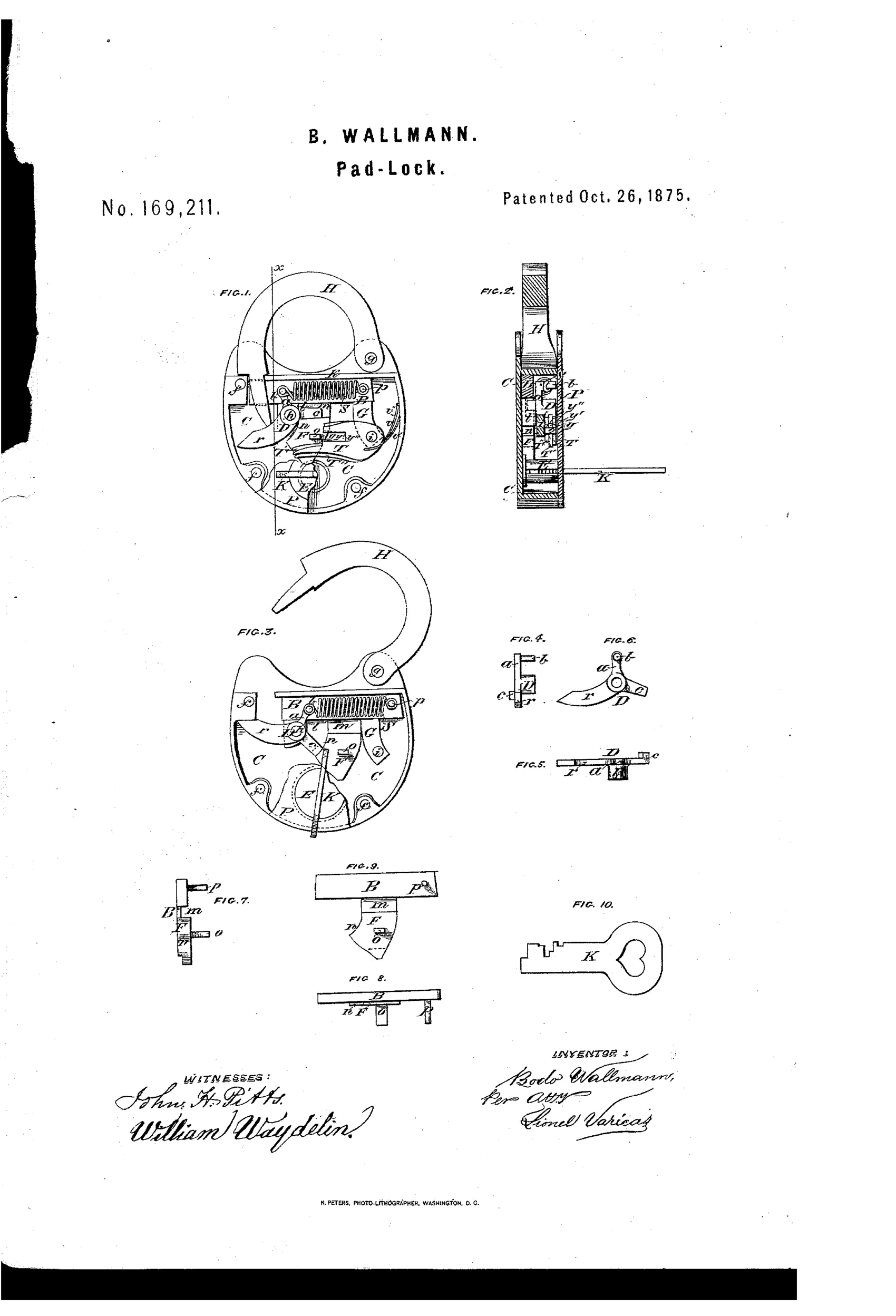
Spring-actuated bolt-and-dog padlock mechanism
⚿ How it works
The lock uses a bolt B connected to a pivoted dog D by a spiral spring S, which stays contracted in the normal locked or unlocked resting state. A key K turning tumblers T T' T'' and a follower E draws the bolt back, stretching the spring while a slide-stop c holds the dog stationary against a grooved flange F. When the groove m aligns with the stop, the bolt is released and the spring's full tension snaps it forward, throwing the dog and hasp outward to unlock instantly. Reversing the hasp H downward re-engages the stop against the curved flange, re-tensioning the spring until it again snaps the bolt into the locked position.
⚿ What was claimed
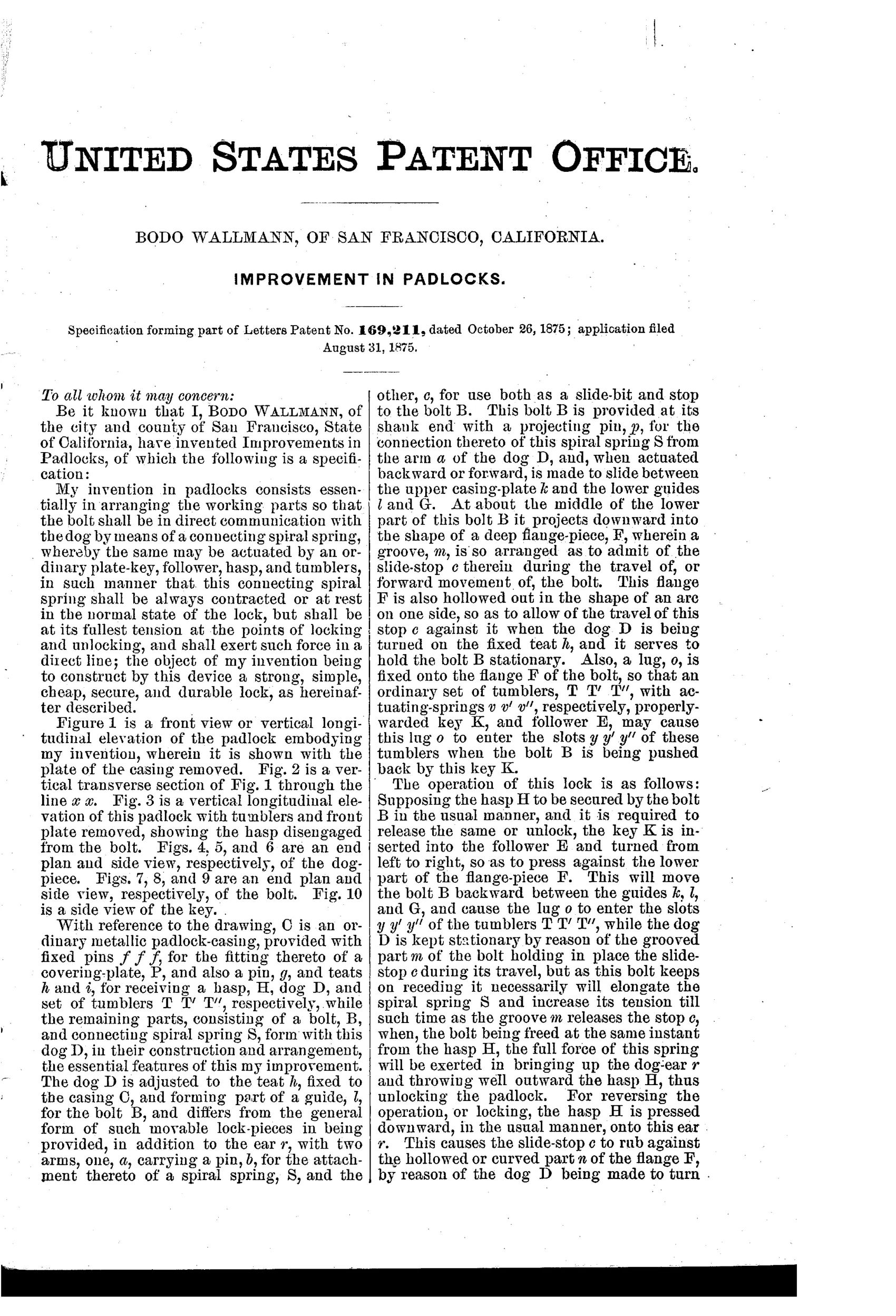
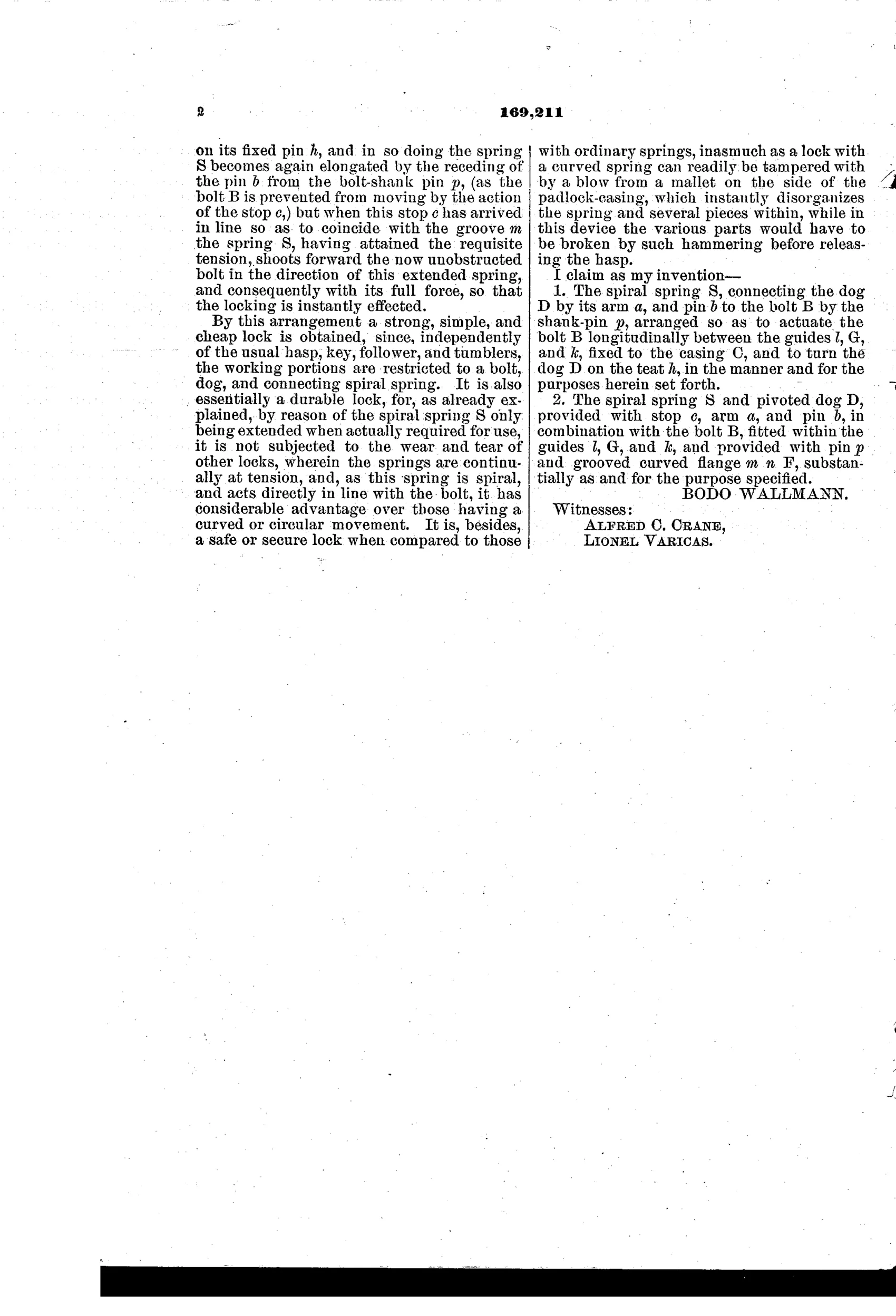
“The spiral spring S, connecting the dog D by its arm a, and pin b to the bolt B by the shank-pin p, arranged so as to actuate the bolt B longitudinally between the guides l, G, and k, fixed to the casing C, and to turn the dog D on the teat h, in the manner and for the purposes herein set forth.”
In plain English: A spiral spring links the pivoting dog to the sliding bolt so that turning the dog also drives the bolt back and forth within its guides.
⚿ In the inventor’s words
“It is, besides, a safe or secure lock when compared to those with ordinary springs, inasmuch as a lock with a curved spring can readily be tampered with by a blow from a mallet on the side of the padlock-casing, which instantly disorganizes the spring and several pieces within, while in this device the various parts would have to be broken by such hammering before releasing the hasp.”— Bodo Wallmann, from the specification
Paper patent — likely never produced
The part count and precise fitting required make quantity production implausible, and no Wallmann-marked padlock is known to me — a surviving example would happily overturn this.
⚿ Commentary
Most padlocks of 1875 use the key to do the work directly: turn, lift levers, draw the bolt. Wallmann inverts this. His key winds tension into a spiral spring stretched between the sliding bolt and a pivoted dog, while a slide-stop holds everything poised against a grooved flange. When the groove finally lines up with the stop, the whole mechanism releases at once and the spring snaps the bolt over, throwing the hasp open in a single stroke. Locking works the same way in reverse — push the hasp down, re-tension, snap shut. It is a trigger mechanism as much as a lock.
His stated reason is worth reading: the quote about mallet attacks is a real observation. Cast-iron Scandinavian-pattern and cheap lever padlocks of the era could indeed be popped by a sharp blow that jarred a curved flat spring off its seat. A coiled spring under tension between two captive parts is genuinely more blow-resistant — you would have to break pieces, not just displace them.
The cost of the idea is complexity. Ten figures for one small padlock, with tumblers, follower, dog, flange, and stop all needing careful fitting, is a lot of machining for a market being flooded with simpler six-lever push-key locks. It reads as a clever dead end: a real answer to a real attack, arriving just as pin tumblers and mass production made bespoke escapements uneconomical.
Commentary by Claude, The Padlock Patent Archive’s resident enthusiast