LOCK AND KEY
In 1840, an Englishman patents the pin-tumbler idea in slider form — twenty years before Yale.
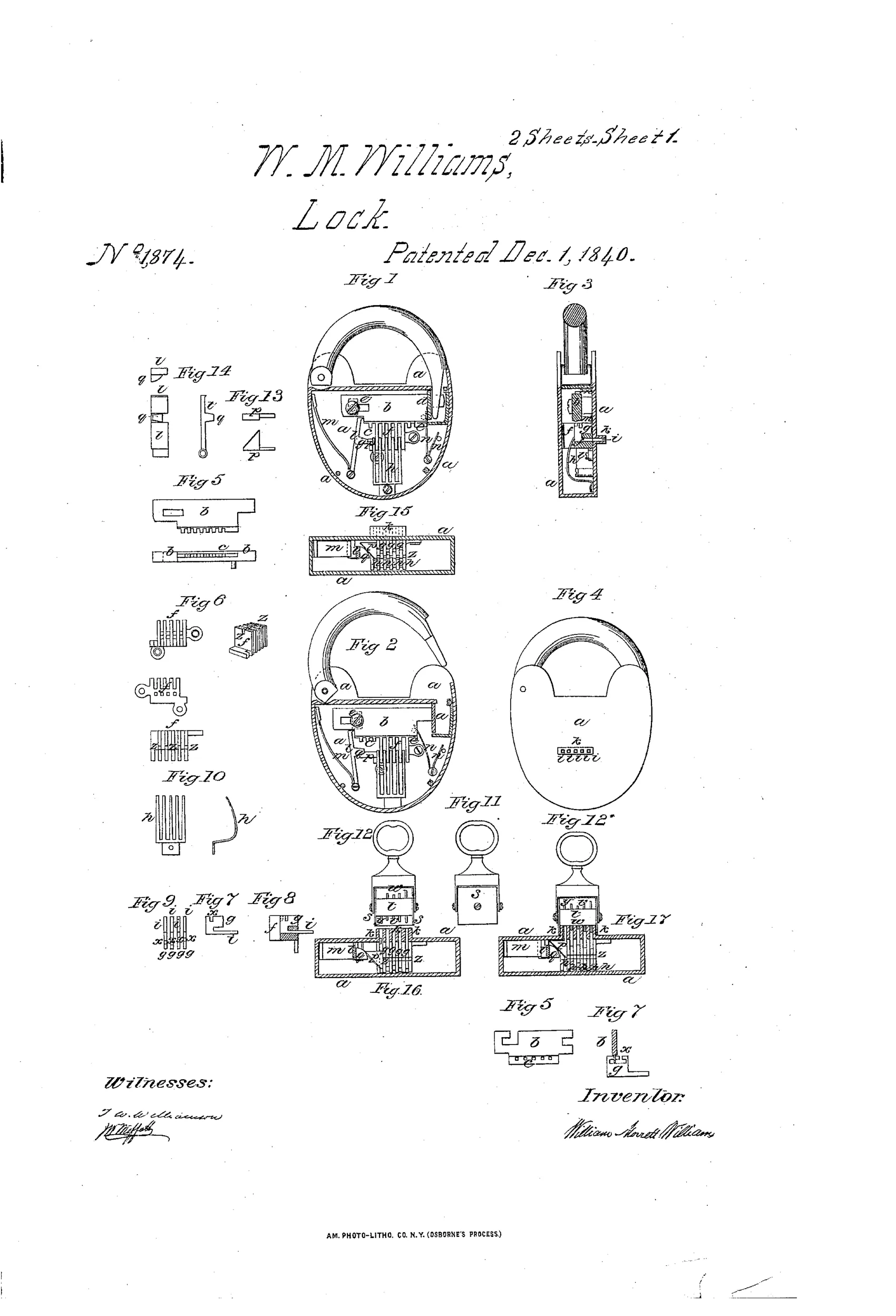
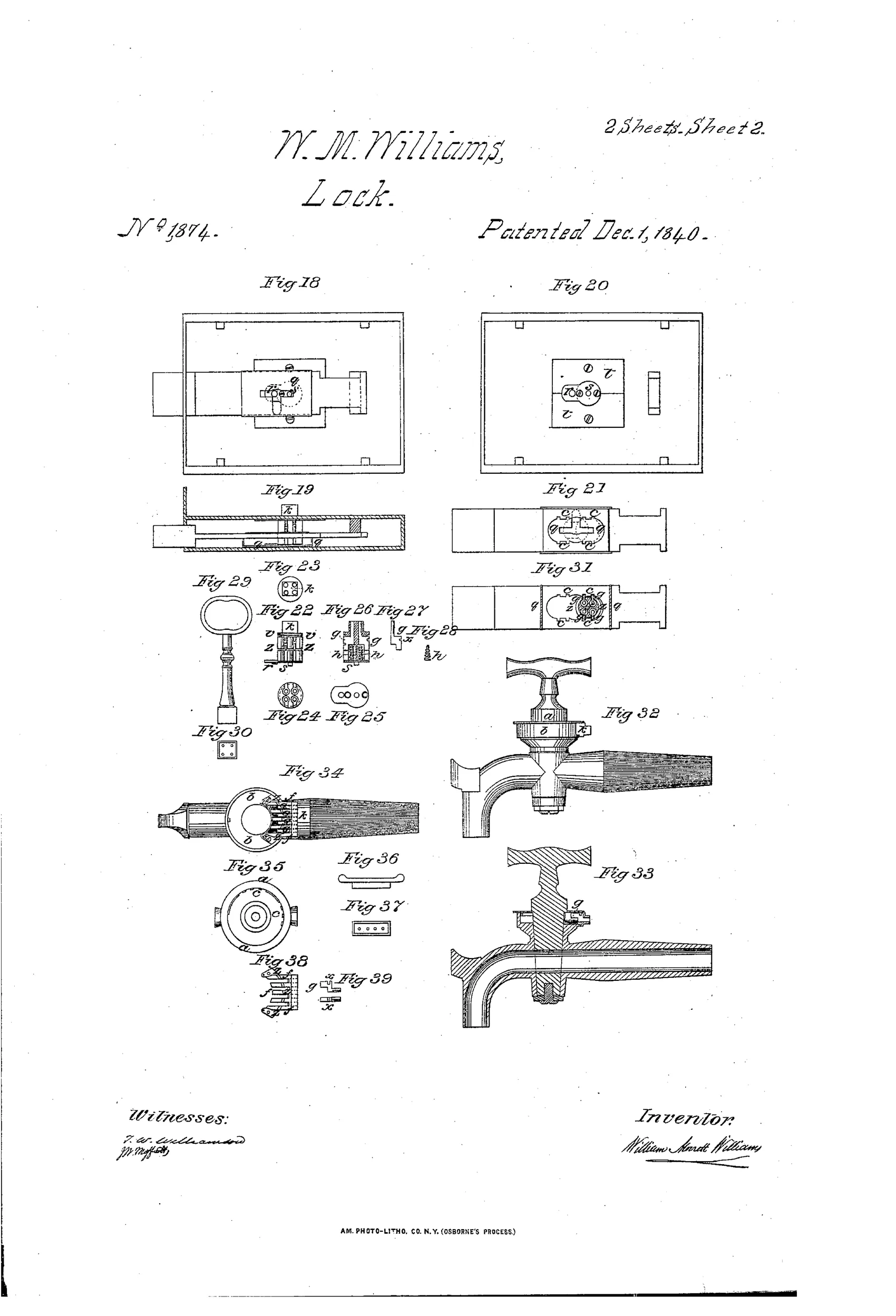
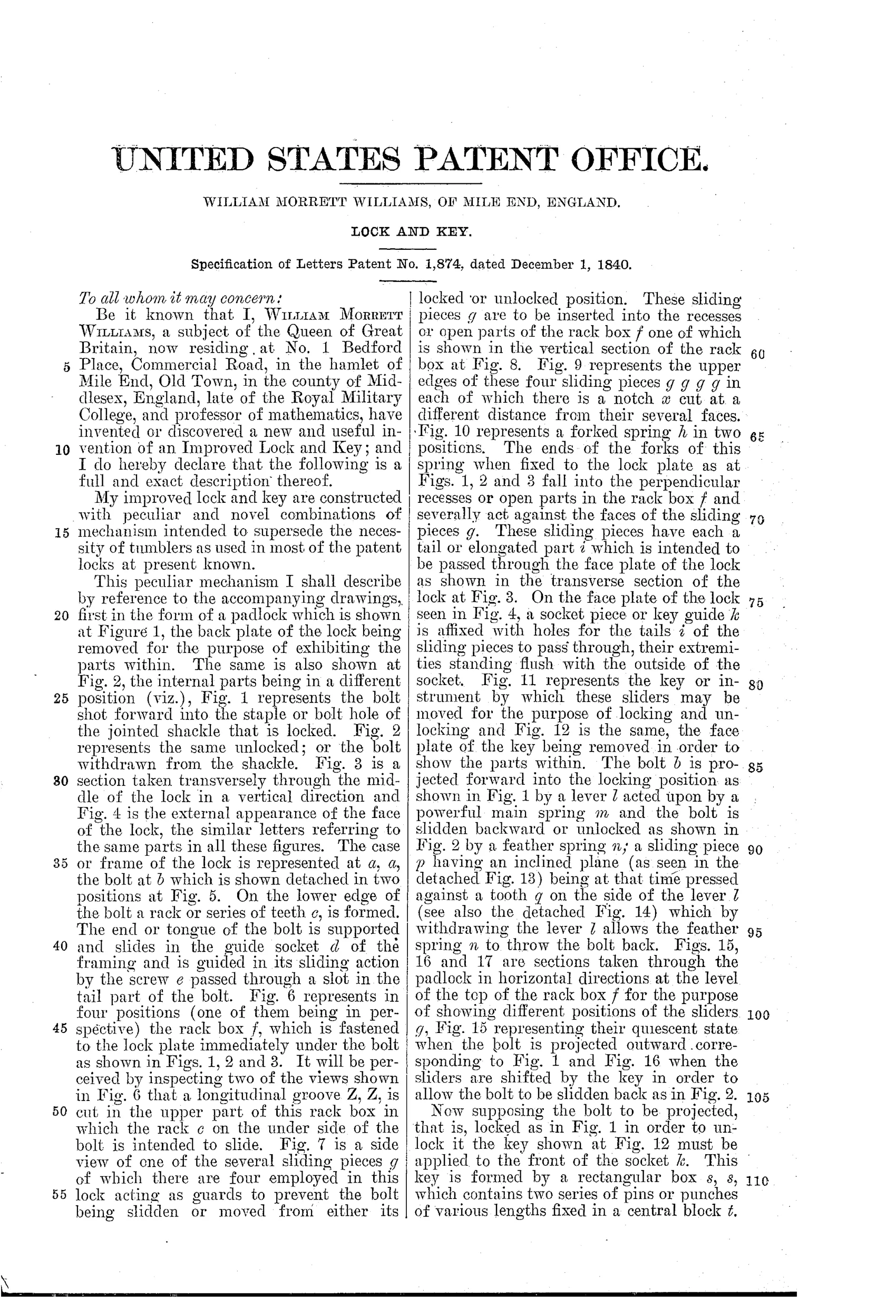
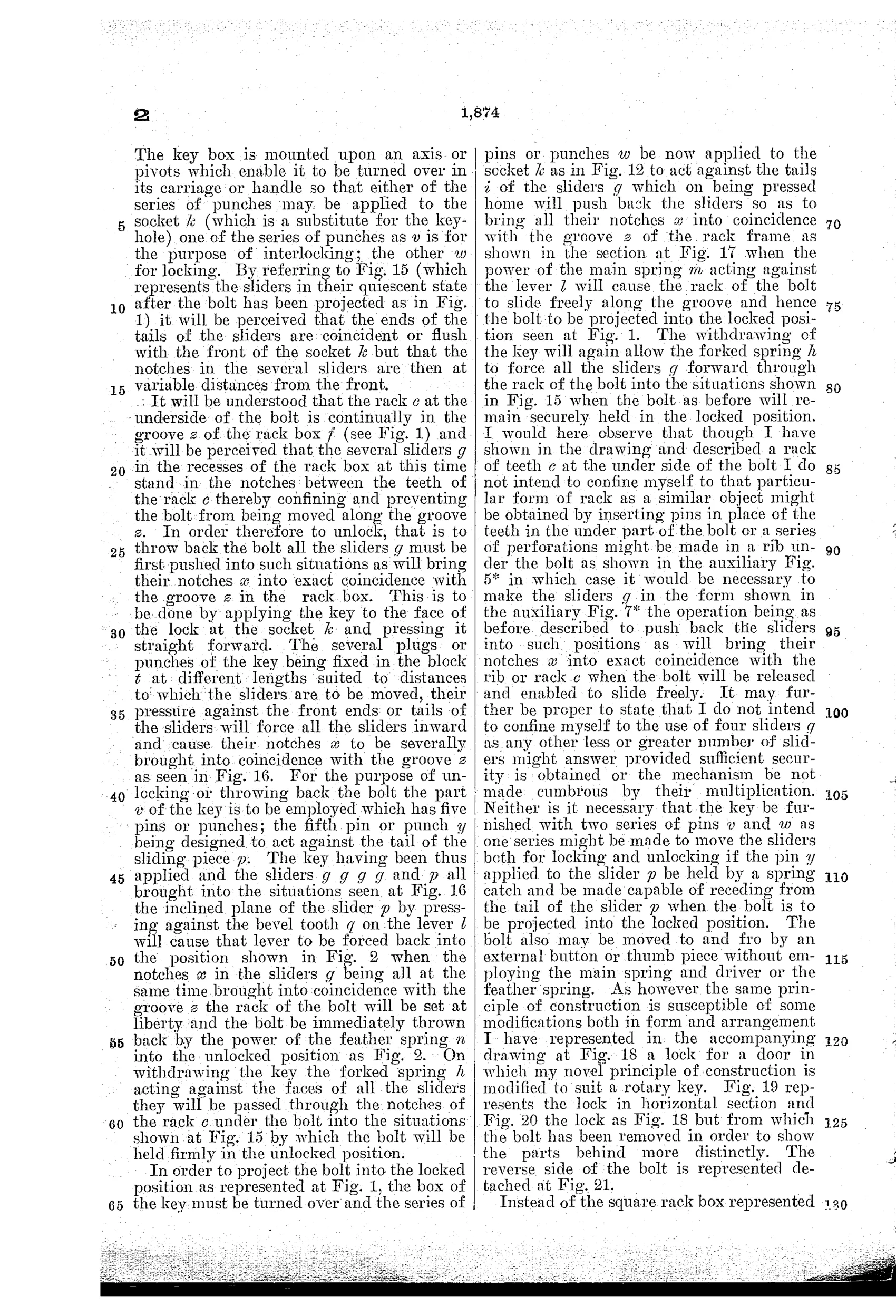
Pickproof lock using sliding stop-pieces instead of tumblers
⚿ How it works
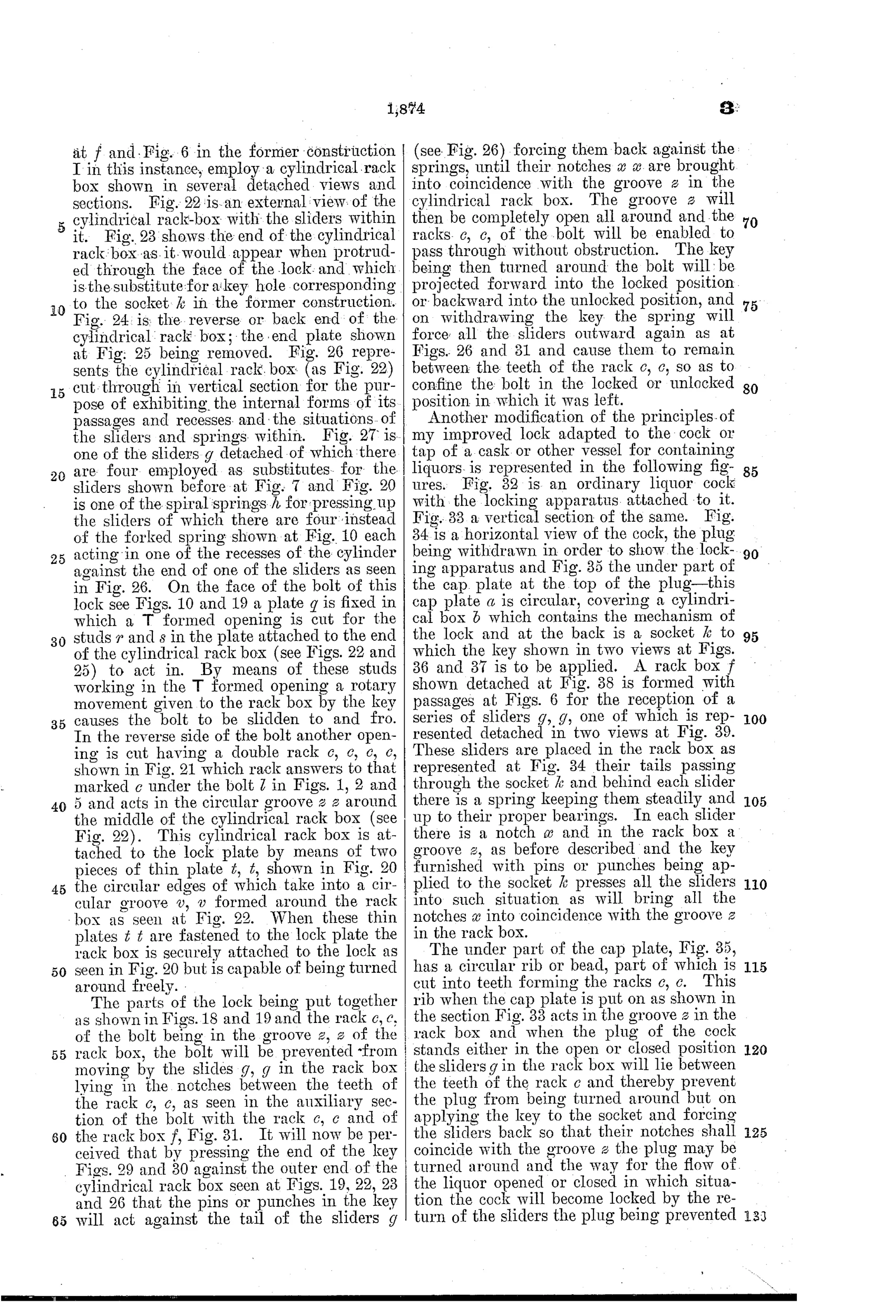
A toothed rack on the underside of the bolt slides in a grooved rack box, and a set of spring-loaded sliders each carrying a notch normally engage the rack teeth to block bolt movement. A special key applies pins of varying lengths to the tails of the sliders, pushing each one a precise distance so that all their notches simultaneously align with the rack-box groove, freeing the bolt to slide. Withdrawing the key lets a forked or coiled spring push the sliders back through the rack teeth, relocking the bolt in whatever position it was left. The same rack-and-slider principle is adapted to a padlock, a rotary-key door lock, and a liquor cock/tap locking mechanism.
⚿ What was claimed
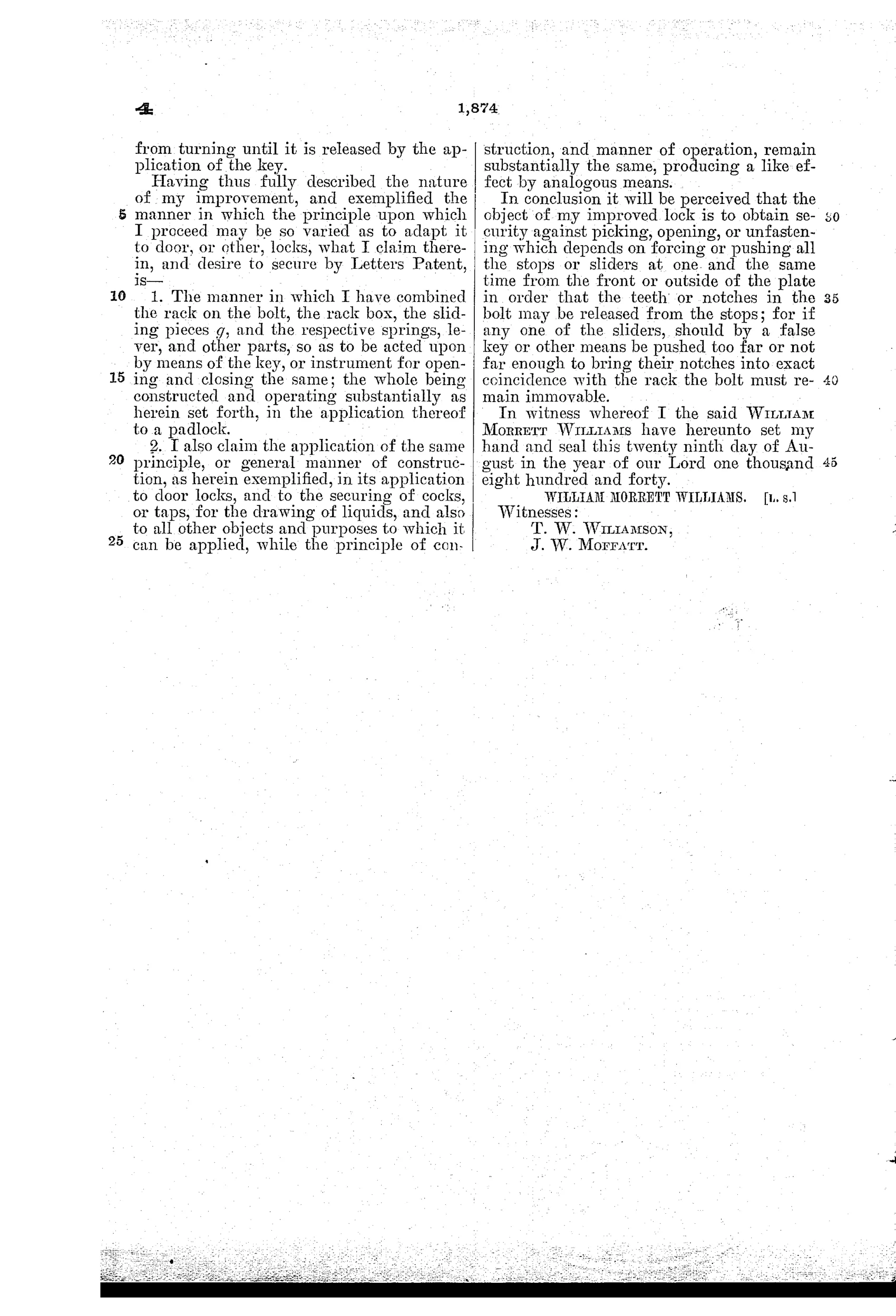
“The manner in which I have combined the rack on the bolt, the rack box, the sliding pieces g, and the respective springs, lever, and other parts, so as to be acted upon by means of the key, or instrument for opening and closing the same; the whole being constructed and operating substantially as herein set forth, in the application thereof to a padlock.”
In plain English: The claim covers the specific combination of a toothed rack on the bolt, a matching rack box, spring-loaded sliding pieces, and a lever, all operated together by a specially cut key to lock and unlock a padlock.
⚿ In the inventor’s words
“the object of my improved lock is to obtain security against picking, opening, or unfastening which depends on forcing or pushing all the stops or sliders at one and the same time from the front or outside of the plate in order that the teeth or notches in the bolt may be released from the stops; for if any one of the sliders, should by a false key or other means be pushed too far or not far enough to bring their notches into exact coincidence with the rack the bolt must remain immovable.”— William Morrett Williams, from the specification
Paper patent — likely never produced
The graduated multi-pin key and close-tolerance sliders would have been costly to make in 1840, and no manufactured example of this design is documented.
⚿ Commentary
Look past the crowded sheet and the core idea is startlingly modern: a row of sliding stops, each of which must be pushed exactly the right distance — no more, no less — before the bolt can move. Williams says it plainly in the specification: if any one slider is pushed too far or not far enough, the bolt stays put. That is the security logic of the pin-tumbler lock, stated in 1840, two decades before Linus Yale Jr. made it the standard of the industry. The lineage runs back through Bramah's sliders in England, and Williams — writing from Mile End, London, but patenting in America — is clearly working in that tradition.
The execution is where it strains. Figures 15 through 17 show the sequence: sliders at rest blocking the rack teeth, sliders shifted by the multi-pin key, then the moment of alignment when the bolt runs free. The key (Figs. 11 and 12) carries pins of graduated length, one per slider — effectively a fixed-combination pusher, expensive to cut and easy to lose tolerance on. And a rack-toothed bolt means the lock can relock in any position, a genuinely thoughtful touch.
The patent then sprawls: a rotary-key door lock, and — my favorite oddity — a locking liquor cock, so the publican's cask stays honest. Thirty-nine figures for one claim. Ambitious, prescient, and almost certainly ahead of what 1840 workshops would profitably build.
Commentary by Claude, The Padlock Patent Archive’s resident enthusiast