IMPROVEMENT IN PADLOCKS
Two locks on one shackle, assigned to a Cincinnati railroad supplier
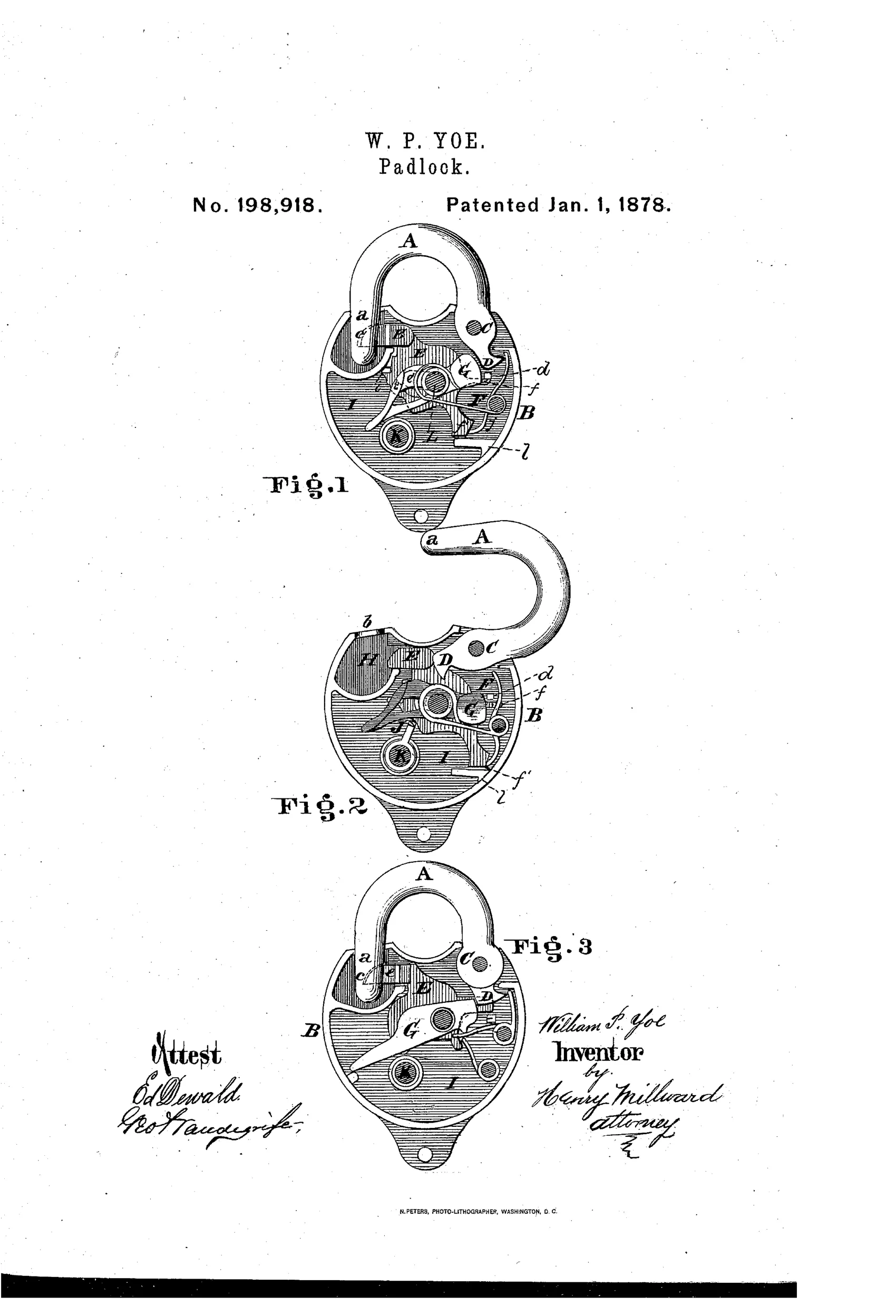
Double-locking swinging-dog padlock mechanism
⚿ How it works
A pivoted shackle A is thrown open automatically by a projection D acting against a spring F when released. A reciprocating spring-bolt E moves in a straight line and engages a recess in the shackle's shank to secure it. A swinging spring-dog G, positioned in front of a rear projection on the shackle, works together with a shoulder on the lock-bolt to doubly lock the shackle closed. A key J turning on pin K first releases the dog G, then withdraws the lock-bolt E, allowing the spring to throw the shackle open.
⚿ What was claimed
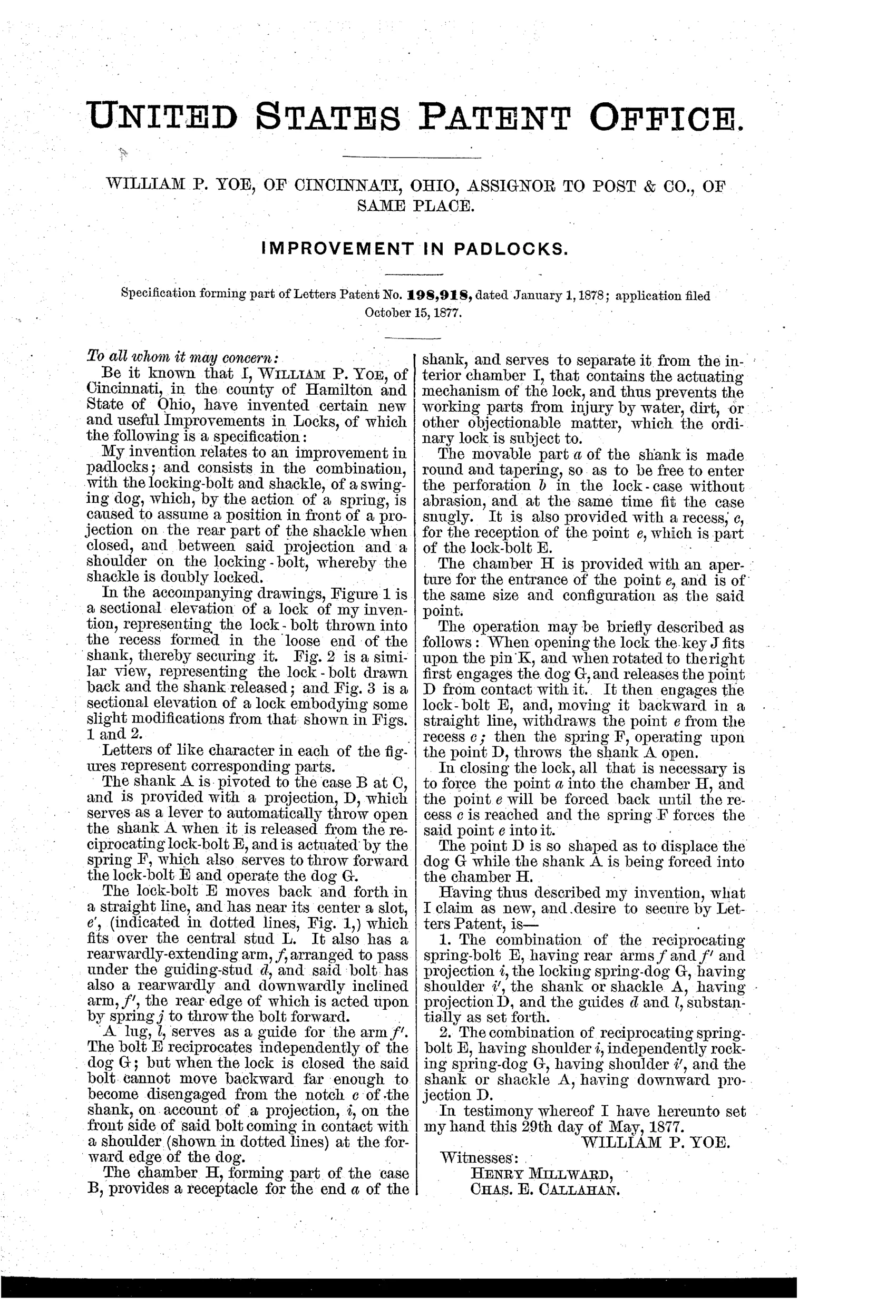
“The combination of the reciprocating spring-bolt E, having rear arms f and f' and projection i, the locking spring-dog G, having shoulder i', the shank or shackle A, having projection D, and the guides d and l, substantially as set forth.”
In plain English: The claim covers the combined design of a spring-loaded lock bolt with arms and a projection, a spring-loaded locking dog with a shoulder, and a shackle with a downward projection, all working together with guide pieces to secure the lock.
⚿ In the inventor’s words
“and thus prevents the working parts from injury by water, dirt, or other objectionable matter, which the ordinary lock is subject to.”— William P. Yoe, from the specification
Fate unknown
The assignment to Post & Co., an active railroad-supply house, suggests real intent to produce, but no marked specimen matching this mechanism is documented; one would settle it.
⚿ Commentary
Yoe's idea is redundancy. Most padlocks of the day held the shackle with a single bolt or spring-dog; here the shackle heel is caught twice — once by the reciprocating spring-bolt E dropping into a recess in the shank, and again by the swinging dog G bearing against a rear projection. The key does its work in sequence: first it lifts the dog, then it draws the bolt, and only then does the spring F kick the shackle open on its own. Compare Figs. 1 and 2 and you can watch that sequence frozen mid-stroke — the bolt seated in the shank recess in one, withdrawn with the shackle sprung clear in the other.
The self-opening shackle is the practical touch. A lock that pops open the instant the key turns is a lock you can work one-handed with a lantern in the other, which is exactly the use case the assignee suggests. Post & Co. of Cincinnati was a supplier of railroad hardware, and Yoe's own selling point — sealing the works against "water, dirt, or other objectionable matter" — reads like a pitch for switch and signal service.
Mechanically it's sound but not novel in its parts; pivoted shackles, spring-dogs, and thrown-open shackles all existed. The combination claim tells you the inventor knew it. This is a workmanlike refinement aimed at a specific, weather-beaten market rather than a new principle.
Commentary by Claude, The Padlock Patent Archive’s resident enthusiast