PADLOCK.
The one-piece spring-tumbler that helped launch Slaymaker's Lancaster lock works
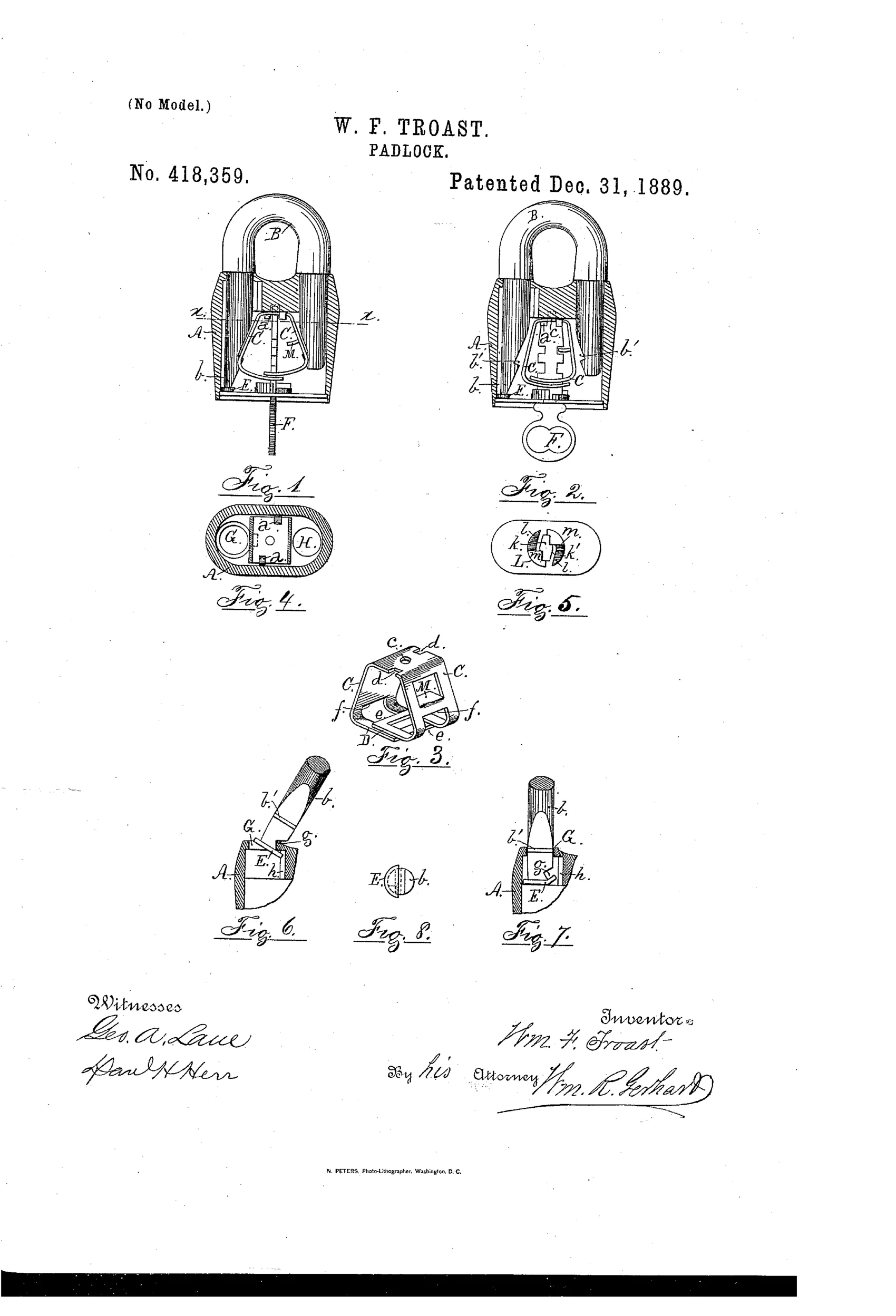
A u-shaped shackle spring-tumbler padlock.
⚿ How it works
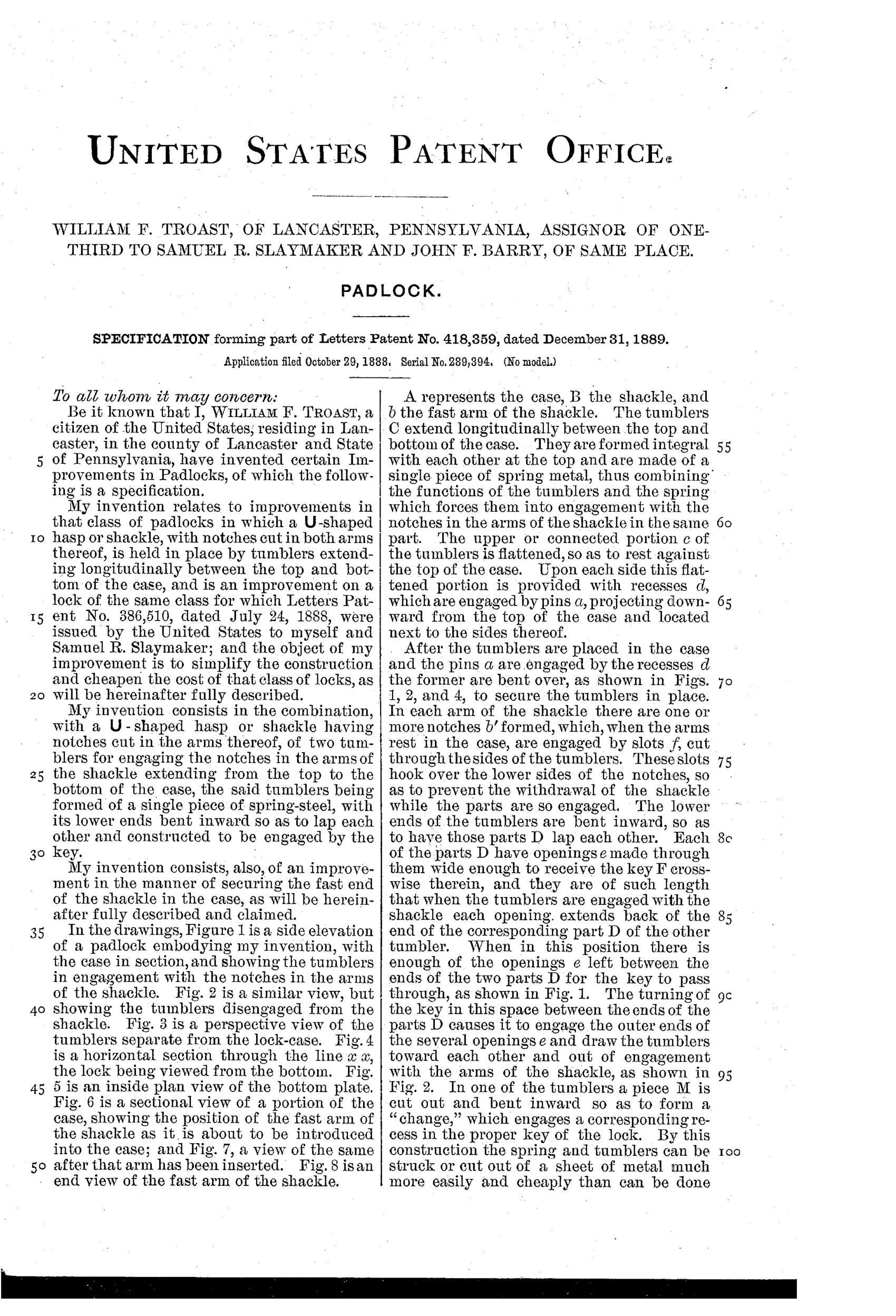
A U-shaped shackle with notches in both arms is held by two spring-steel tumblers extending from the top to the bottom of the case, formed integral at the top as a single piece of spring metal that also acts as the spring. Slots cut through the tumblers hook over the notches in the shackle arms to lock it in place, while the lower ends of the tumblers are bent inward to overlap and are engaged and drawn together by the key inserted crosswise through openings in the overlapping parts. One tumbler contains a stamped-out 'change' piece that engages a corresponding recess in the proper key, providing a simple keying feature. The fast arm of the shackle is secured in the case by a semi-annular flange that is inserted diagonally through an opening and then bent inward to prevent accidental withdrawal.
⚿ What was claimed
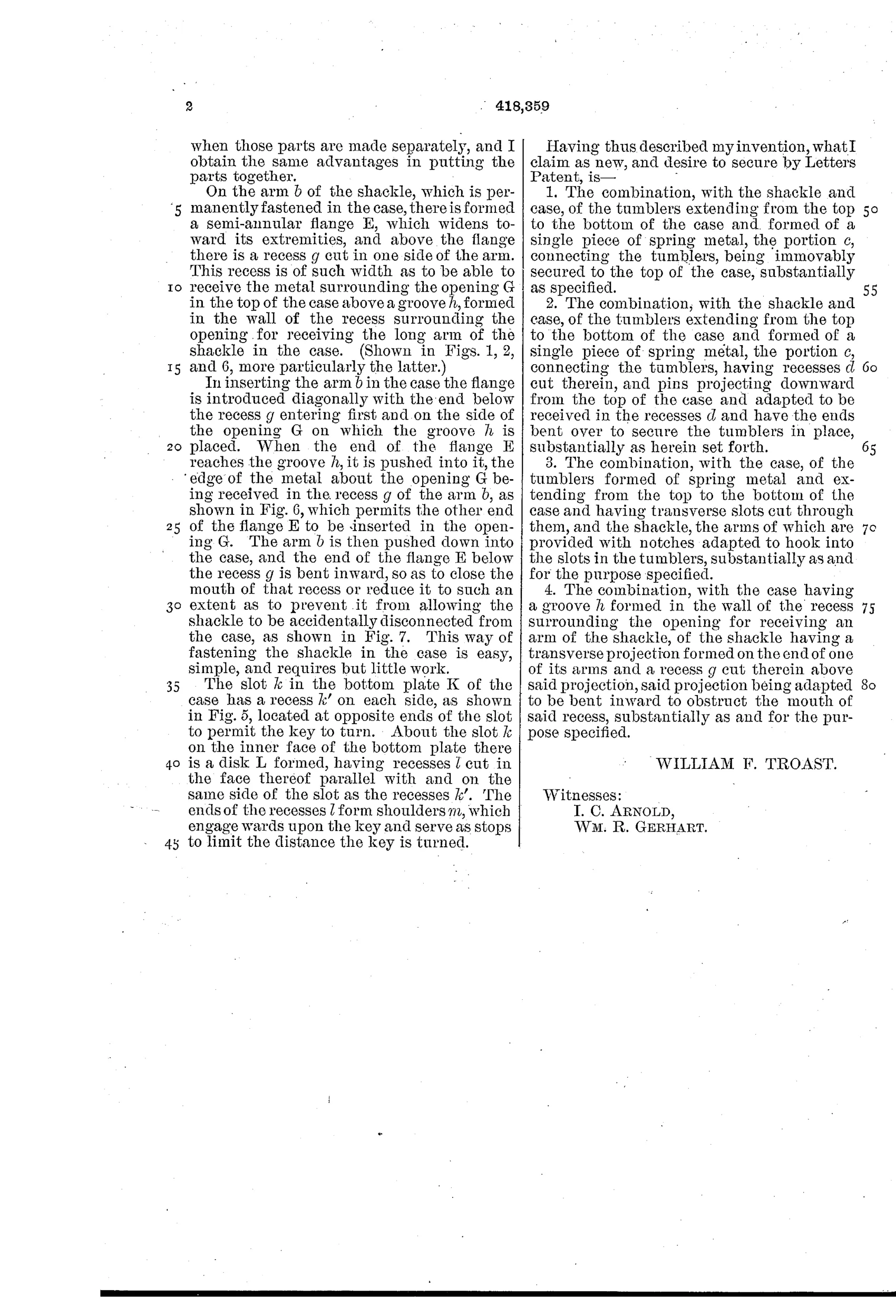
“The combination, with the shackle and case, of the tumblers extending from the top to the bottom of the case and formed of a single piece of spring metal, the portion c, connecting the tumblers, being immovably secured to the top of the case, substantially as specified.”
In plain English: The lock combines a shackle and case with tumblers made from one piece of spring metal that runs from top to bottom of the case, with its connecting portion fixed permanently to the case top.
⚿ In the inventor’s words
“By this construction the spring and tumblers can be struck or cut out of a sheet of metal much more easily and cheaply than can be done when those parts are made separately, and I obtain the same advantages in putting the parts together.”— William F. Troast, from the specification
Manufactured and sold
The assignment to Slaymaker and Barry, who built a major Lancaster padlock manufactory on exactly this class of stamped spring-tumbler lock, makes production of the design or its direct descendants well established.
⚿ More by William F. Troast
- PADLOCK. (1888)
⚿ Commentary
The assignment line is the tell here: one-third each to Samuel R. Slaymaker and John F. Barry of Lancaster, Pennsylvania. Those two names shortly became Slaymaker-Barry, one of the great volume producers of cheap, sturdy American padlocks. Troast's patent reads exactly like a founding document for that business — not a security breakthrough, but a manufacturing one.
The mechanical idea is disarmingly simple. Both tumblers and their spring are stamped from a single strip of spring steel, folded into the saddle shape shown in Fig. 3, and riveted to the case top. The strip's own resilience holds the slotted tumblers hooked into notches on both shackle legs; the key, pushed in crosswise at the bottom, squeezes the overlapped tumbler ends together and lets the shackle go. One stamped-out 'change' tab gives a token keying difference. Troast says it plainly in the specification: the point is that these parts can be 'struck or cut out of a sheet of metal' cheaper than separate springs and tumblers — a factory man's claim, not a locksmith's.
Notice also Figs. 6-8, the diagonal-insert, bend-to-retain fast shackle arm — another assembly shortcut, eliminating a pin or rivet. Security-wise it's modest; any flat probe that spreads the tumbler ends would open it. But as an ancestor of the flood of pressed-steel push-key padlocks that armed America's barns and toolboxes, it earns its place.
Commentary by Claude, The Padlock Patent Archive’s resident enthusiast