PADLOCK.
Pull harder and the dog wedges tighter — a self-defeating trap for burglars
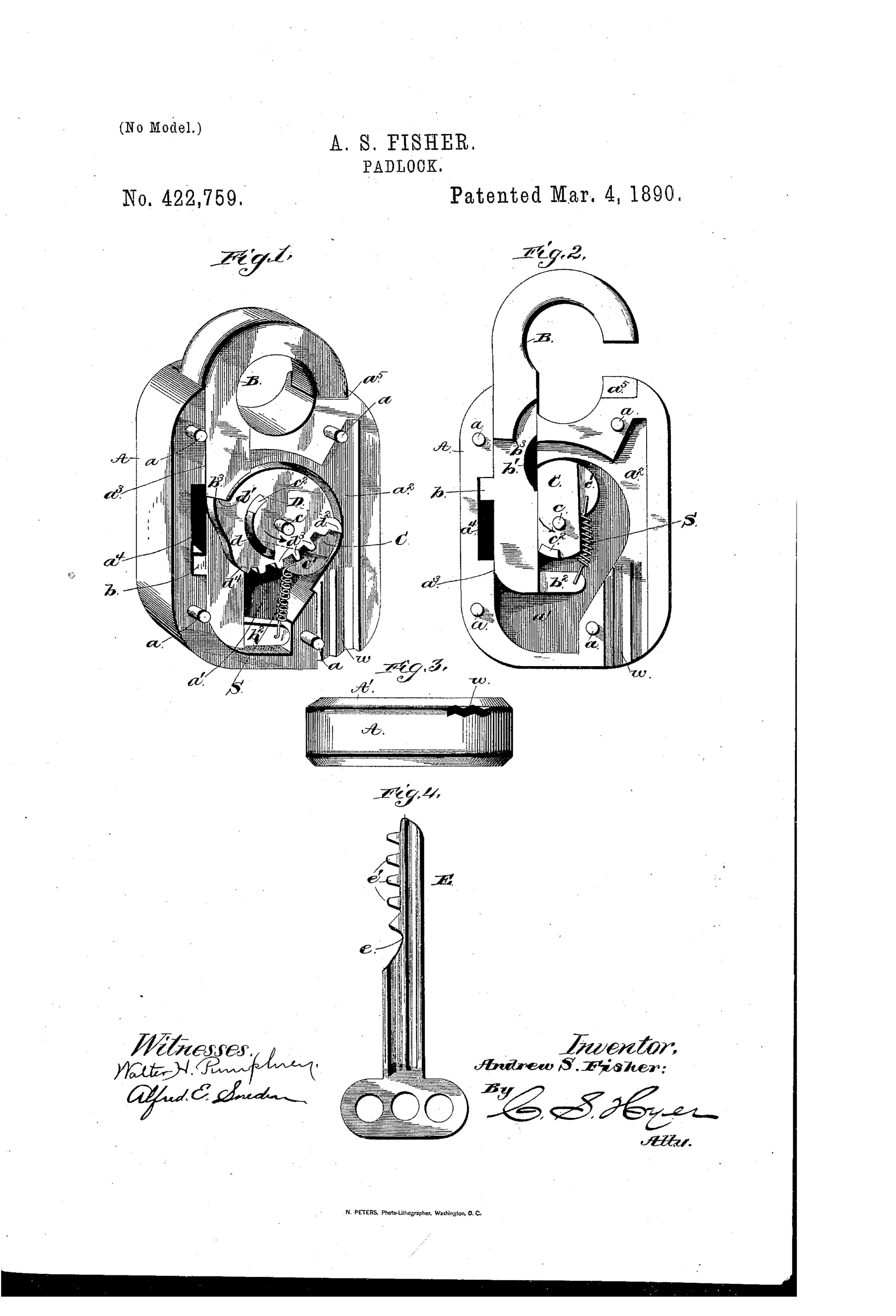
Toothed-key padlock with spring-loaded pivoting dog
⚿ How it works
A shackle is held closed by an eccentrically mounted dog that engages a curved recess on the shackle leg. A toothed tumbler sits over the dog's pivot post and meshes with the teeth of a specially corrugated key when inserted. As the key turns the tumbler, a slot-and-pin connection pulls the dog around its center, releasing the shackle, which is then automatically thrown outward by a coiled spring connecting the dog and the shackle leg. Any forcible attempt to pull the shackle out instead wedges the dog tighter against the shackle recess, preventing forced opening.
⚿ What was claimed
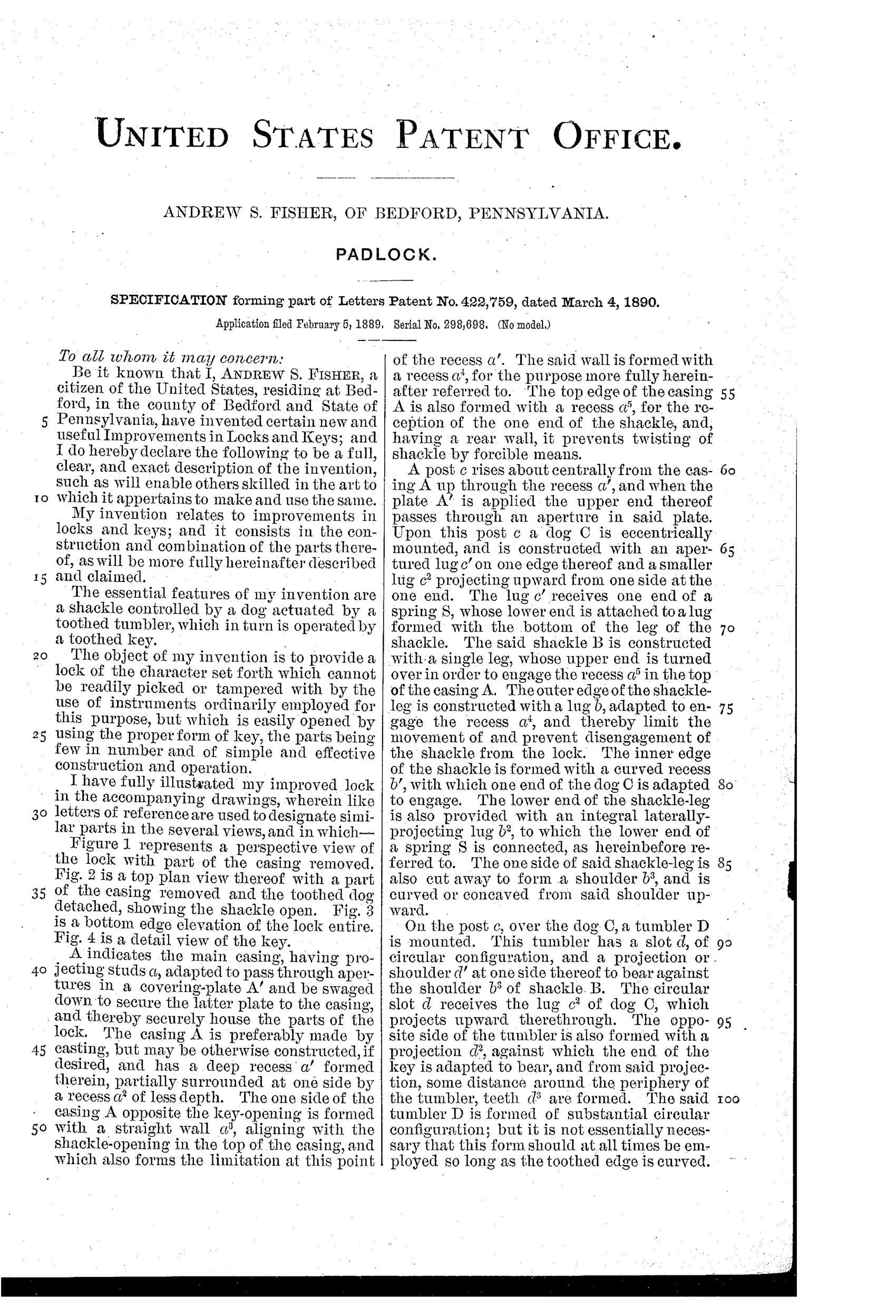
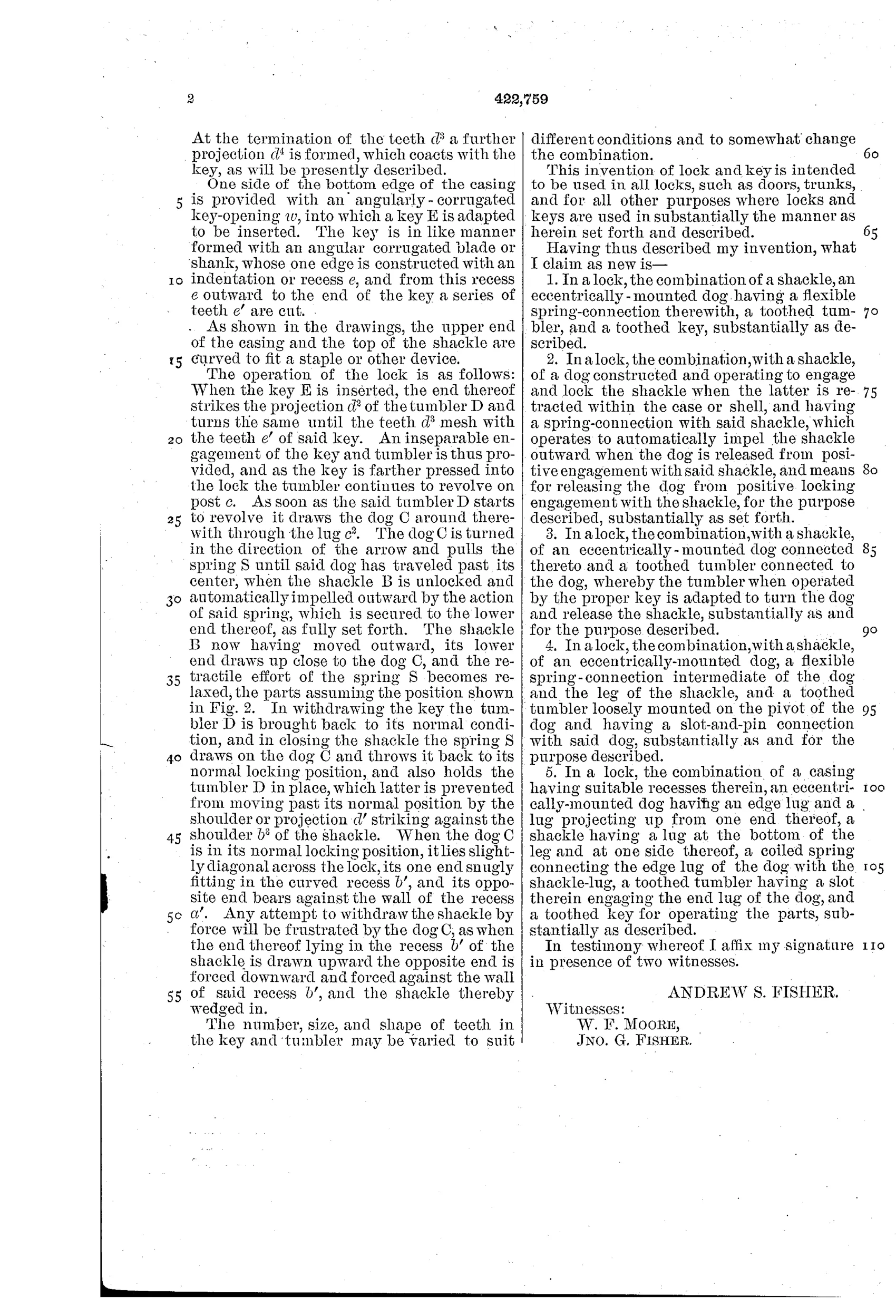
“In a lock, the combination of a shackle, an eccentrically-mounted dog having a flexible spring-connection therewith, a toothed tumbler, and a toothed key, substantially as described.”
In plain English: The lock combines a shackle, a spring-connected off-center dog, a toothed tumbler, and a matching toothed key to control locking and unlocking.
⚿ In the inventor’s words
“Any attempt to withdraw the shackle by force will be frustrated by the dog C, as when the end thereof lying in the recess b' of the shackle is drawn upward the opposite end is forced downward and forced against the wall of said recess b', and the shackle thereby wedged in.”— Andrew S. Fisher, from the specification
Fate unknown
No manufacturer, assignee, or surviving marked example is documented; a specimen matching the eccentric-dog interior would settle it.
⚿ Commentary
Fisher's one genuinely good idea here is the eccentric dog. Because it pivots off-center, any brute-force pull on the shackle rotates the dog into the shackle recess rather than out of it — the attack force becomes the locking force. That wedging principle is old wisdom in door locks, but applying it inside a padlock case, where prying and pulling were the standard attacks, is a sensible move. The claim language is dry; the best line in the specification is the one describing exactly this frustration of force.
The key is the odd part. Instead of a bitted flat key or a pin-tumbler cylinder, Fisher uses a rack-and-pinion arrangement: the key's edge carries teeth (Fig. 4 shows the corrugated blade clearly) that mesh with a toothed tumbler over the dog's pivot. Turning the key walks the tumbler around, and a slot-and-pin link drags the dog clear. Then the coiled spring visible in Fig. 2, stretched between dog and shackle leg, snaps the shackle open — a nice self-opening touch that Yale and others were also chasing.
The weakness is security. A toothed key meshing with a gear offers essentially one 'combination'; any similarly toothed blank would work it. By 1890 the pin tumbler had already shown what real key differing looked like, so this reads as a clever mechanical exercise arriving a generation late — sturdy against force, naive against picking.
Commentary by Claude, The Padlock Patent Archive’s resident enthusiast