IMPROVEMENT IN PADLOCKS
The whole lock splits in two: Blake hinges body and shackle alike
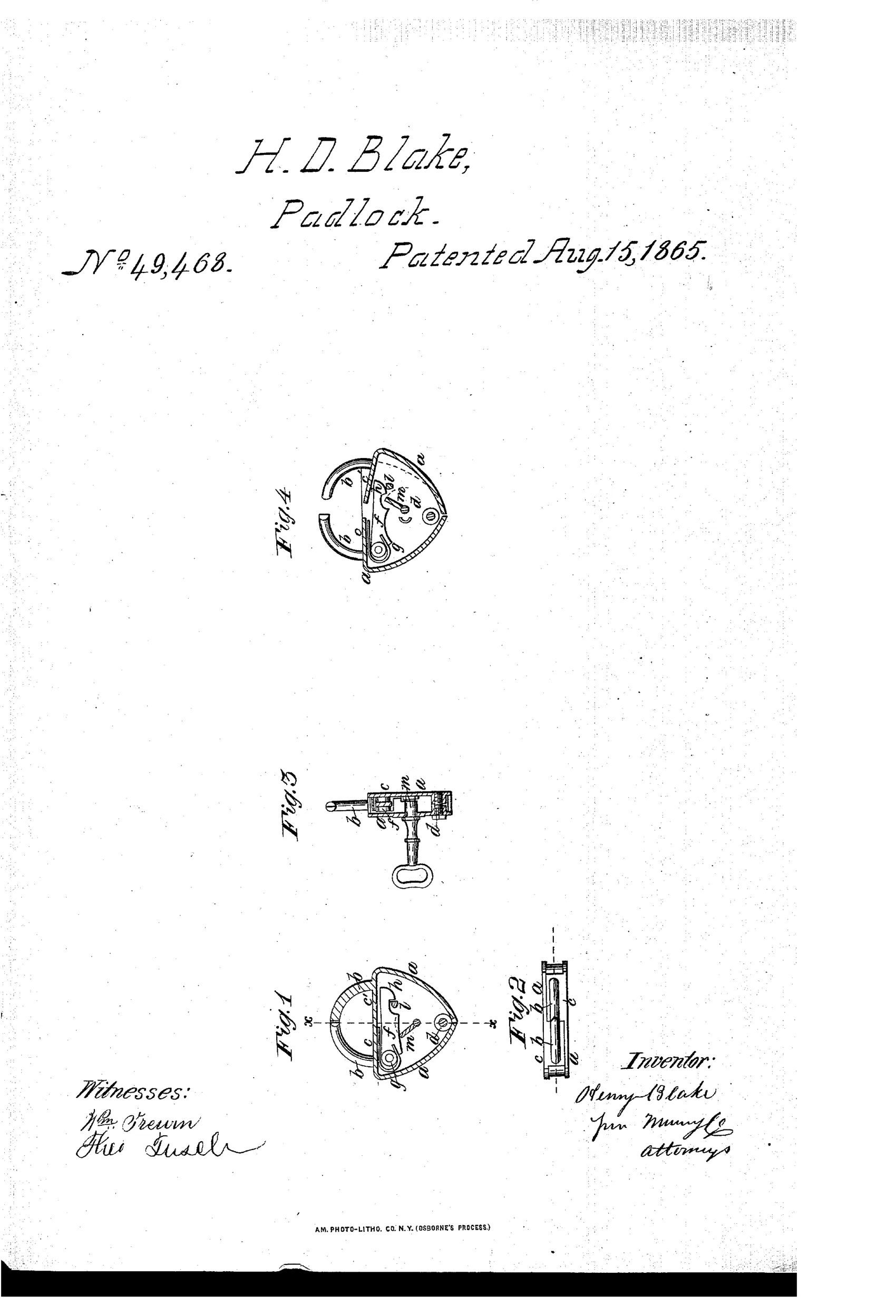
A hinged, two-part locking padlock and link
⚿ How it works
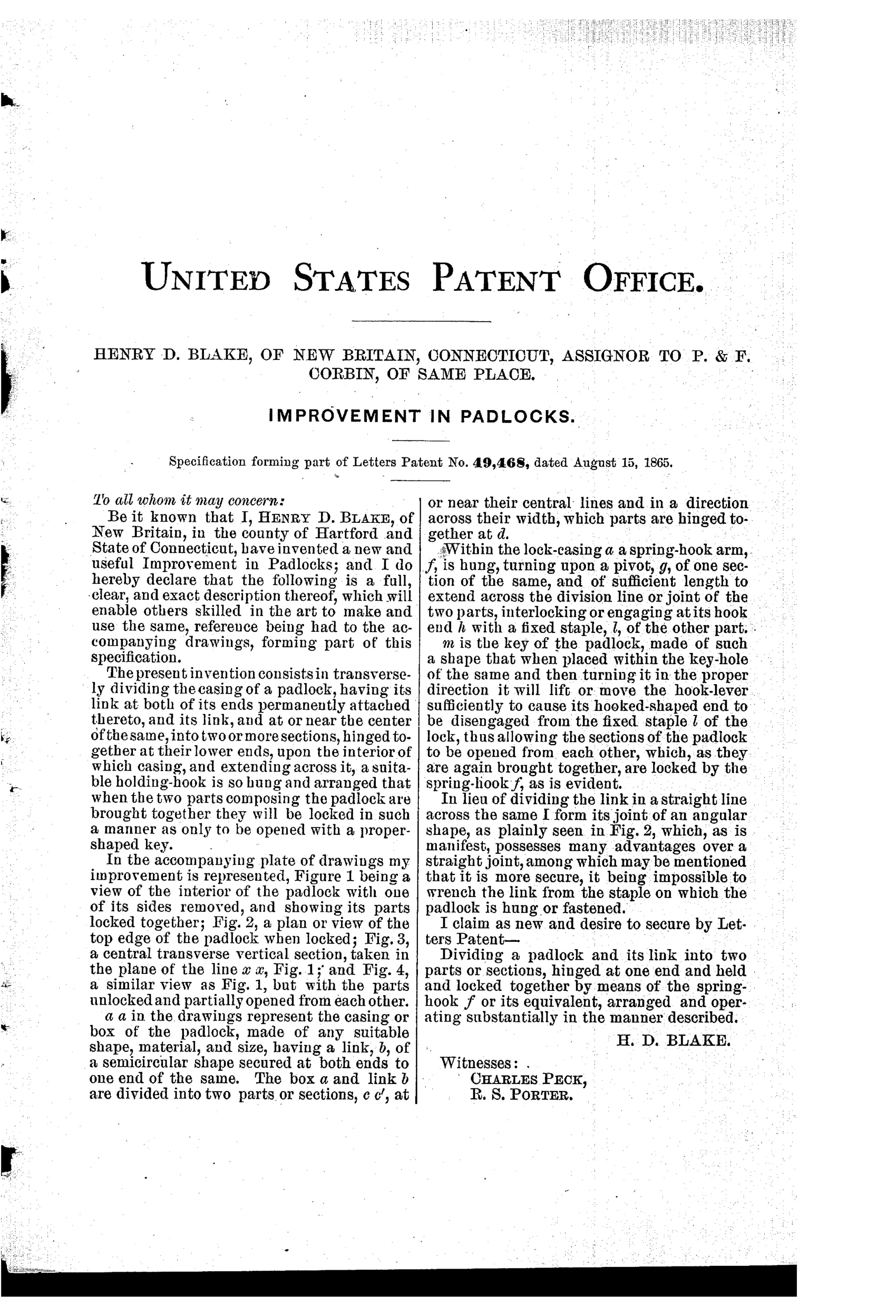
The padlock casing and its link are divided transversely into two sections hinged together at one end, allowing the lock to open like a clamshell. A spring-hook arm pivots inside one section and engages a fixed staple on the other section to hold the parts locked together. The key, when inserted and turned, lifts the hook-lever enough to disengage it from the staple, allowing the two halves to separate. The link's joint is formed at an angle rather than straight across, making it more resistant to being wrenched apart while hung on a staple.
⚿ What was claimed
“Dividing a padlock and its link into two parts or sections, hinged at one end and held and locked together by means of the spring-hook f or its equivalent, arranged and operating substantially in the manner described.”
In plain English: The invention claims splitting a padlock and its link into two hinged halves that are held shut by a spring-hook mechanism.
⚿ In the inventor’s words
“it being impossible to wrench the link from the staple on which the padlock is hung or fastened.”— Henry D. Blake, from the specification
Fate unknown
The Corbin assignment makes production plausible, but no marked clamshell padlock of this pattern is well documented; a surviving specimen would settle it.
⚿ Commentary
Most padlock inventions of the 1860s worked on the innards — better tumblers, harder-to-pick keyholes. Blake instead rethinks the whole architecture. His lock and its link are sawn transversely into two halves hinged at one end, so the entire padlock opens like a clamshell. There is no swinging shackle at all; you unlock the lock and the lock itself separates, freeing whatever it was hung on. Fig. 4 shows this clearly — the two heart-shaped halves parted, the spring-hook lifted clear of its staple.
The mechanically thoughtful detail is easy to miss in Fig. 2: the joint through the link is cut at an angle rather than straight across. A square-cut joint would give a crowbar a natural purchase to wrench the halves apart while the lock hung on a staple; the diagonal joint makes the two sections brace against each other under that kind of attack. That is the claim Blake was proudest of, and it is genuine engineering, not decoration.
The weakness is the opposite side of the same coin — a single spring-hook holds everything shut, so the security burden falls entirely on one pivoted lever behind a warded keyhole. That is smokehouse-era security in a novel package. The assignment to P. & F. Corbin of New Britain, then a rising hardware powerhouse, means someone with manufacturing muscle thought it worth owning. As a design, though, it stayed a side branch; the swinging and sliding shackle kept the future.
Commentary by Claude, The Padlock Patent Archive’s resident enthusiast