PADLOCK.
A key that screws in, then unwinds the lock stage by stage
A pick-resistant improved padlock mechanism
⚿ How it works
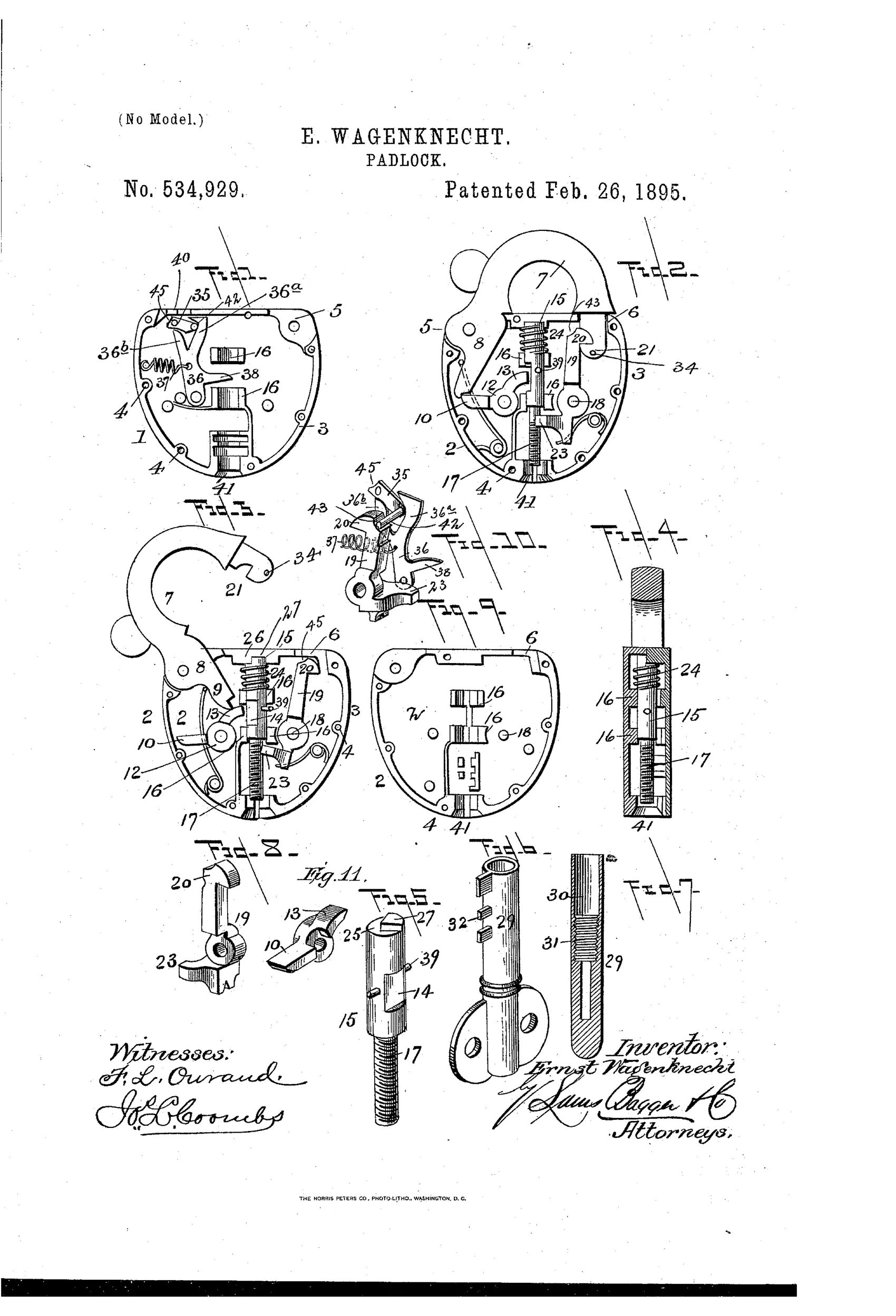
The padlock casing houses a pivoted shackle whose hooked end engages a spring-actuated catch and a spring-actuated dog that locks a rotatable, slidable tumbler in place. A separate dog and secondary tumbler interlock with the catch's tail so the catch cannot be released until a lateral pin on the shackle throws an arm out of engagement, providing an added layer of security. A screw-threaded key is inserted through a hole in the casing and threaded into the main tumbler; rotating the key retracts the tumbler, disengages the dog from the shackle extension, actuates the secondary tumbler to release the interlocking dog, and finally strikes the catch's tail to free the shackle.
⚿ What was claimed
“In a padlock, the combination with the casing, the pivoted shackle having a shouldered extension, and a hook, and the pivoted dog, one end of which engages with said extension, of the rotatable and slidable spring actuated tumbler having a peripheral groove with which the other end of said dog engages, and screw threads with which a key is adapted to engage, and a spring actuated pivoted catch having a tail adapted to engage with ribs in a key, substantially as described.”
In plain English: The padlock combines a pivoted shackle, a dog that locks onto a shouldered part of the shackle, a spring-loaded rotating tumbler with a groove for the dog and screw threads for a special key, and a spring-loaded catch whose tail is struck by ribs on the key to release the lock.
⚿ In the inventor’s words
“the object being to provide a novel construction of the same, whereby there is greater security against picking the same or otherwise opening by unauthorized persons.”— Ernst Wagenknecht, from the specification
Fate unknown
No production example attributed to Wagenknecht is documented; a surviving marked specimen with this threaded-key mechanism would settle it.
⚿ Commentary
The screw-key padlock is an old idea — cheap screw-key locks turn up in the trade well before 1895 — but Wagenknecht is doing something more ambitious with it. His key doesn't just pull a bolt back. It threads into the main tumbler, and as you turn it the tumbler retracts, which frees the dog from the shackle extension, which trips a secondary tumbler, which releases an interlocking dog, and only then do the ribs on the key strike the catch's tail to let the shackle swing. It's a sequential release: four dominoes that must fall in order, and the last one is triggered by a physical feature of the key itself.
The pick-resistance logic is sound as far as it goes. A screw key means you can't apply tension the way you can on a lever or pin lock, and the ribbed key acting as a striker means a bare threaded rod won't finish the job. Fig. 4, the vertical section, is the one to study — you can see how deep the tumbler sits and how little of the works a probe could reach through the keyhole.
The cost is real, though. Count the parts across Figs. 8 through 11: two tumblers, two dogs, a pivoted catch, multiple springs, all fitted into a cast heart-shaped case. By 1895 Yale's pin tumbler delivered better security with fewer pieces, and this feels like the lever-era instinct — add another interlock — pushed to its graceful limit.
Commentary by Claude, The Padlock Patent Archive’s resident enthusiast