LOCK.
A padlock shaped like a handcuff, whose jaws must unhook before they swing
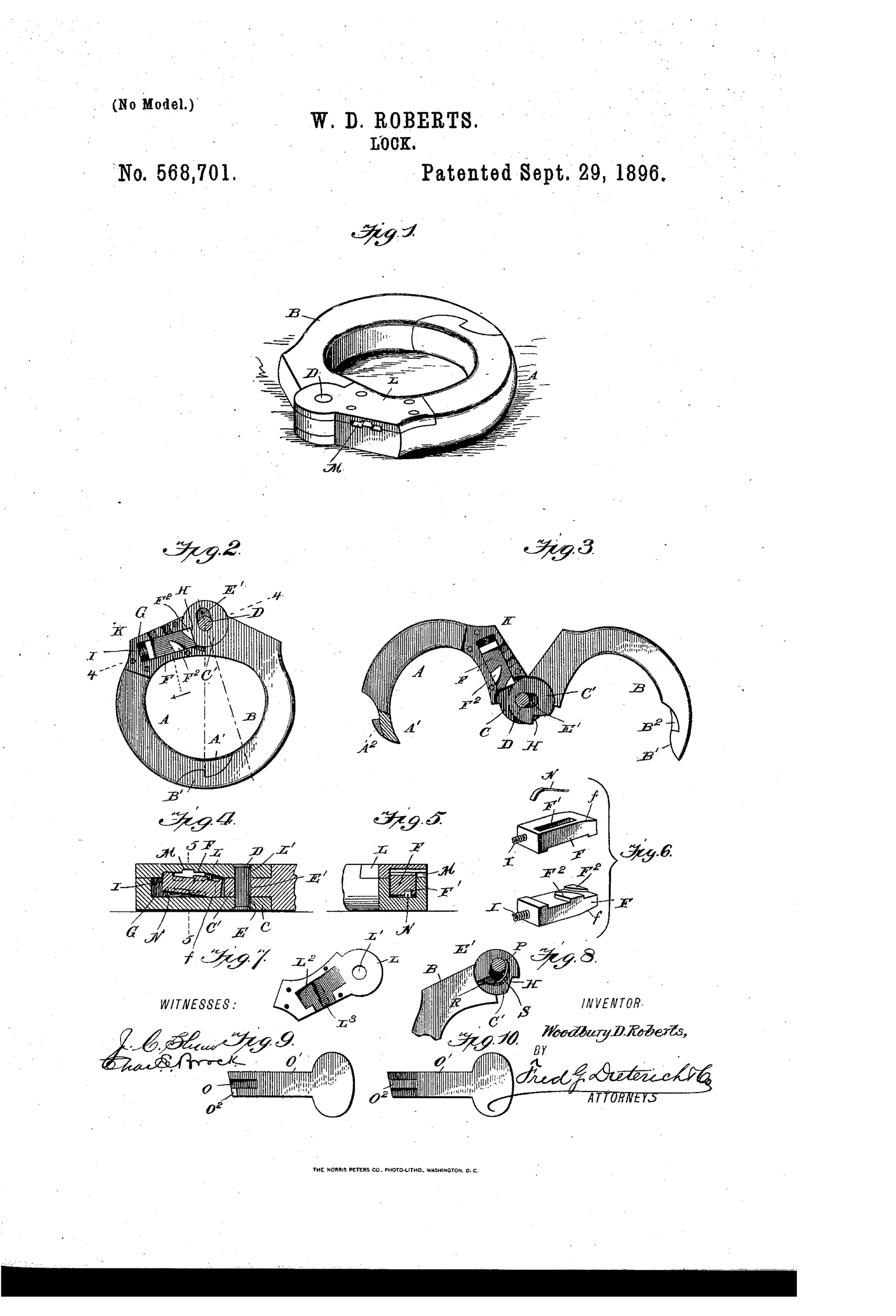
Ring-shaped hasp lock with hinged interlocking jaws
⚿ How it works
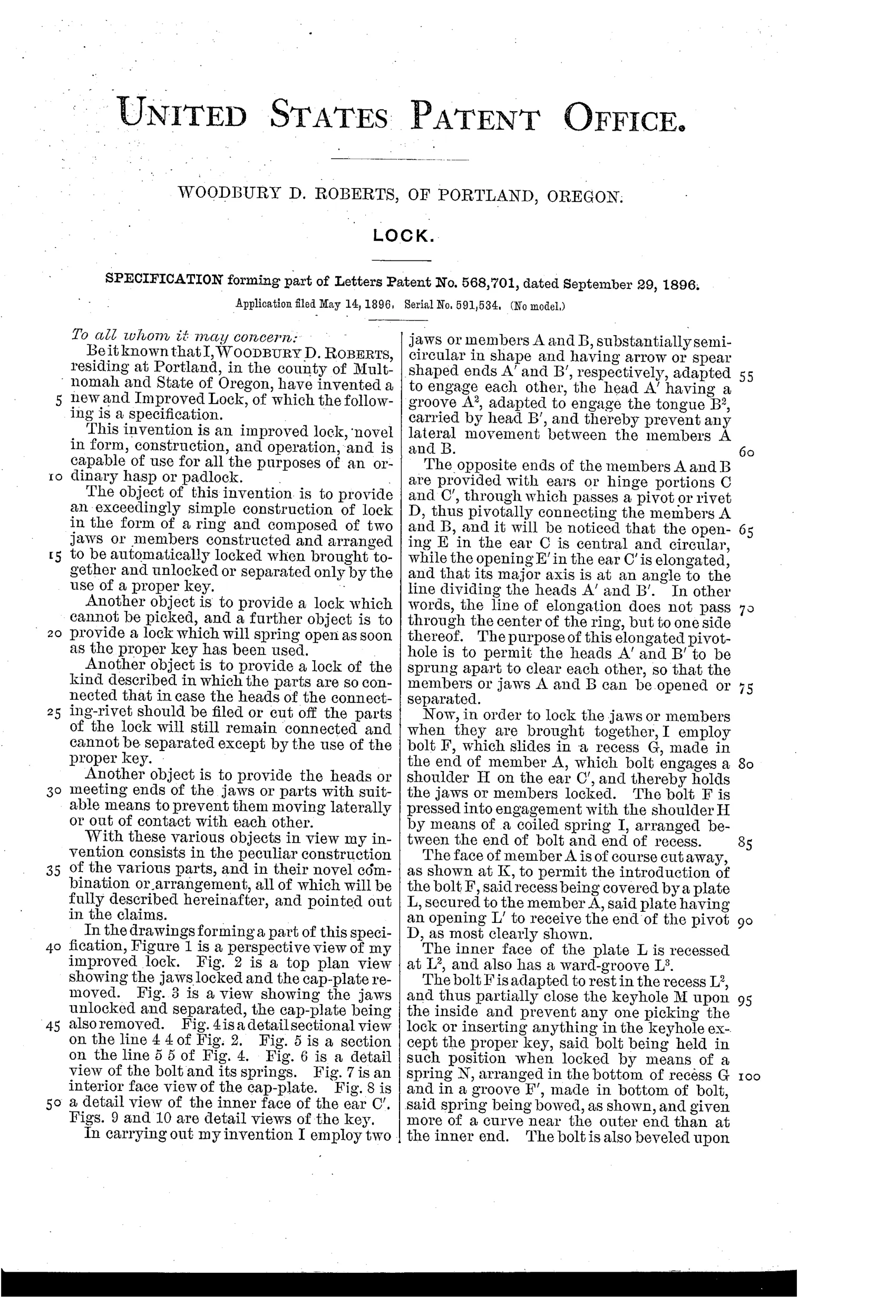
The lock is formed of two semicircular jaws pivoted at one end, with spear-shaped heads at the other end that interlock via a tongue-and-groove connection to prevent lateral movement. A spring-loaded sliding bolt in one jaw engages a locking shoulder on the other jaw when the heads are pressed together, automatically locking the device. A proper key with wards on both faces, inserted at an oblique beveled end, presses the bolt back to release the shoulder, after which an internal spring on the pivot pin forces the heads apart and springs the jaws open. The elongated, angled pivot-hole allows the interlocking heads to shift slightly to disengage before the jaws swing open.
⚿ What was claimed
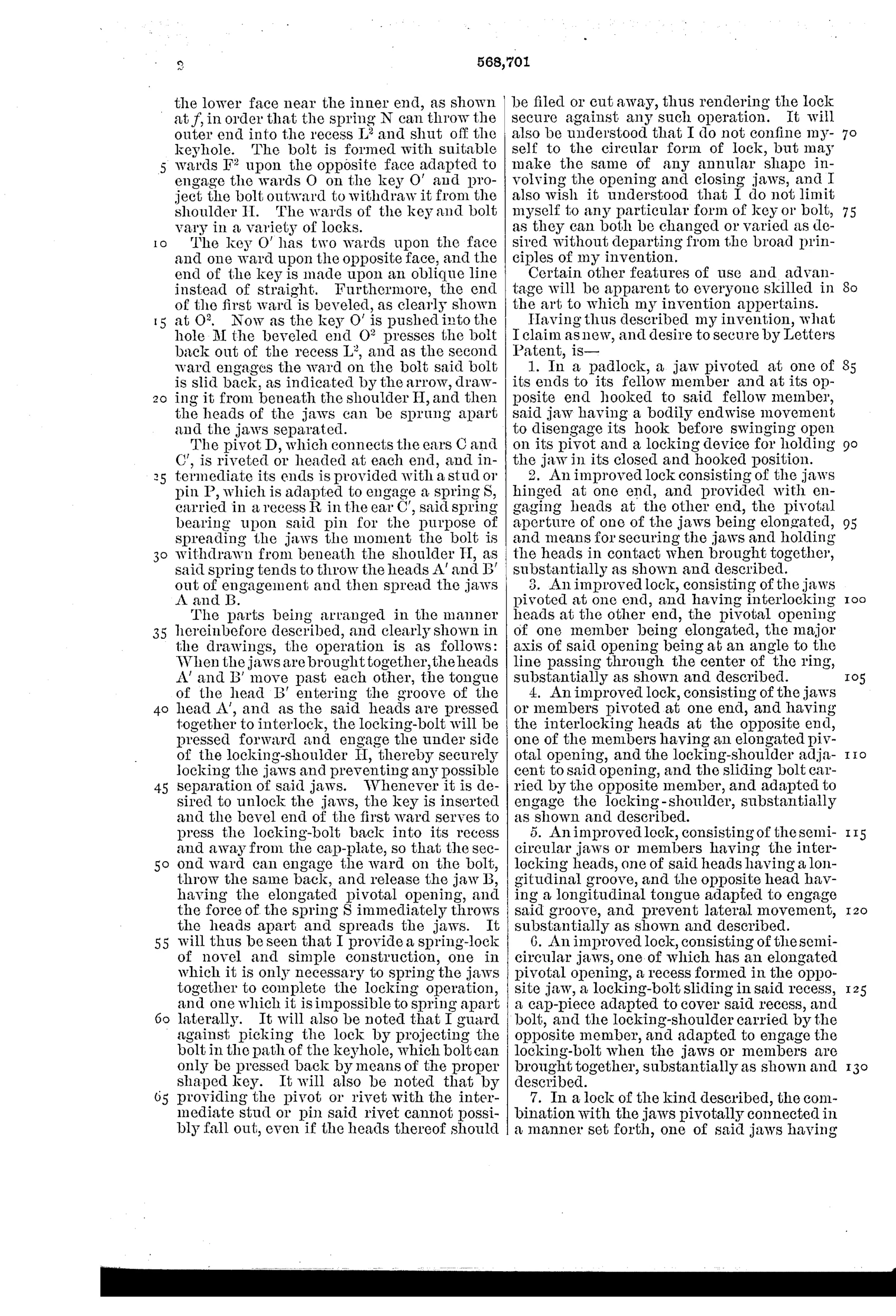
“In a padlock, a jaw pivoted at one of its ends to its fellow member and at its opposite end hooked to said fellow member, said jaw having a bodily endwise movement to disengage its hook before swinging open on its pivot and a locking device for holding the jaw in its closed and hooked position.”
In plain English: One jaw of the lock is hinged at one end and hooked at the other, and it must first slide slightly to unhook before it can pivot open, with a locking device holding it shut until released.
⚿ In the inventor’s words
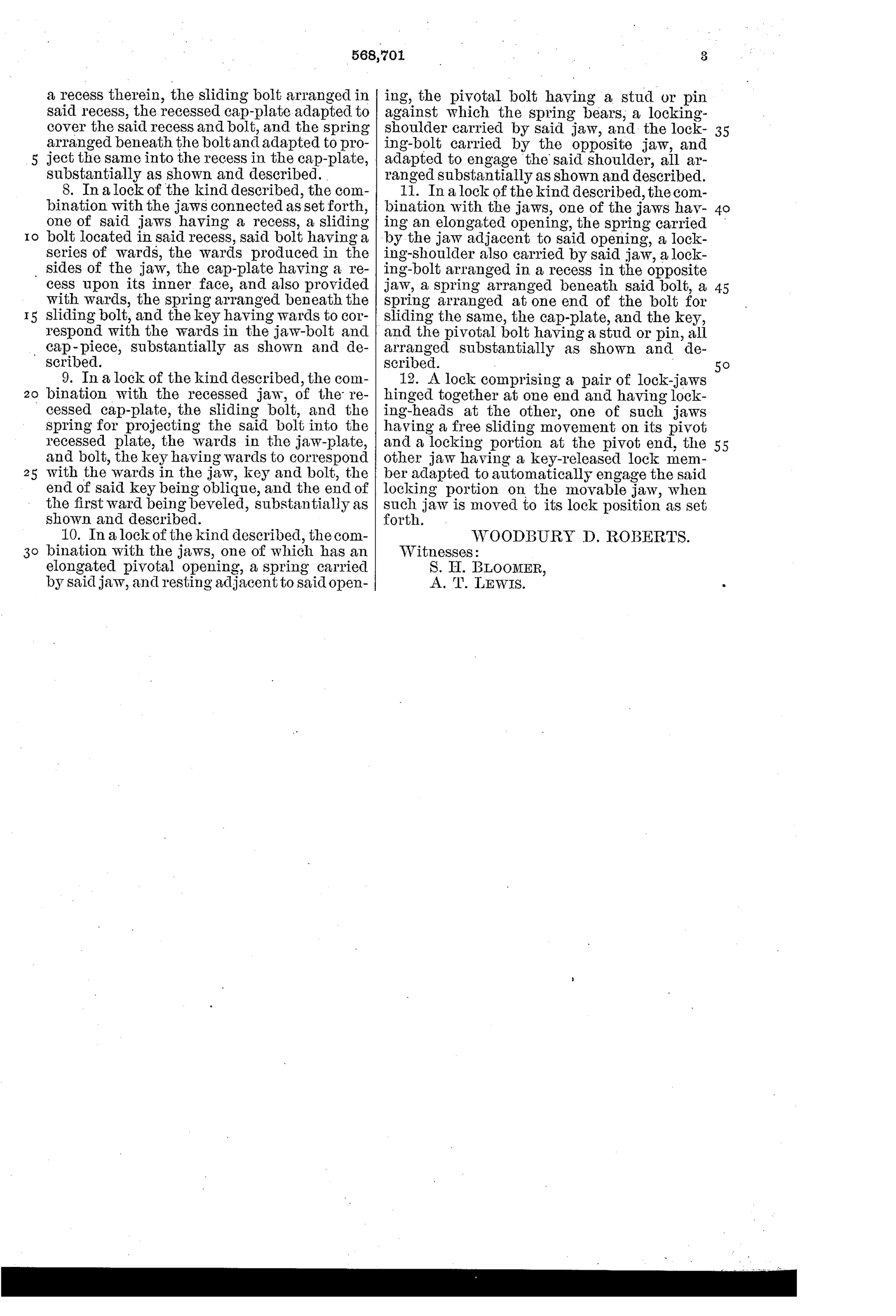
“It will thus be seen that I provide a spring-lock of novel and simple construction, one in which it is only necessary to spring the jaws together to complete the locking operation, and one which it is impossible to spring apart laterally.”— Woodbury D. Roberts, from the specification
Paper patent — likely never produced
No production ring lock matching this two-stage jaw is documented, and the machining of the interlocked heads and slotted pivot would have priced it against simpler warded locks; a surviving specimen would change the call.
⚿ More by Woodbury D. Roberts
- LOCK (1898)
⚿ Commentary
Fig. 1 stops you cold: this is a padlock that looks like a single handcuff, a continuous ring split into two semicircular jaws hinged at one end. Roberts of Portland, Oregon filed it as simply "Lock," but nothing about it is simple. The clever part is at the meeting end, where the two spear-shaped heads interlock in a tongue-and-groove joint. That joint means you cannot pry the jaws apart sideways — the usual attack on any hinged shackle — because the heads are keyed into each other in the lateral direction.
The cost of that trick is kinematic: an interlocked joint cannot simply swing open. So Roberts elongates and angles the pivot hole, giving the moving jaw a bodily endwise slide to disengage the hook before it rotates. His main claim is exactly that two-stage motion — slide, then swing — held shut by a spring bolt. Snap the jaws together and it self-locks; a double-warded key inserted at the beveled end presses the bolt back, and a spring on the pivot pin pops the whole thing open. That is more machining than any warded padlock of 1896 needed, and warding was already the weak link — the fancy joint resists the crowbar while the key security stays ordinary.
As a category entry it's a dead-end shape, but an honest one: hasp and lock fused into a single ring, closer to a shackle or trunk ring than to the box padlocks that won the market.
Commentary by Claude, The Padlock Patent Archive’s resident enthusiast