LOCK
A padlock with no shackle at all — the whole body snaps shut like handcuffs
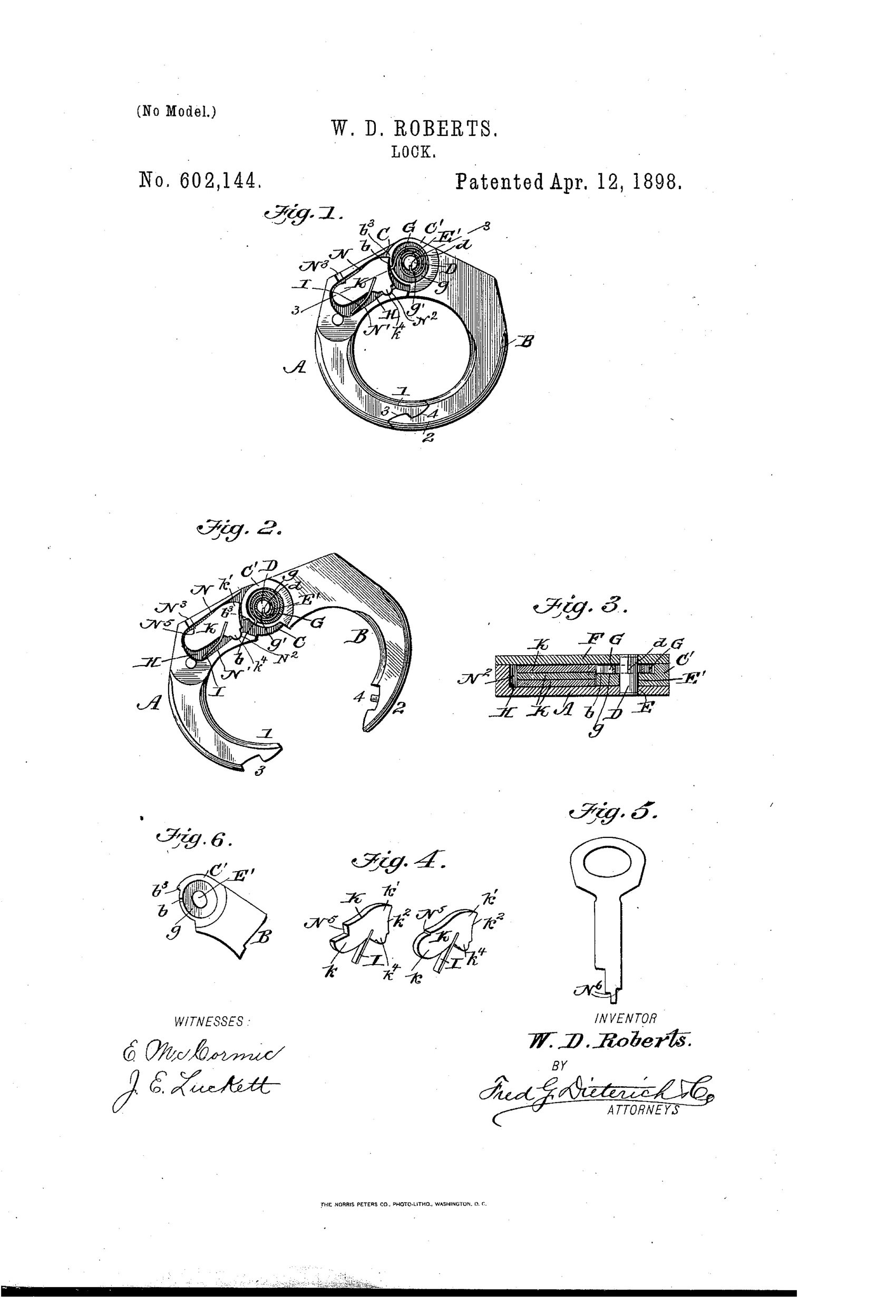
Improved padlock with interlocking spring-loaded jaws
⚿ How it works
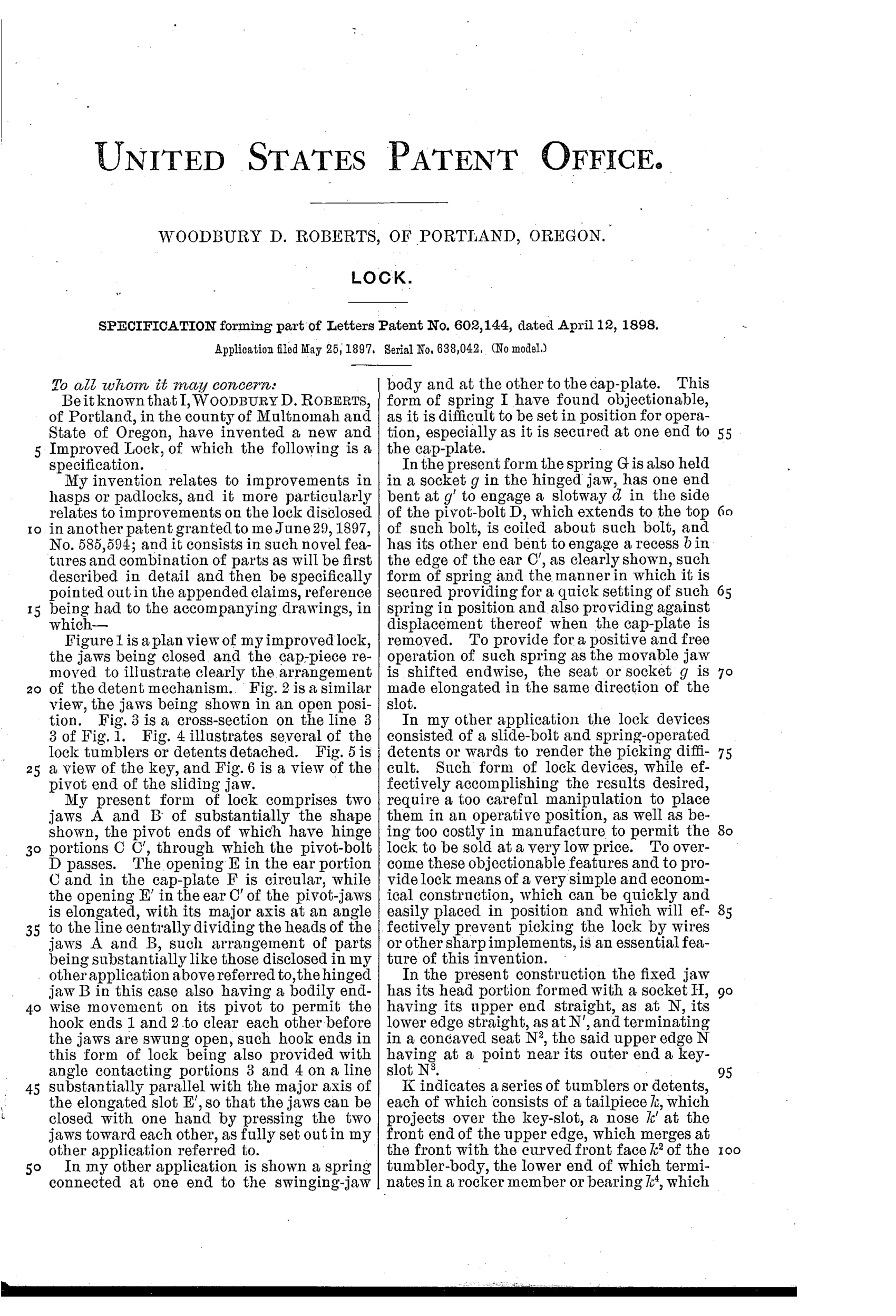
The padlock uses two pivoted jaws, A and B, that interlock via hook ends and are held together by a series of independently fulcrumed tumblers engaging a lock-lip on the hinged jaw. A volute spring seated in the hinged jaw and engaging the pivot-bolt automatically swings the jaw outward once the tumblers are disengaged by the correct key. The key's wards align with notches on the tumblers, allowing them to swing back in unison and release the lock-lip. When closed, the lock-nose at the tumbler's upper edge rides along a concaved front face, permitting free movement until the hook ends touch and the nose slides under the jaw's lock-lip to secure it.
⚿ What was claimed
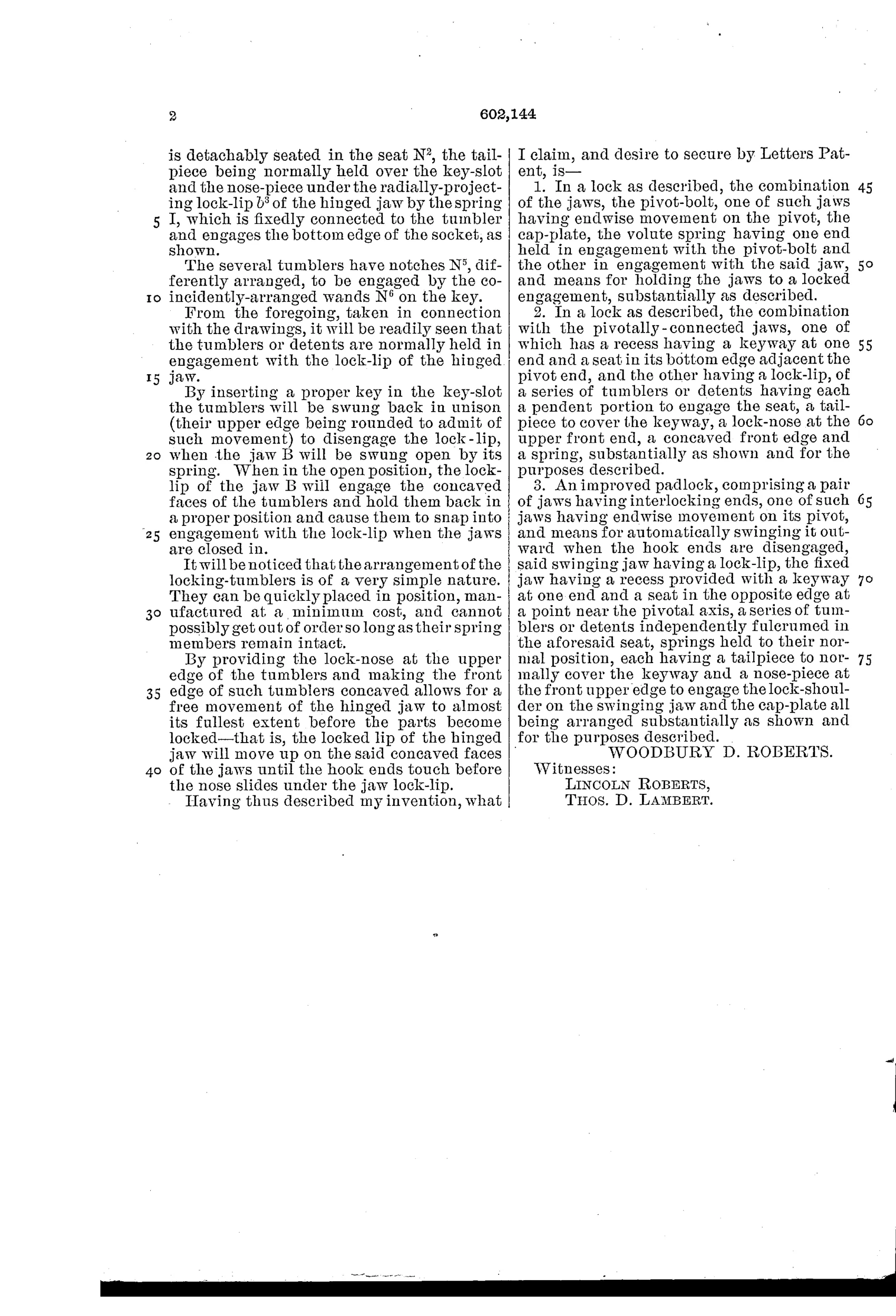
“An improved padlock, comprising a pair of jaws having interlocking ends, one of such jaws having endwise movement on its pivot, and means for automatically swinging it outward when the hook ends are disengaged, said swinging jaw having a lock-lip, the fixed jaw having a recess provided with a keyway at one end and a seat in the opposite edge at a point near the pivotal axis, a series of tumblers or detents independently fulcrumed in the aforesaid seat, springs held to their normal position, each having a tailpiece to normally cover the keyway and a nose-piece at the front upper edge to engage the lock-shoulder on the swinging jaw and the cap-plate all being arranged substantially as shown and for the purposes described.”
In plain English: The padlock has two interlocking jaws, one of which springs open automatically when the correct key disengages a row of independent spring-loaded tumblers that normally cover the keyway and lock the jaw shut.
⚿ In the inventor’s words
“To overcome these objectionable features and to provide lock means of a very simple and economical construction, which can be quickly and easily placed in position and which will effectively prevent picking the lock by wires or other sharp implements, is an essential feature of this invention.”— Woodbury D. Roberts, from the specification
Fate unknown
No manufacturer took an assignment and no marked example of this jaw-type lock is documented; a surviving specimen would settle it.
⚿ More by Woodbury D. Roberts
- LOCK. (1896)
⚿ Commentary
Roberts throws out the conventional shackle-and-case arrangement entirely. His lock is a ring of two pivoted jaws, A and B, whose hooked ends grab each other — the padlock body IS the shackle, closing around a staple the way a handcuff closes around a wrist. Fig. 2 shows the jaws swung apart, and a volute spring on the pivot-bolt makes the opening automatic: turn the key and the lock pops open on its own, a small convenience most padlocks of the era didn't offer.
Inside, the security comes from a row of independently fulcrumed lever tumblers, each with its own spring, whose noses catch under a lock-lip on the swinging jaw. Fig. 4 shows them detached, and the detail worth noticing is the tailpieces: at rest they physically cover the keyway from the inside. Roberts says outright his aim is to stop picking with 'wires or other sharp implements,' and blocking the keyway with the tumblers themselves is a genuinely thoughtful touch, even if a determined picker would still find the tumblers one at a time.
As mechanism it should work — nothing here defies machining, though the endwise-moving pivot jaw and the concave riding surfaces are fussier than they look. The idea sits in a small side branch of the family tree: jaw-type padlocks appear periodically and never displace the shackle, mostly because a hinged joint is an exposed weak point that a solid shackle doesn't have.
Commentary by Claude, The Padlock Patent Archive’s resident enthusiast