PADLOCK.
A key that pushes with its flat side, gaining leverage the tumblers punish
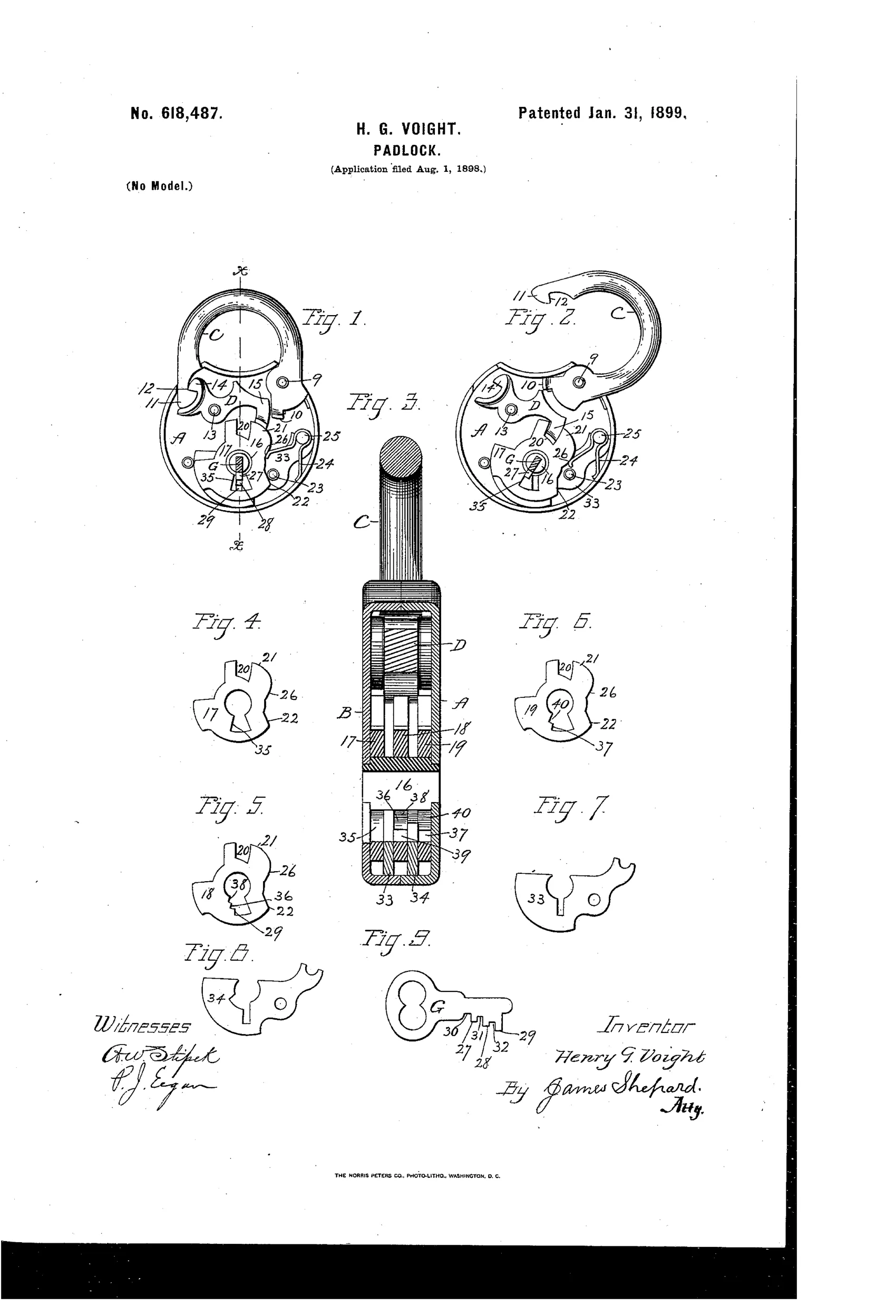
A tumbler padlock with pivoted shackle dog
⚿ How it works
The shackle is pivoted to the case and locked by a swinging dog that engages a locking-shoulder on the shackle's nose and a wing on its heel. A flat, three-winged key acts by its flat side—not its edge—against the active faces of concentrically mounted tumblers to rotate them into alignment. Once the tumbler slots line up beneath the dog's arm, the dog can pivot on its own pin to release the shackle. Because the tumblers' peripheral slots sit at a larger radius than the key's bit, a small key rotation produces a comparatively large tumbler movement, making the lock sensitive to incorrect keys engaging false faces.
⚿ What was claimed
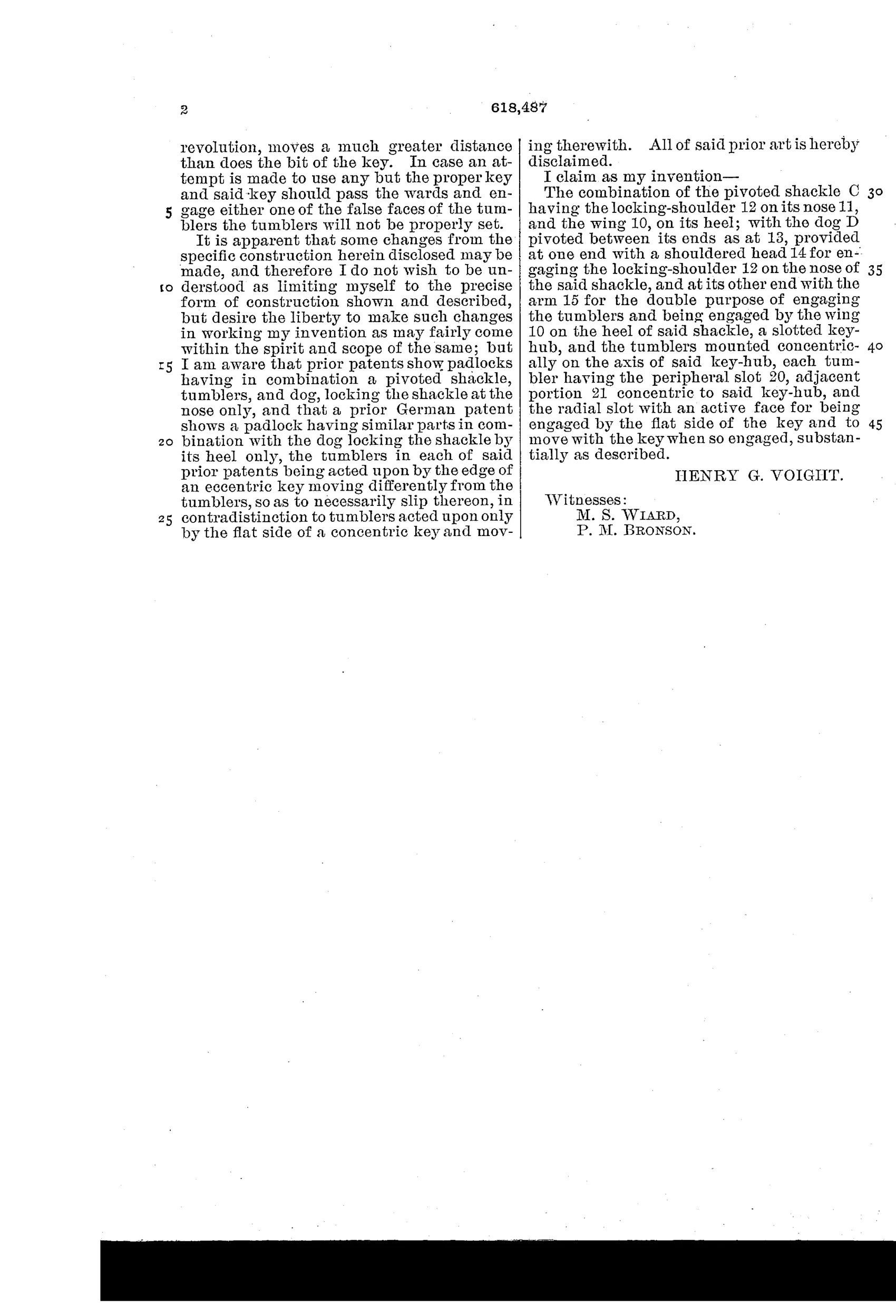
“The combination of the pivoted shackle C having the locking-shoulder 12 on its nose 11, and the wing 10, on its heel; with the dog D pivoted between its ends as at 13, provided at one end with a shouldered head 14 for engaging the locking-shoulder 12 on the nose of the said shackle, and at its other end with the arm 15 for the double purpose of engaging the tumblers and being engaged by the wing 10 on the heel of said shackle, a slotted key-hub, and the tumblers mounted concentrically on the axis of said key-hub, each tumbler having the peripheral slot 20, adjacent portion 21 concentric to said key-hub, and the radial slot with an active face for being engaged by the flat side of the key and to move with the key when so engaged, substantially as described.”
In plain English: The lock combines a pivoted shackle with a locking nose and heel wing, a two-ended dog that both locks the shackle and reads the tumblers, and concentric tumblers driven by the flat side of a key so they rotate in step with it.
⚿ In the inventor’s words
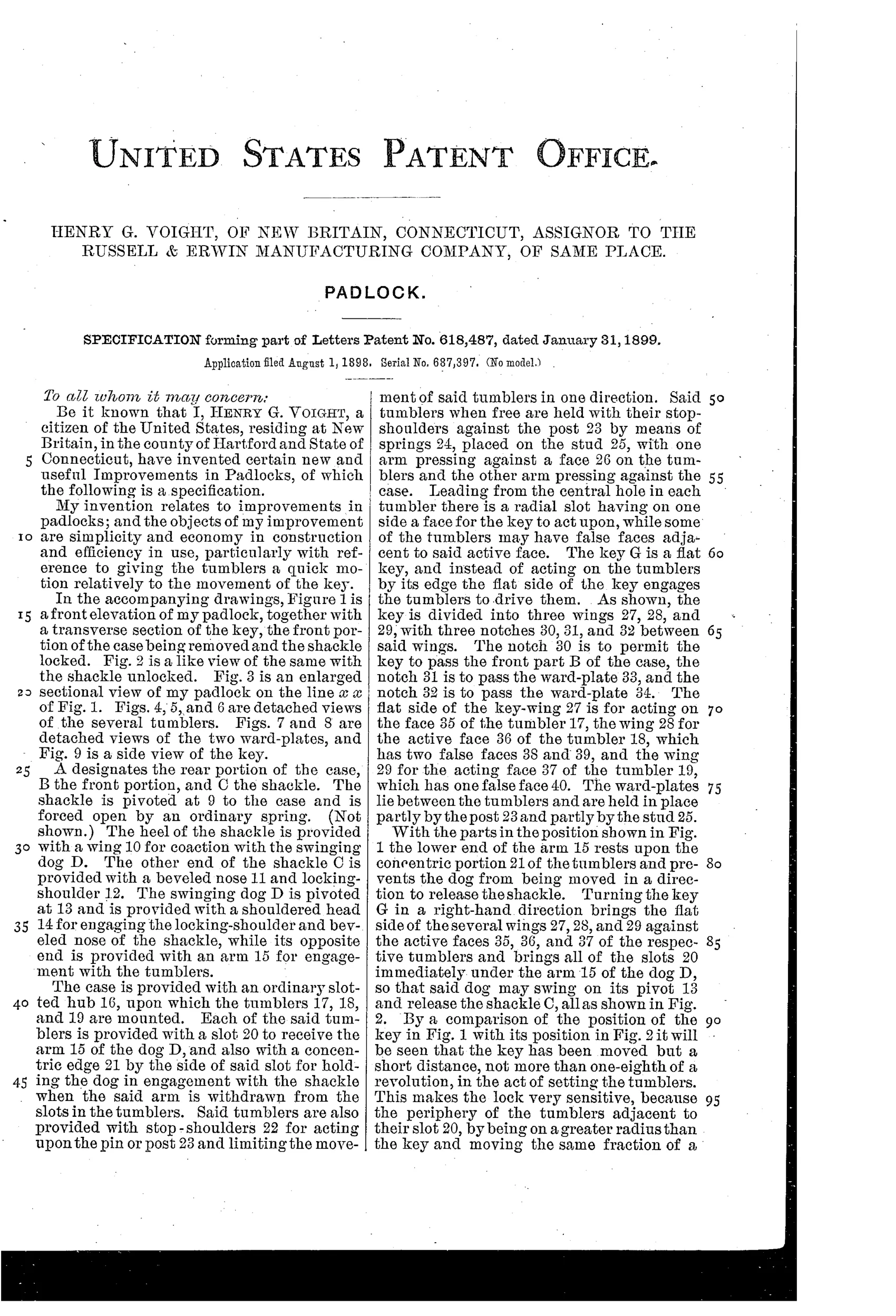
“This makes the lock very sensitive, because the periphery of the tumblers adjacent to their slot 20, by being on a greater radius than the key and moving the same fraction of a revolution, moves a much greater distance than does the bit of the key.”— Henry G. Voight, from the specification
Fate unknown
Russell & Erwin made padlocks in volume and Voight was their working designer, but I know of no documented specimen matching this exact mechanism; a marked example with the three-winged flat key would settle it.
⚿ Commentary
Voight's trick here is geometric, and the patent says it plainly: the key's flat side—not its bitted edge—drives three rotary tumblers mounted concentrically around the key hub. Because the tumbler slots that the dog must read sit at a larger radius than the key bit, the same few degrees of rotation move the tumbler periphery much farther than the key surface travels. In effect the lock amplifies every error. A wrong key that is off by a hair at the bit is off by several hairs at the gate, and the dog stays put. It is a cheap way to buy precision without machining anything to tighter tolerance.
The dog itself earns its keep twice. One end has a shouldered head grabbing a locking-shoulder on the shackle's nose; the other end carries the arm that both reads the tumbler gates and gets kicked by a wing on the shackle's heel. One pivoting part does the locking, the reading, and the resetting. Look at Fig. 3 and you can see how tightly the tumbler stack, ward plates, and key hub nest in a compact column—this was drawn by someone who expected it to be die-cut and stamped, not filed by hand.
Coming from a Russell & Erwin house inventor in 1898, this is not a dreamer's puzzle lock. It is lever-tumbler thinking refitted for rotary parts and factory production, in the last years before pin tumblers swept the field.
Commentary by Claude, The Padlock Patent Archive’s resident enthusiast