IMPROVEMENT IN PADLOCKS
Twelve spring-jaw bolts grip both shackle legs in three stacked chambers
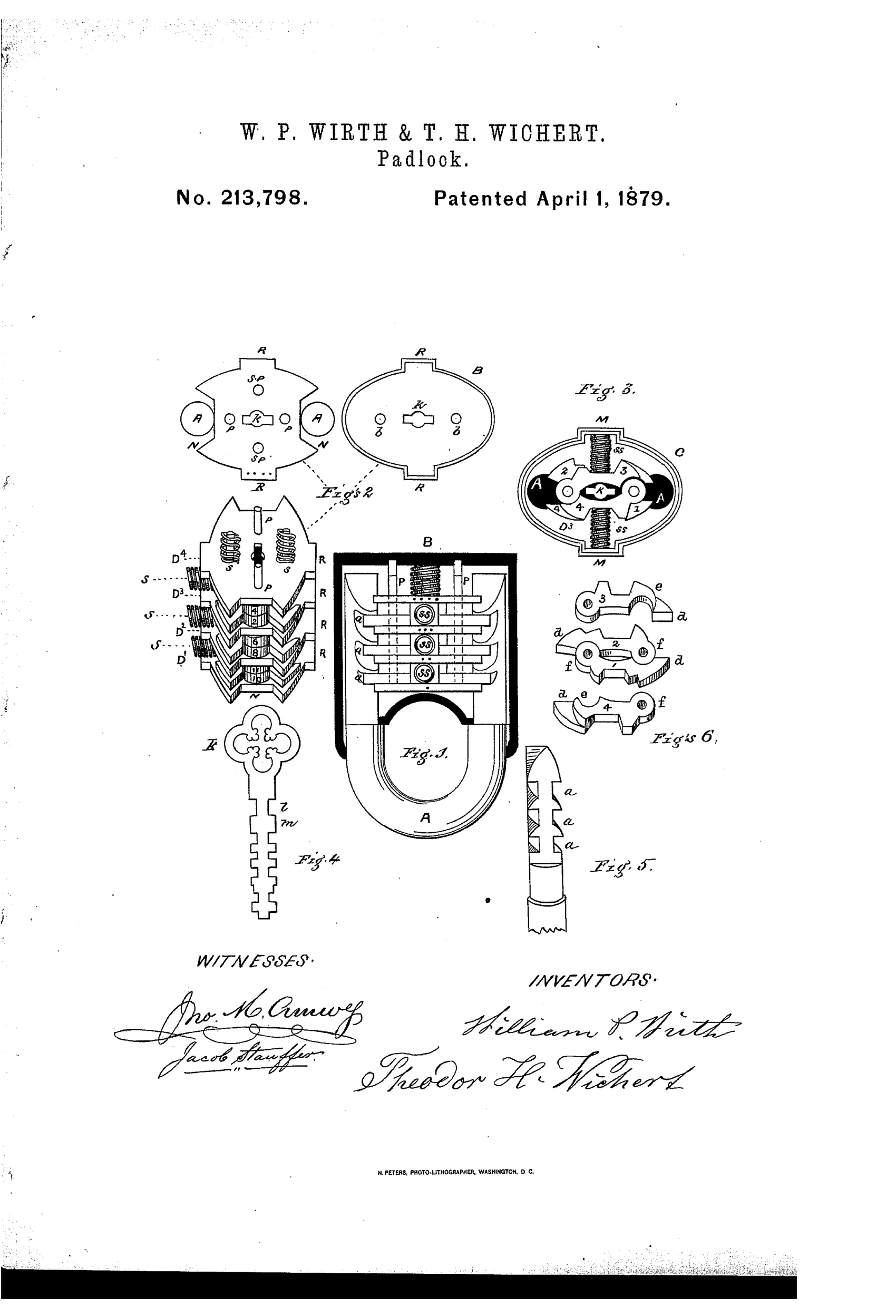
Multiple combined padlock with twelve interlocking bolts
⚿ How it works
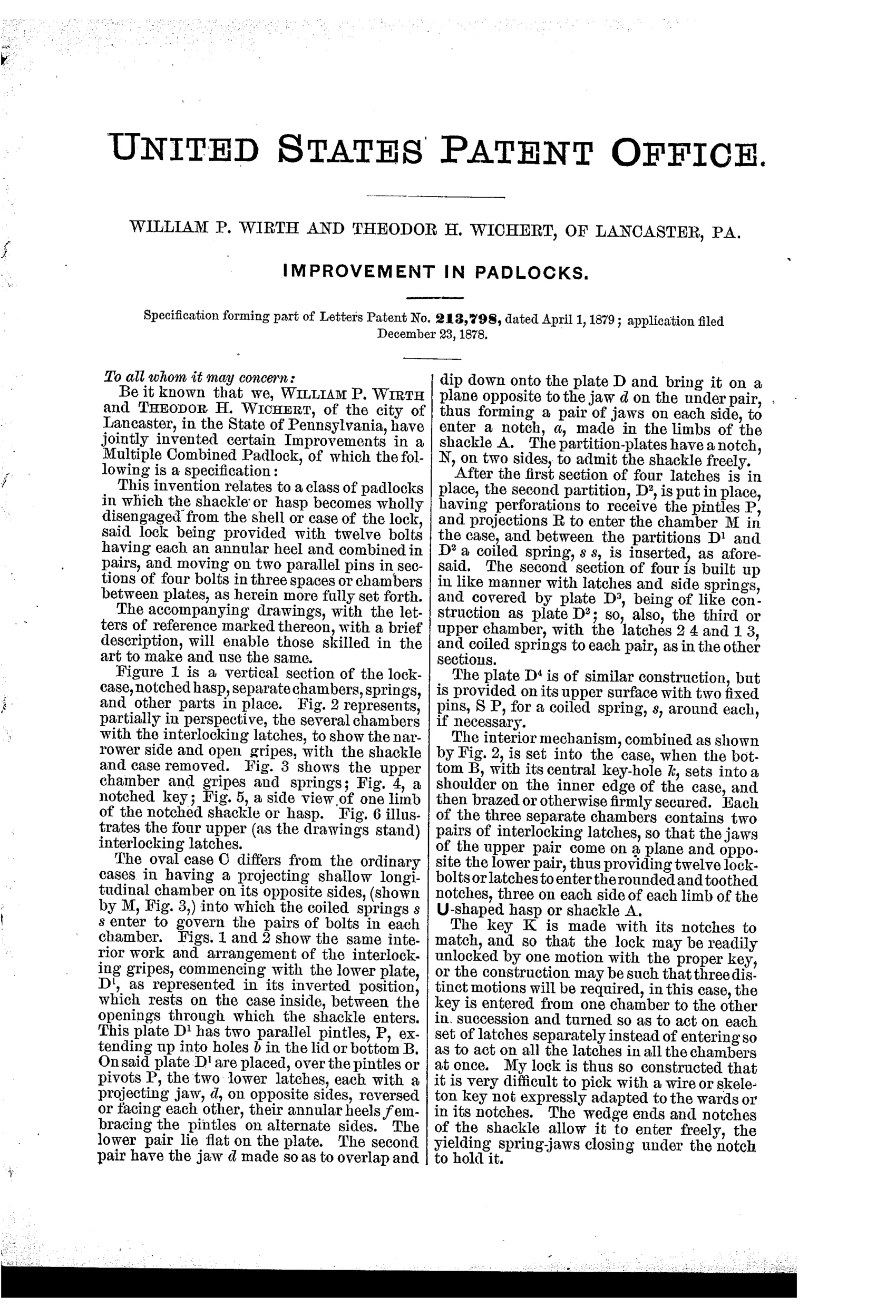
The lock case contains three separate chambers, each holding two pairs of interlocking latches pivoting on pintles, providing twelve lock-bolts total that engage notches on both limbs of a U-shaped shackle. Coiled springs positioned in side chambers of the oval case bias the latch pairs to close under the shackle notches when it is inserted. A specially warded key with matching notches enters a central key-hole to act on the latches, either unlocking all chambers with one motion or requiring three distinct motions depending on construction. The wedge-shaped, notched shackle ends allow the shackle to enter freely while the yielding spring-jaws close beneath the notches to hold it securely.
⚿ What was claimed
“The combination of the case C, having side chambers M, the plates D1 D2 D3 D4, having projections R, the pintles P, affixed to plate D1 and passing through the plates D2 D3 D4, the interlocking latches vibrating upon the pintles P, the springs S S, notched shackle A, and key K, substantially as described, and for the purpose set forth.”
In plain English: The claim covers the combination of the case with side chambers, stacked partition plates with pintles, interlocking latches that pivot on those pintles, springs, a notched shackle, and a matching key, all working together as described.
⚿ In the inventor’s words
“My lock is thus so constructed that it is very difficult to pick with a wire or skeleton key not expressly adapted to the wards or in its notches.”— William P. Wirth and Theodor H. Wichert, from the specification
Paper patent — likely never produced
The multi-chamber, twelve-latch construction would have been expensive to fit, and no production lock matching this design is known; a surviving marked example would be a genuine find.
⚿ Patented the same day
- IMPROVEMENT IN PADLOCKS — William C. McGill
⚿ Commentary
Most padlocks of 1879 held the shackle with one bolt, maybe two. Wirth and Wichert of Lancaster decided that was eleven bolts too few. Their case is partitioned into three chambers, each with two pairs of interlocking latches pivoting on shared pintles, so a dozen spring-loaded jaws snap under notches cut into both legs of the shackle. The wedge-shaped shackle ends push the jaws aside on the way in; on the way out, every one of them must be lifted clear at once — or, in one variant, in three separate key motions.
Fig. 2 is the sheet's best moment: the exploded stack of partition plates with the chevron-shaped latches nested between them shows how a single warded key bit, notched to match each layer, sweeps the whole column. Fig. 6 details the latch pairs — they interlock like meshed hands, so lifting one without its mate does nothing. That is a genuine anti-picking idea, not just multiplication for show.
The cost of the idea is the cost, literally. Four plates, twelve latches, multiple springs, and a key that has to index three chambers is a lot of fitting for a padlock competing against six-lever Scandinavian and push-key locks that were nearly as secure and far cheaper to build. This reads as an ingenious dead end — the kind of maximalist security thinking pin tumblers would soon make unnecessary.
Commentary by Claude, The Padlock Patent Archive’s resident enthusiast