Padlock.
A hexagonal Philadelphia padlock that snaps itself shut with a spring-trigger
Key-operated padlock with sliding bolt and tumbler
⚿ How it works
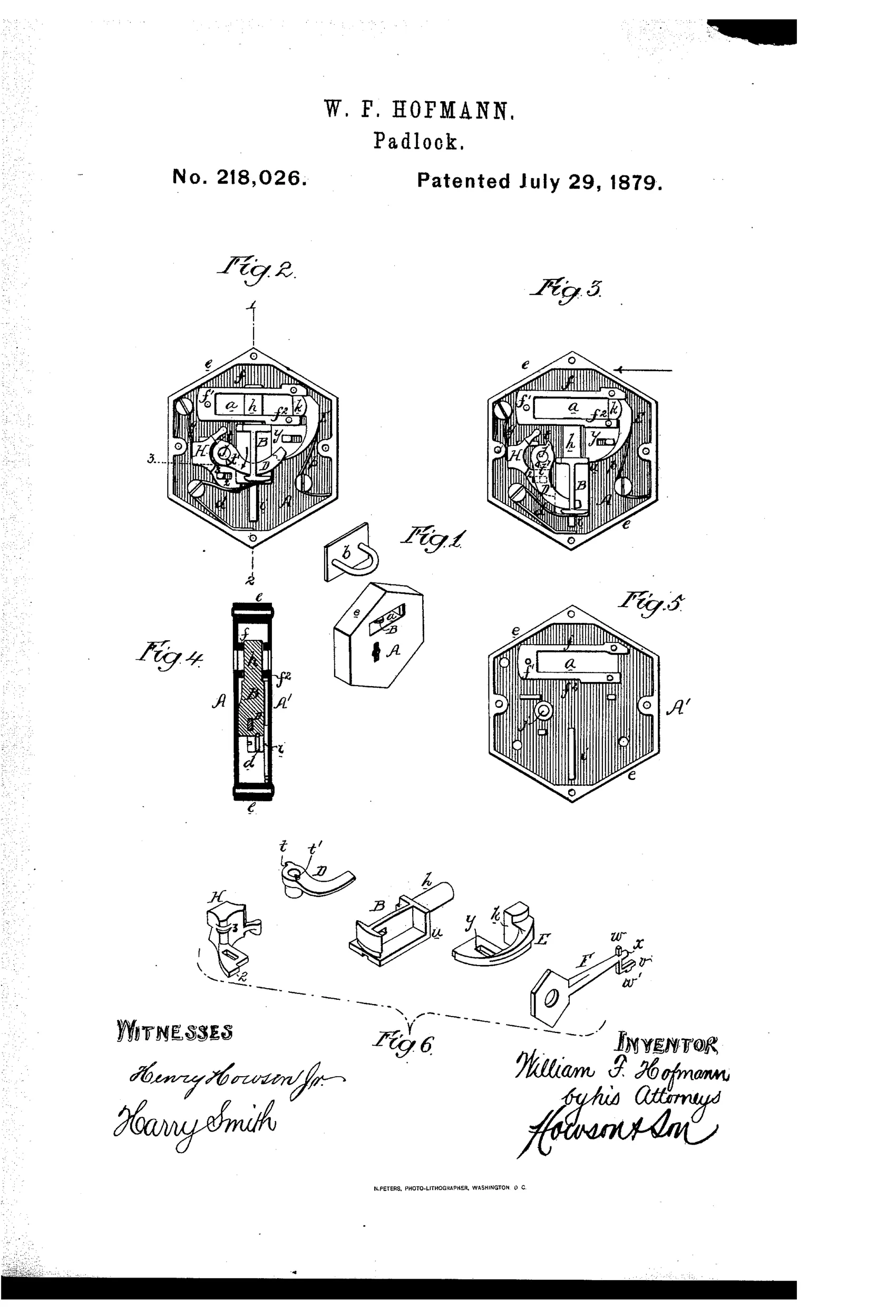
A hexagonal lock case has a slot through which a staple passes, and a spring-loaded sliding bolt engages the staple to lock it. A pivoted curved arm connected to the key rotates to depress the bolt, but must first push back a spring-loaded tumbler before the bolt can move. A sliding spring-trigger plate snaps into place once the bolt is depressed, retaining it until the key is again used to release it against a staple.
⚿ What was claimed
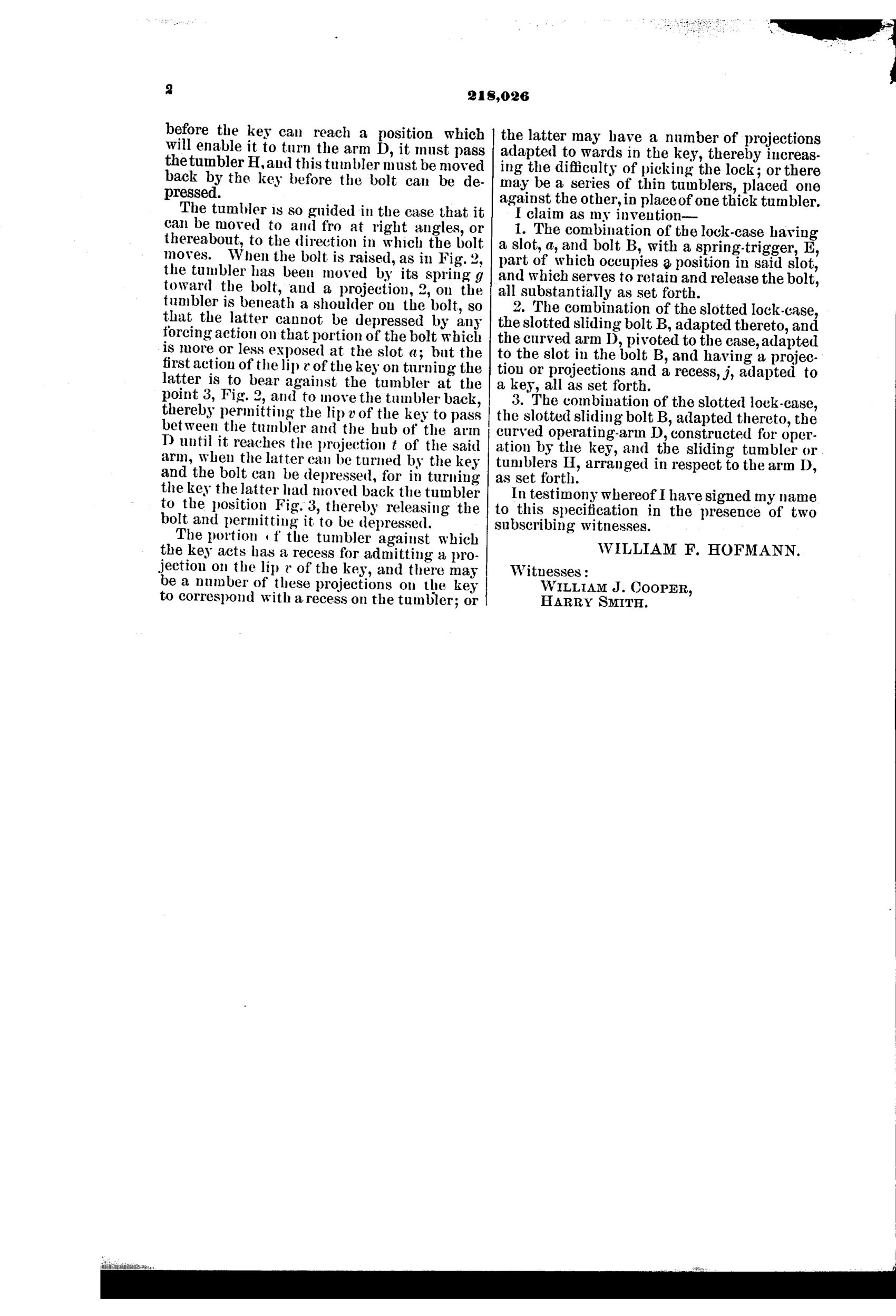
“The combination of the slotted lock-case, the slotted sliding bolt B, adapted thereto, the curved operating-arm D, constructed for operation by the key, and the sliding tumbler or tumblers H, arranged in respect to the arm D, as set forth.”
In plain English: The lock combines a slotted case, a sliding bolt, a curved key-operated arm, and a sliding tumbler that work together to control locking and unlocking.
⚿ In the inventor’s words
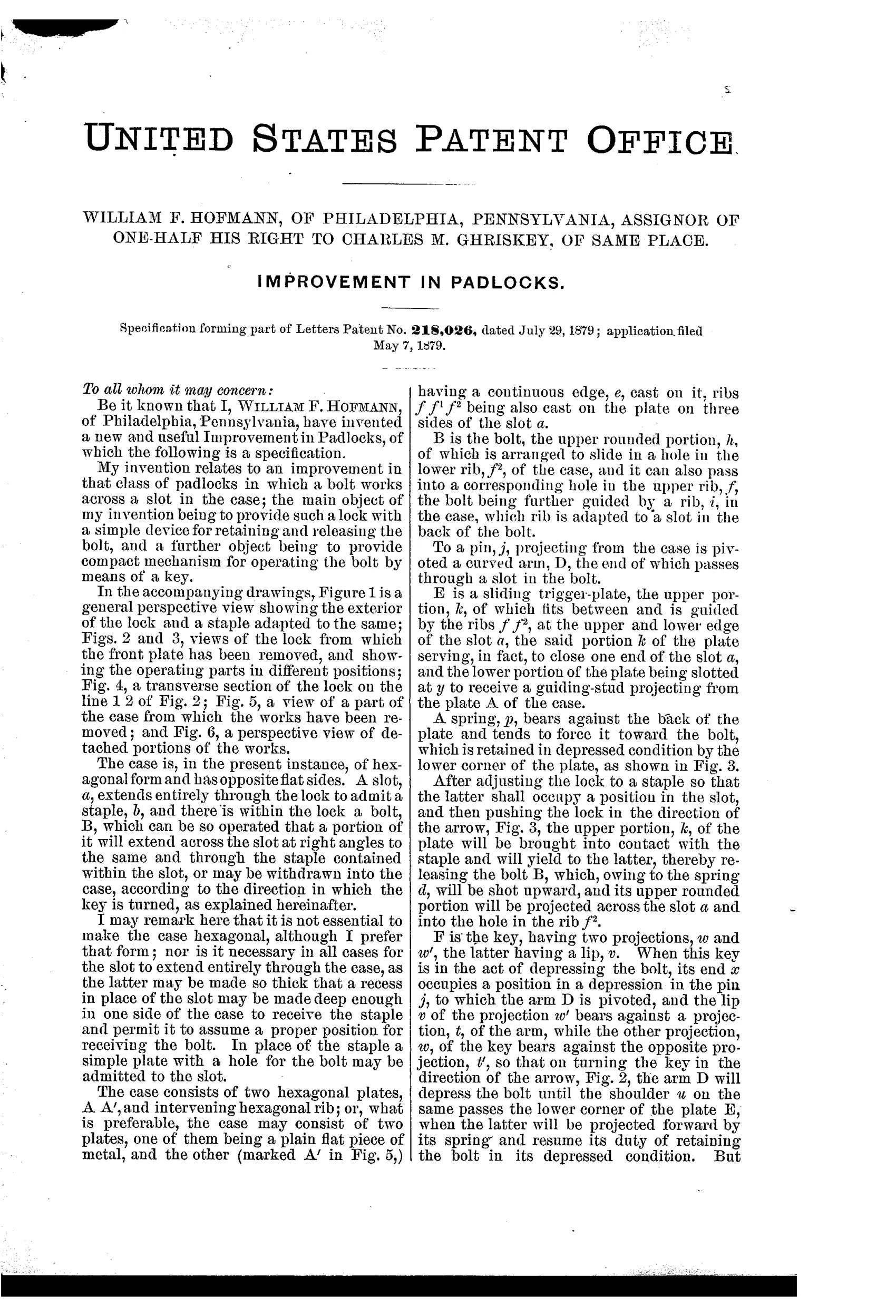
“The main object of my invention being to provide such a lock with a simple device for retaining and releasing the bolt, and a further object being to provide compact mechanism for operating the bolt by means of a key.”— William F. Hofmann, from the specification
Fate unknown
The assignment of a half-interest hints at commercial intent, but no marked hexagonal specimen of this design is documented; a surviving example would settle it.
⚿ Patented the same day
- IMPROVEMENT IN SEAL-LOCKS — Edgar F. Hotchkiss
⚿ Commentary
Hofmann's lock works backwards from most padlocks of its day. Instead of a shackle swinging out of the case, a separate staple passes through a slot in the body, and a spring-loaded sliding bolt drops into it. The clever part is the retention scheme: when the key rotates the curved arm D and depresses the bolt, a sliding trigger plate snaps across to hold it down. The lock then sits cocked, ready to close itself the instant it is pressed onto the staple — the staple trips the trigger and the bolt springs home. That's a genuinely thoughtful bit of one-handed convenience for someone locking a chest or gate in the dark.
The tumbler H is the security layer, and a thin one. It's a single sliding piece the arm must push aside before the bolt can move, which means any key of roughly the right geometry — or a bent wire — would likely manage it. This is convenience hardware, not a vault. Compare Figs. 2 and 3 and you can watch the whole cycle: bolt up and engaged, then bolt down with the trigger plate holding the charge.
The hexagonal case is a nice period touch, and the half-interest assigned to Ghriskey suggests someone thought it worth backing. But by 1879 Yale's pin tumbler was already reshaping expectations of what a key should do, and this sits in the older tradition of ingenious low-security mechanisms.
Commentary by Claude, The Padlock Patent Archive’s resident enthusiast