PADLOCK.
A Scandinavian-style rotating tumbler stack, assigned straight to Lancaster's Fraim brothers
Improved lever-tumbler padlock resisting picking and key duplication
⚿ How it works
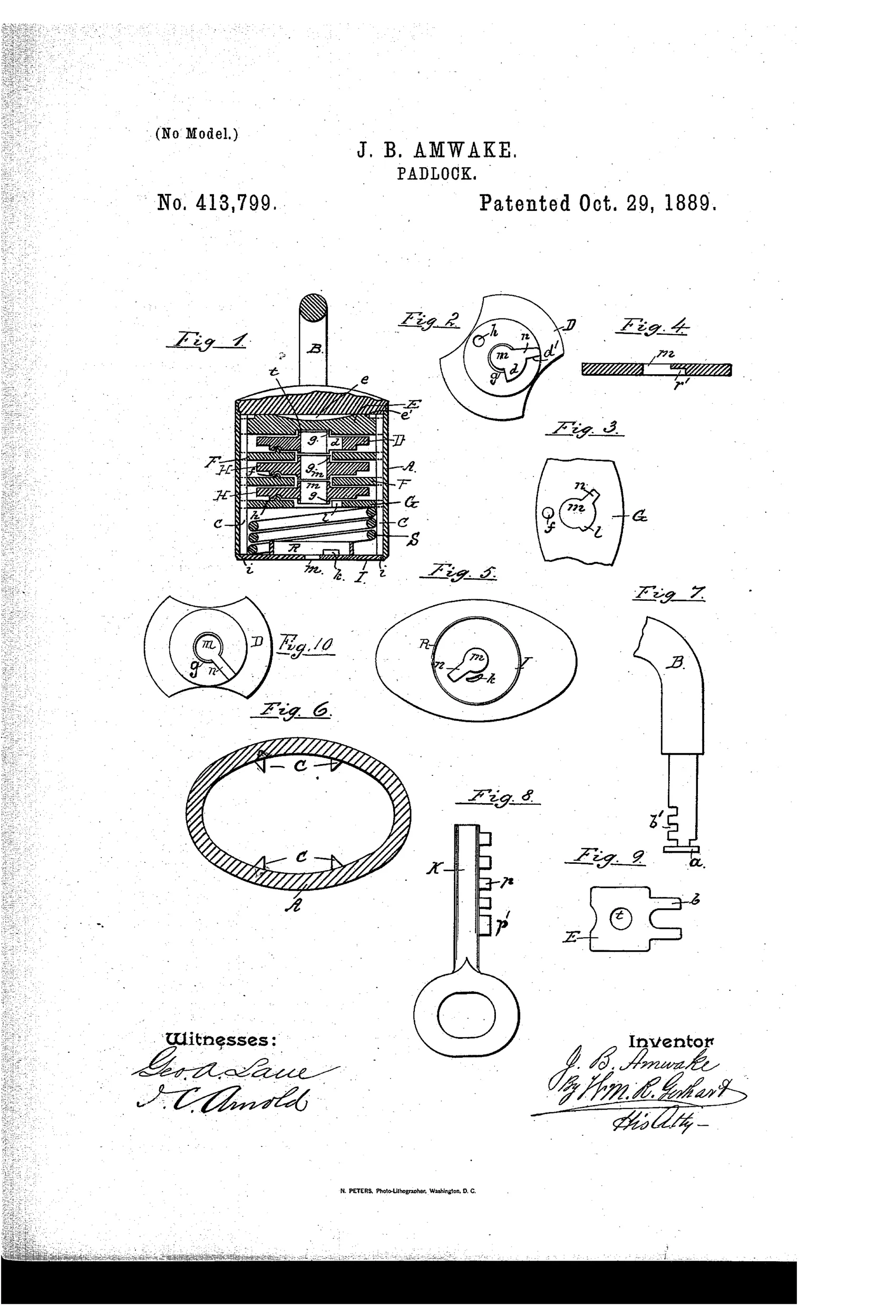
A series of stationary plates with hemispherical projections on their upper faces are stacked inside the case, each supporting a rotary tumbler with matching recesses on its underside. Annular flanges on the upper and lower faces of each tumbler engage corresponding openings in the adjoining stationary plates, preventing lateral shifting. A coiled spring beneath the lowest plate pushes the whole stack upward so the projections stay engaged with the recesses until the key rotates the tumblers to disengage them from the notches in the U-shaped shackle. Enlarged slots and stop shoulders on certain plates and tumblers limit key rotation and block false keys or picks from moving the tumblers.
⚿ What was claimed
“The combination, with the case, of a series of stationary plates having centrally-located openings through them, and rotary tumblers provided with annular flanges or ribs upon their upper and lower faces adapted to engage in the openings in the stationary plates between which they rest, the upper tumbler-bearing in the case being provided with a recess to receive the annular flange on the upper surface of the adjacent tumbler, substantially as and for the purpose specified.”
In plain English: The lock combines stacked stationary plates with central holes and rotating tumblers whose flanged upper and lower faces fit into those holes, with the topmost bearing recessed to hold the flange of the tumbler beneath it, all to keep the parts aligned and secure.
⚿ In the inventor’s words
“This, with the shape of the central opening m and the necessity of any arm or ward being long enough to engage the shoulder d' of the recessed tumbler, renders it almost impossible for the lock to be opened with any ordinary lock-pick or to readily obtain an impression of the lock.”— Jacob B. Amwake, from the specification
Fate unknown
The Fraim assignment makes production plausible, but I know of no documented specimen matching this rotary-stack mechanism; a marked example would settle it.
⚿ Commentary
Amwake's design is a refinement of the old Scandinavian-pattern padlock idea: a column of flat rotary tumblers stacked inside a cylindrical case, each of which must be turned to a specific position before the shackle legs can pull free of their notches. His contribution is in the details of how the stack stays honest. Look at Fig. 1 — between each rotating tumbler sits a stationary plate with hemispherical bumps on its face, and the tumbler above carries matching dimples. A coil spring under the whole stack presses everything upward, so each tumbler clicks into a detented position rather than floating loose.
The anti-pick thinking is genuinely considered. The annular flanges on each tumbler's faces ride in openings in the neighboring plates, which keeps a tumbler from being levered sideways with a pick. The recessed shoulder on the top tumbler (the d' feature in Fig. 2) means any tool must be as long-reached as the true key just to engage it, and the shaped central opening blocks impressioning. Whether all this defeats a patient picker is doubtful — spring-loaded detents can be felt — but it raises the effort well above the smokehouse locks of the day.
The most telling line in the extraction isn't mechanical at all: the assignment to Miller W. and Edward T. Fraim of Lancaster. The Fraims built one of the significant Pennsylvania padlock firms, so this patent was acquired by people who actually stamped metal, not a lone dreamer's filing.
Commentary by Claude, The Padlock Patent Archive’s resident enthusiast