PADLOCK.
Push-key padlock whose hasp springs open by itself, from New Britain's hardware belt
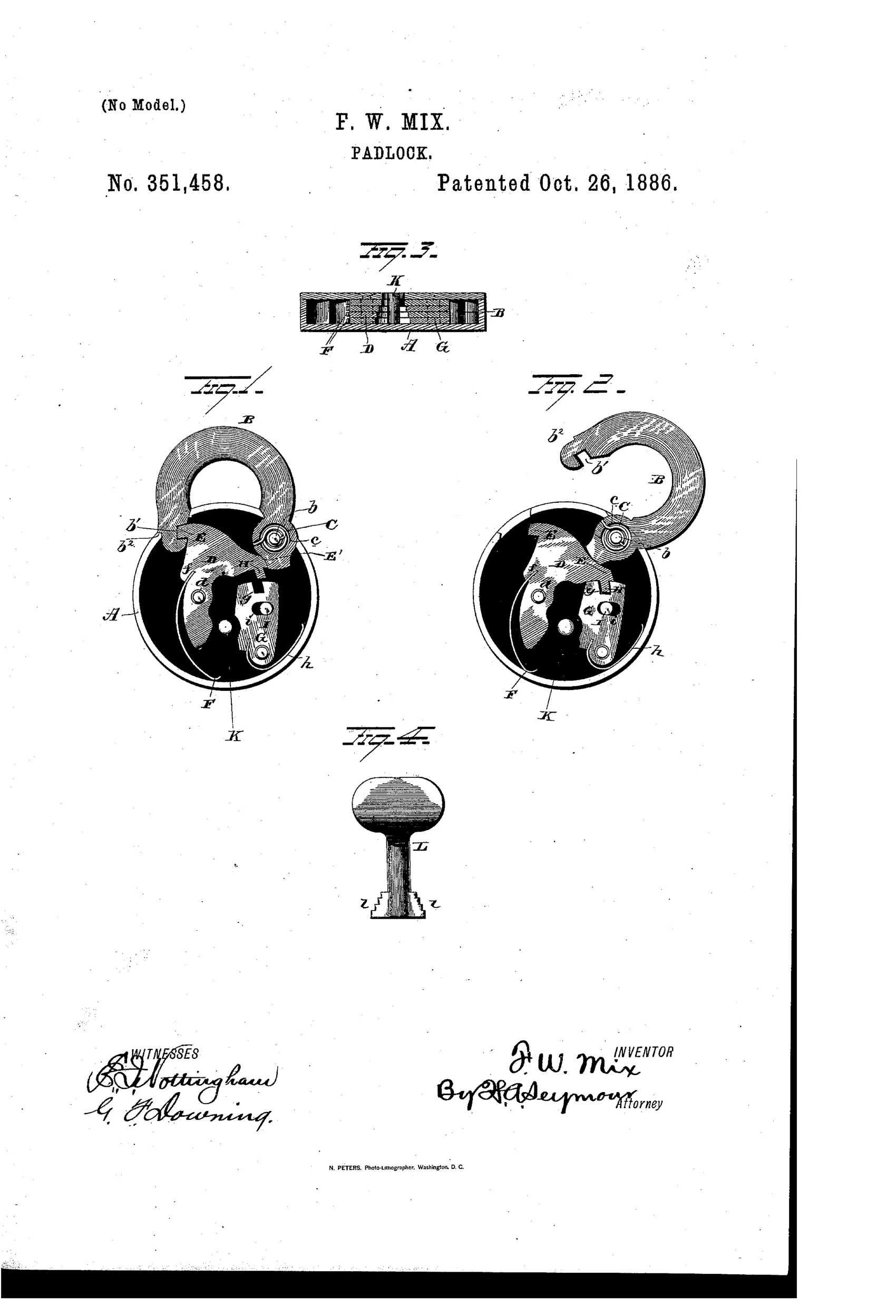
Improved spring-actuated padlock with pivoting hasp
⚿ How it works
A hinged hasp is spring-biased to automatically pop open when released. A spring-actuated locking bolt pivots within the casing and engages a notch in the hasp's free end. A pivoted tumbler, limited in its throw by a pin riding in an elongated slot, positively blocks the bolt from disengaging under jarring or picking attempts. A specially notched push-type key with oppositely-extending wings simultaneously moves the tumbler and bolt to release the hasp, which then springs open automatically via its own hinge spring.
⚿ What was claimed
“In a padlock, the combination, with a spring-actuated locking-bolt pivotally secured to the casing, of a vibratory tumbler pivoted at its lower end and limited in its throw by a pin or stud located in an elongated closed slot formed transversely through the tumbler, a key-post located between the bolt and tumbler, and a key adapted to engage the tumbler above its pivotal point and engage the bolt below its pivotal point, substantially as set forth.”
In plain English: The padlock combines a spring-loaded pivoting bolt with a limited-swing tumbler and a key-post, so that a single key can simultaneously engage both the tumbler and bolt to unlock it.
⚿ In the inventor’s words
“A further object is to provide a padlock which cannot be easily "picked," and which cannot be sprung open by strain on the hasp.”— Frank W. Mix, from the specification
Fate unknown
Mix was a working New Britain lock man and the design is eminently manufacturable, but I know of no specimen tied to this patent; a marked example or catalog listing would settle it.
⚿ More by Frank W. Mix
- Padlock. (1880)
- PADLOCK (1887)
- HASP-LOCK. (1887)
⚿ Commentary
Frank Mix packs three ideas into one small round case. First, the hasp is spring-loaded at its hinge, so the moment the bolt lets go, the lock pops open in your hand — compare Fig. 1 and Fig. 2 and you can see the hasp swing clear on its own. Second, the pivoted tumbler with its pin-in-slot limit isn't a security tumbler in the lever-lock sense; it's a positive block that keeps the spring bolt from bouncing out of its notch when the lock is jarred or when someone strains the hasp. Third, the winged push key (Fig. 4) has to reach past the key-post and work tumbler and bolt at the same time, one above its pivot and one below — a neat bit of geometry that a straight pick can't easily duplicate.
This sits squarely in the push-key tradition that Connecticut's hardware towns were churning out in the 1880s, the same current that produced the six-lever push-key locks collectors know well. Mix's version is simpler than most — one tumbler, not six — so its resistance to picking is modest despite the claim. But as a cheap, self-opening utility padlock it's an honest, buildable design: everything stamps or casts easily, and there's nothing in the drawing that a New Britain shop couldn't produce by the thousand.
Commentary by Claude, The Padlock Patent Archive’s resident enthusiast