PADLOCK
Guard-tumblers punish wrong keys: over-lift protection in an 1887 round padlock
Pick-resistant tumbler padlock with hooked shackle
⚿ How it works
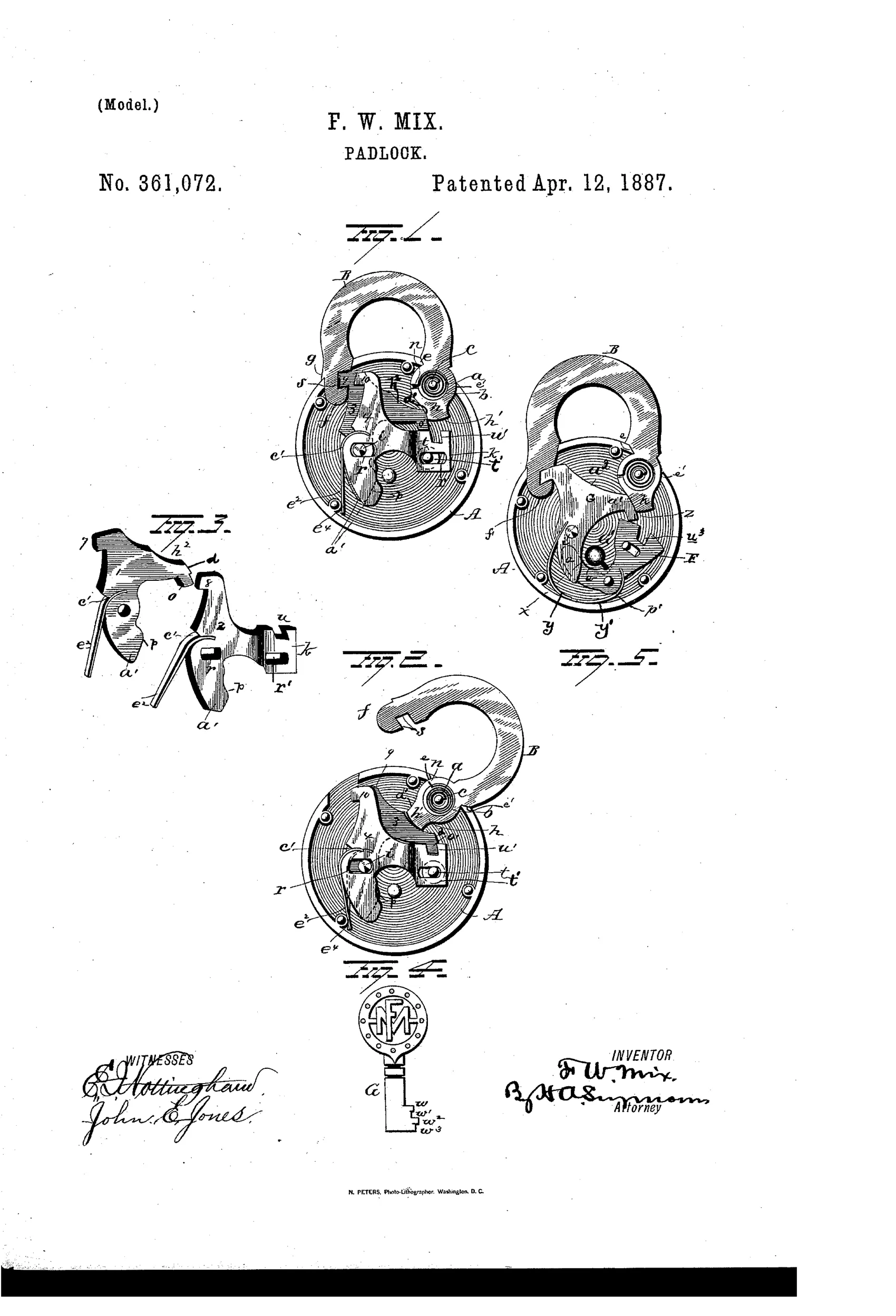
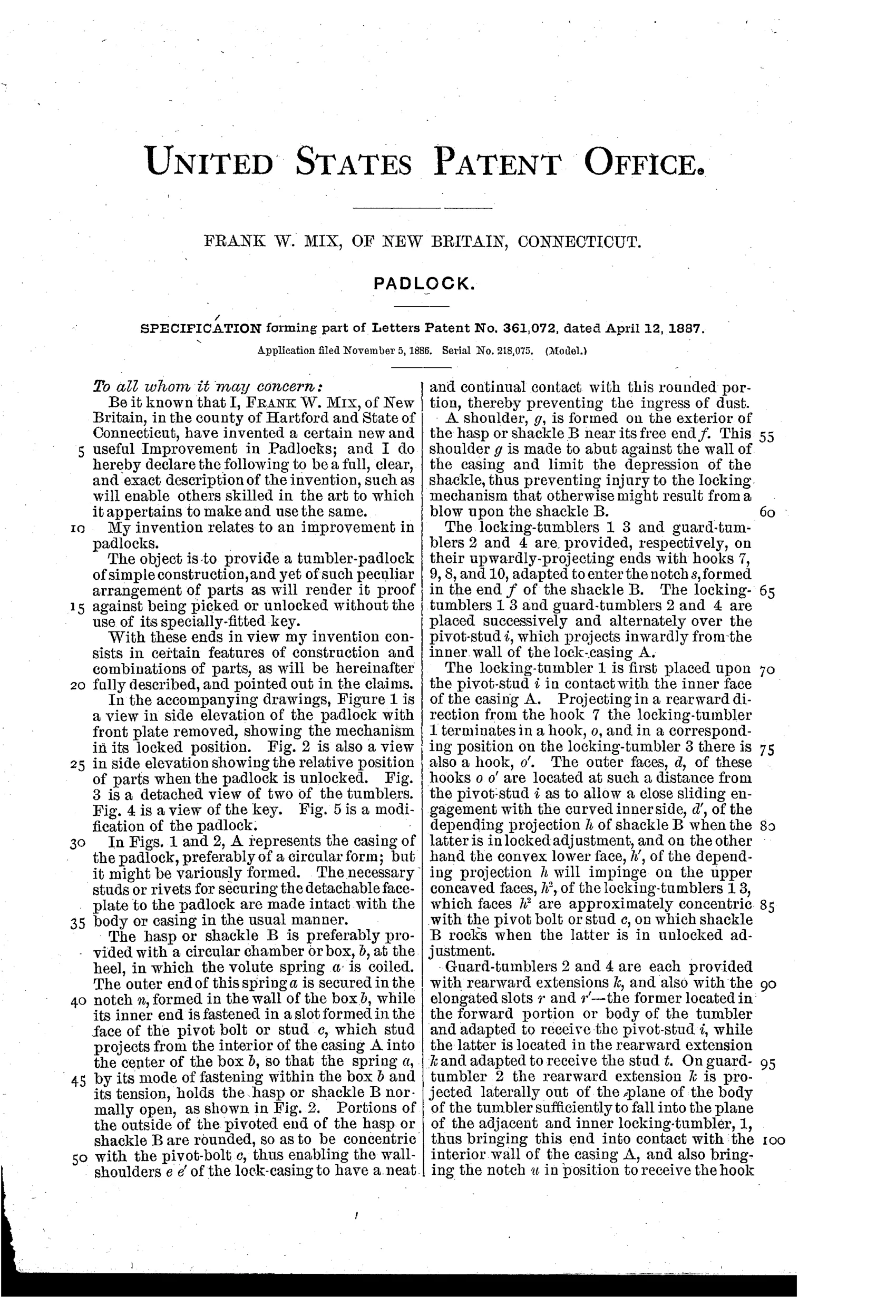
The padlock has a circular casing containing paired locking-tumblers and guard-tumblers mounted alternately on a common pivot-stud, each spring-loaded so their hooks normally wedge into a notch in the hasp or shackle. A single-bitted key with wards of specific varied lengths engages depending legs on both sets of tumblers, shifting the guard-tumblers forward and rocking the locking-tumblers so their hooks drop into register and release the shackle. If a key with wards too short or too long is used, the hooks fail to register properly, keeping the shackle locked and resisting picking. A volute spring coiled in a chamber at the heel of the shackle keeps it normally thrown open once unlocked.
⚿ What was claimed
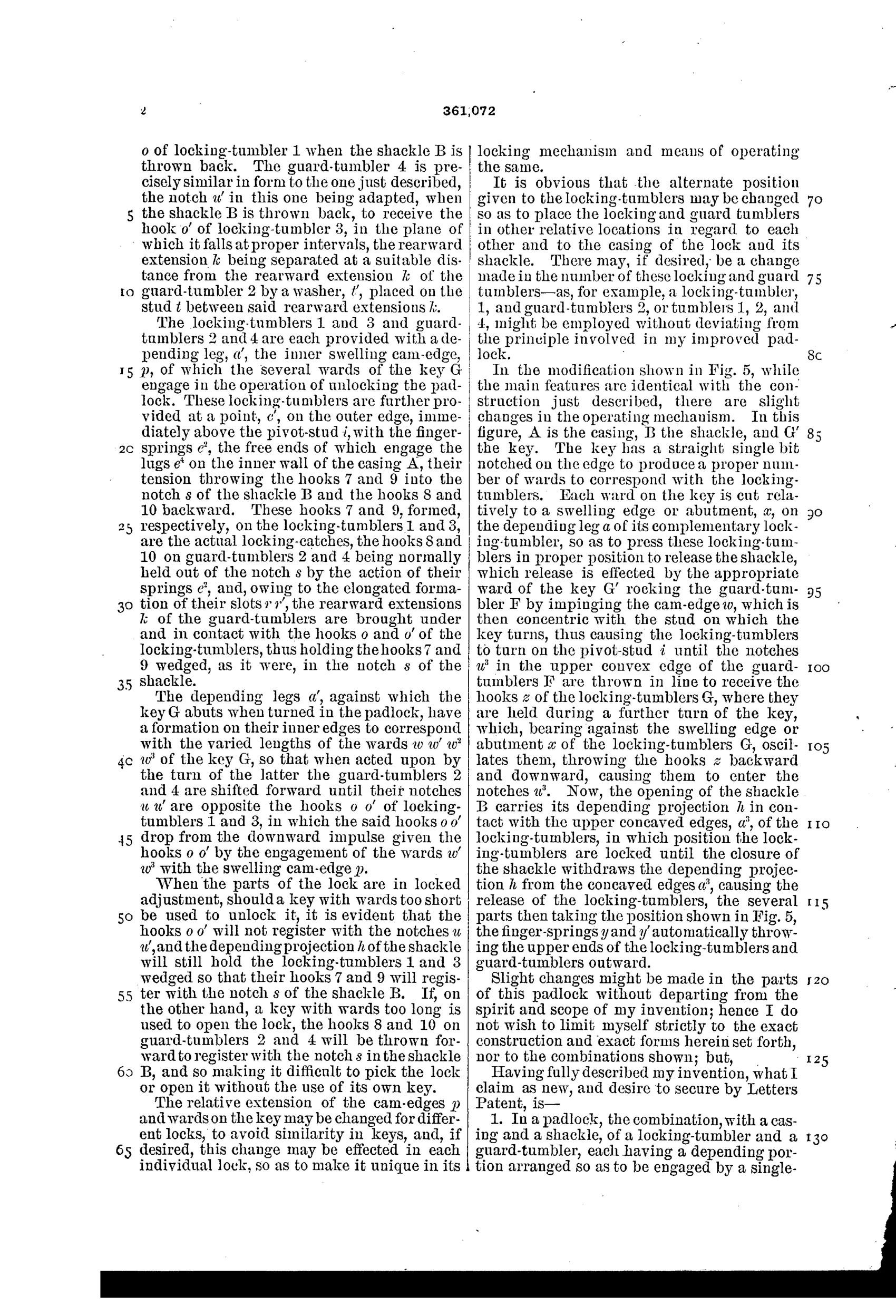
“In a padlock, the combination, with a casing and a shackle, of a locking-tumbler and a guard-tumbler, each having a depending portion arranged so as to be engaged by a single-bitted key, the said locking-tumbler having a hook and the guard-tumbler a corresponding notch adapted to receive said hook as the locking-tumbler is moved away from the free end of the hasp, substantially as set forth.”
In plain English: The lock uses a locking-tumbler with a hook and a guard-tumbler with a matching notch, both moved by a single key, so the hook only catches the notch when the locking-tumbler swings away from the shackle's free end.
⚿ In the inventor’s words
“The object is to provide a tumbler-padlock of simple construction, and yet of such peculiar arrangement of parts as will render it proof against being picked or unlocked without the use of its specially-fitted key.”— Frank W. Mix, from the specification
Fate unknown
The design is practical and Mix was a working Connecticut lock designer, but no specific production padlock is known to match this patent; a marked or dated specimen would settle it.
⚿ More by Frank W. Mix
- Padlock. (1880)
- PADLOCK. (1886)
- HASP-LOCK. (1887)
⚿ Commentary
Frank Mix's design attacks the classic weakness of lever padlocks: that a picker or a stranger's key only has to lift each tumbler far enough. Here he pairs each locking-tumbler with a guard-tumbler, stacked alternately on one pivot stud, and gives the key wards of deliberately varied lengths. Lift too little and the hook never clears; lift too much and the hook drops into the guard-tumbler's notch and catches, holding the shackle fast anyway. That is the same logic as Chubb's detector lever, but built cheaply into a compact round padlock body — the wrong key defeats itself in both directions.
The drawings reward a slow look. Figure 3 shows the two tumblers detached, and you can see the hook-and-notch pairing that does the real work; the swirled shading on the case in Figures 1 and 2 shows a spun or turned circular casing, a common economical form for the period. The volute spring buried at the shackle heel is a nice touch of usability: unlock it and the hooked shackle springs open on its own.
Mix was a New Britain man working in the heart of Connecticut's hardware valley, and this reads like a production-minded refinement rather than an inventor's fantasy — few parts, one pivot stud, a single-bitted key. Whether any factory took it up is another question, but mechanically it is sound and would have worked as claimed against casual key-trying, if not against a determined picker.
Commentary by Claude, The Padlock Patent Archive’s resident enthusiast