Padlock.
Frank Mix does away with the shackle entirely — the case slot is the lock
Compact key-operated padlock with slide and tumblers
⚿ How it works
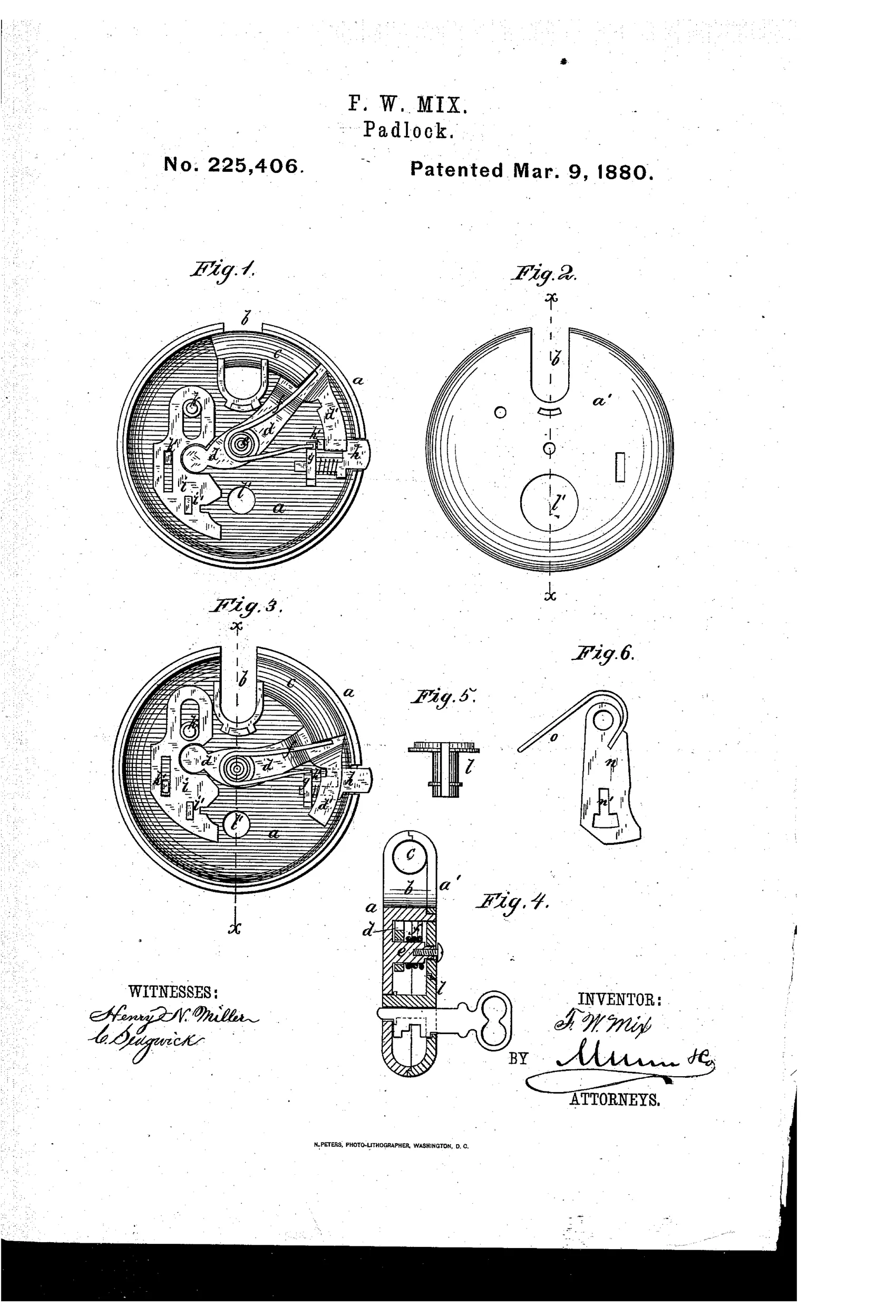
A vibrating bolt c is mounted on a pivoted lever d that swings in an arc to project across a mortise b, forming the shackle opening of the padlock case. A spring f drives the bolt into locked position, while a spring-loaded blocking-piece h engages a notch on the bolt's arm d' to hold it retracted until released by pressure on h. A slide i, moved directly by the key, acts on a toe at the end of lever d to retract the bolt, interposing space between the key and bolt for easier action. Slotted tumblers (as at u) are hung on a post k and engage a fixed projection i' on the slide via a T-slot, being thrown forward by individual springs o so that only the correct key pattern permits the slide to move and retract the bolt.
⚿ What was claimed
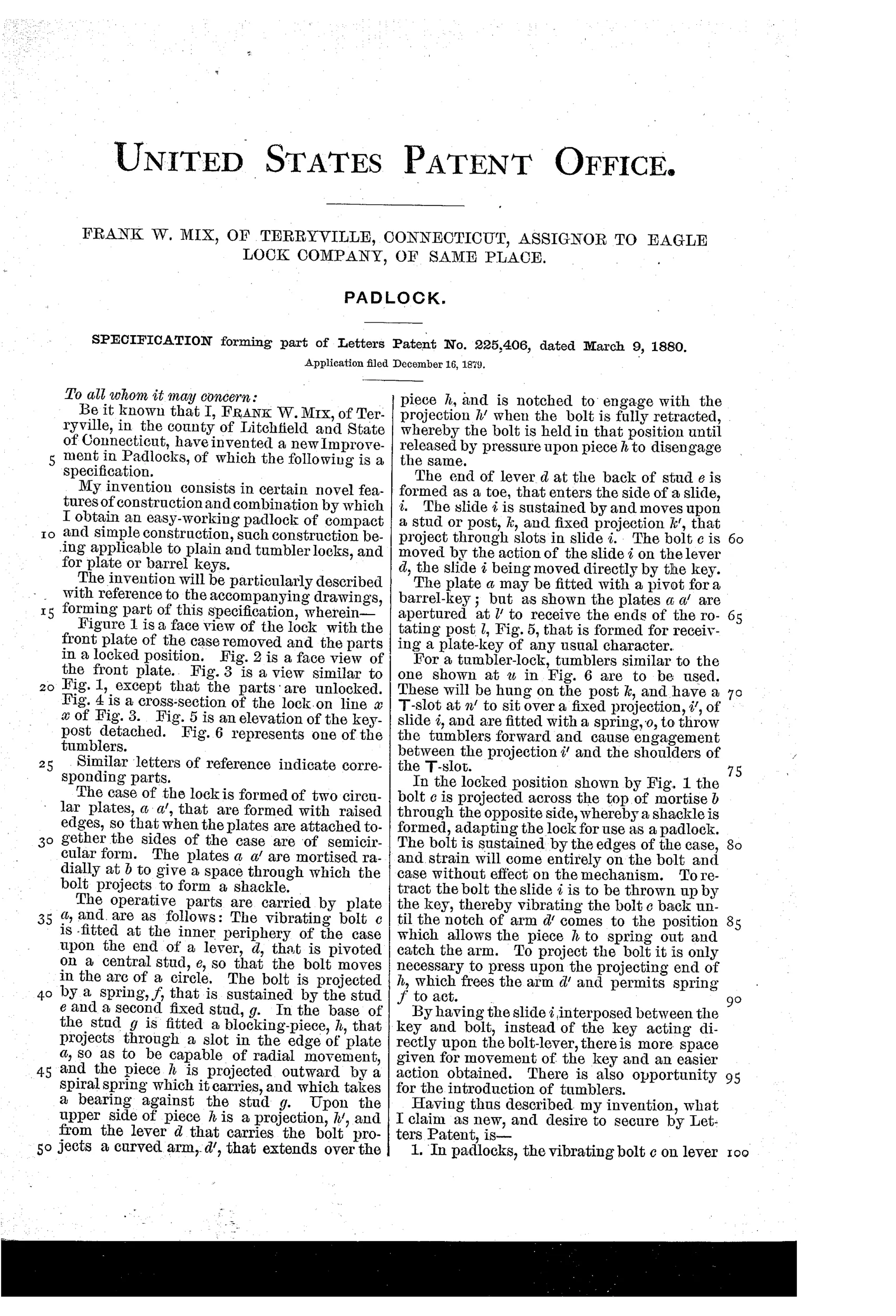
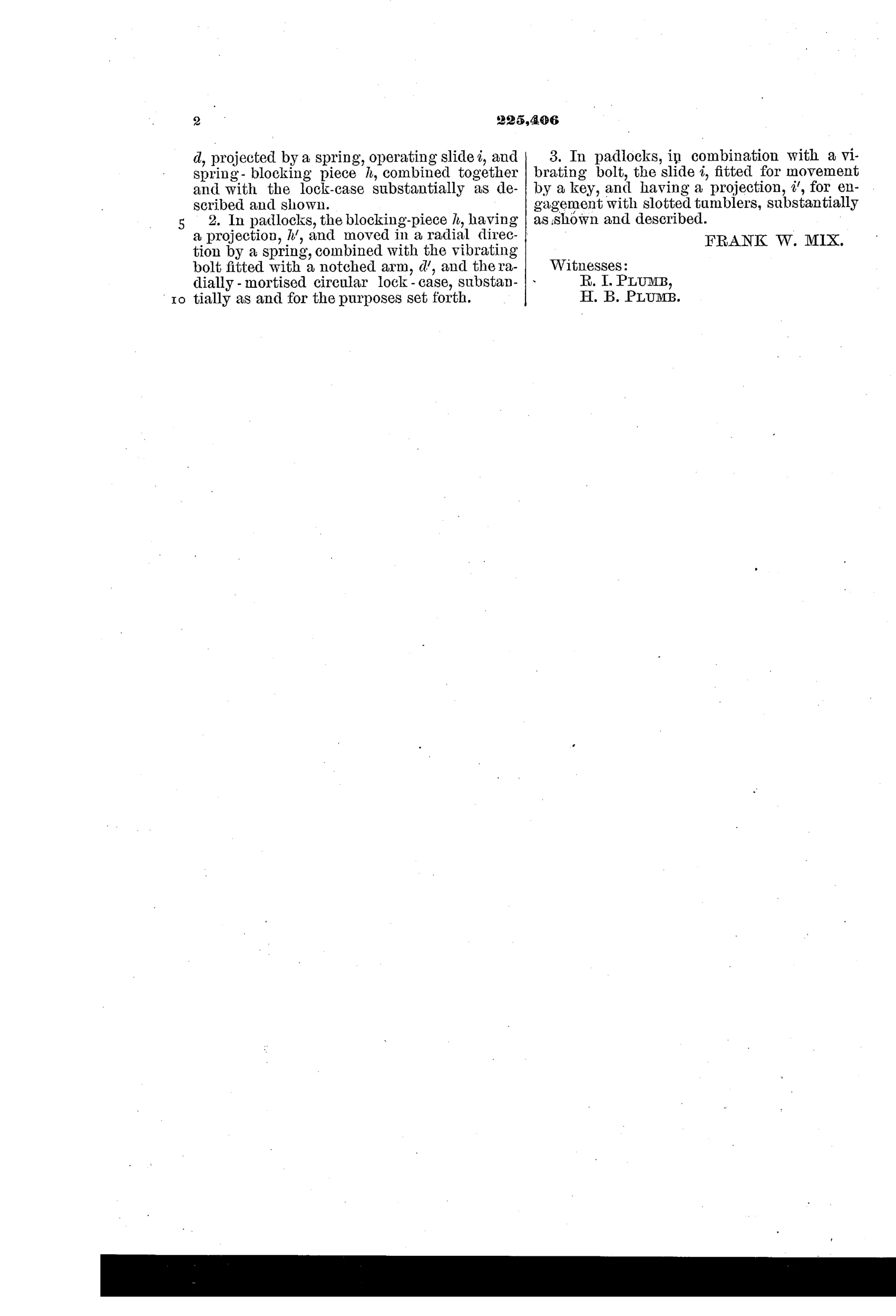
“In padlocks, the vibrating bolt c on lever d, projected by a spring, operating slide i, and spring-blocking piece h, combined together and with the lock-case substantially as described and shown.”
In plain English: The patent claims a padlock design combining a spring-driven pivoting bolt, a key-operated slide, and a spring-loaded blocking piece that work together with the lock case to lock and unlock the shackle.
⚿ In the inventor’s words
“My invention consists in certain novel features of construction and combination by which I obtain an easy-working padlock of compact and simple construction, such construction being applicable to plain and tumbler locks, and for plate or barrel keys.”— Frank W. Mix, from the specification
Fate unknown
The Eagle Lock assignment and Mix's track record make manufacture plausible, but I know of no specimen matched to this exact mechanism; a marked round-case shackleless Eagle lock with the internal blocking piece would settle it.
⚿ More by Frank W. Mix
- PADLOCK. (1886)
- PADLOCK (1887)
- HASP-LOCK. (1887)
⚿ Commentary
Look at Fig. 2 before anything else: there is no swinging shackle on this padlock. The circular case has a deep mortise cut into its rim, and the 'shackle' is just a hasp staple that drops into that slot. Inside, a curved vibrating bolt on a pivoted lever swings across the mortise to trap it. This is the shackleless idea that later became standard on high-security warehouse and boxcar locks, worked out here in 1880 in a tidy round brass case.
The mechanical detail worth savoring is the blocking piece h. When you retract the bolt, a spring catch grabs a notch on the lever arm and holds it open — so the lock stays cocked with the key removed. Push a staple into the mortise, it trips h, and the spring snaps the bolt home. That is self-locking behavior, no key needed to close, which is exactly what you want on a padlock used a hundred times a day. The slide i is also a thoughtful touch: the key never touches the bolt directly, so a short key throw translates into a full bolt swing, keeping the case thin.
Mix was Eagle Lock Company's man in Terryville and one of the most prolific padlock designers of the era, and the assignment on the face of the patent means Eagle owned this from day one. It reads like a production drawing, not a daydream — every spring and tumbler is placed where a die-caster could reach it.
Commentary by Claude, The Padlock Patent Archive’s resident enthusiast