IMPROVEMENT IN PADLOCKS
Bohannan makes the shackle do the work: snap shut, no key required
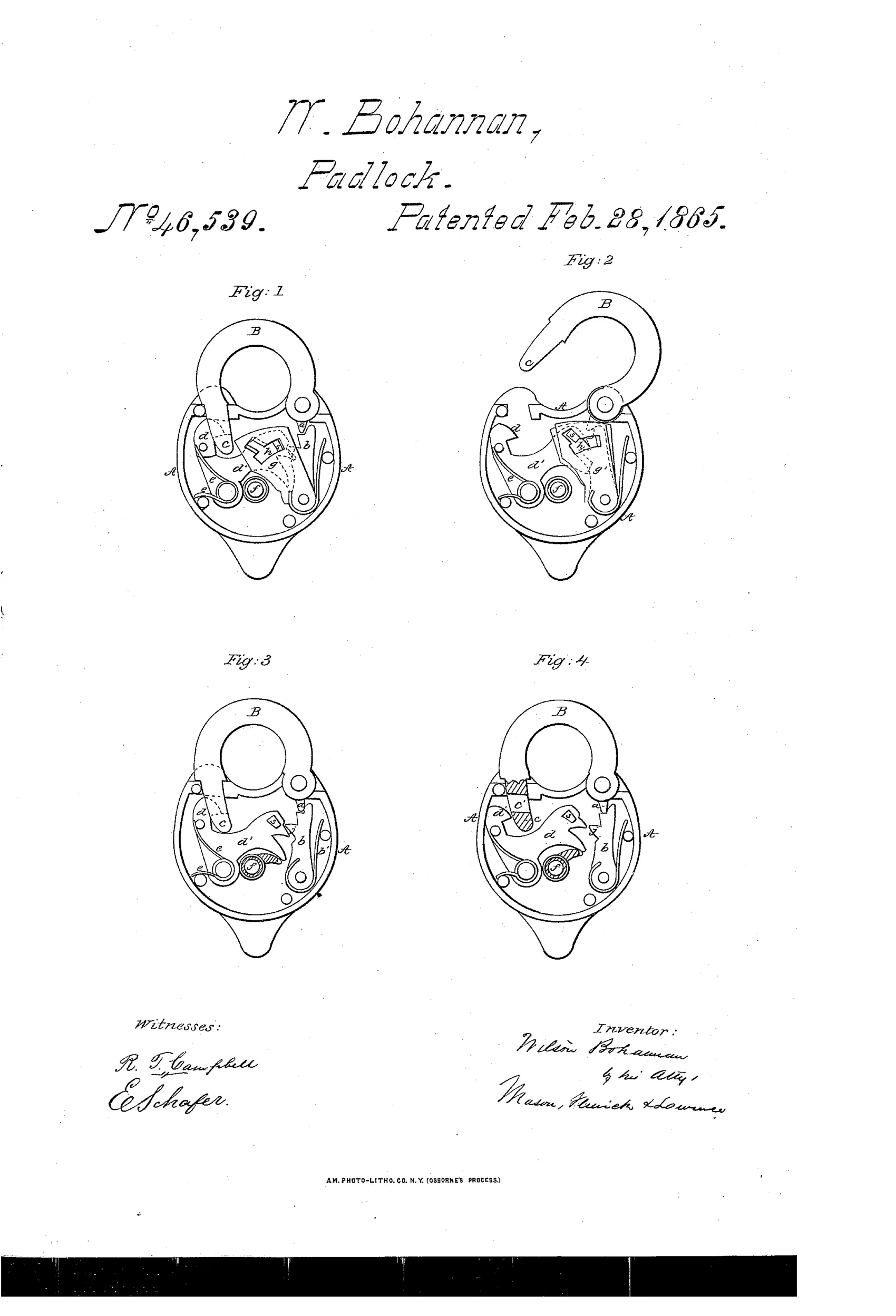
Self-locking padlock with spring pawl mechanism
⚿ How it works
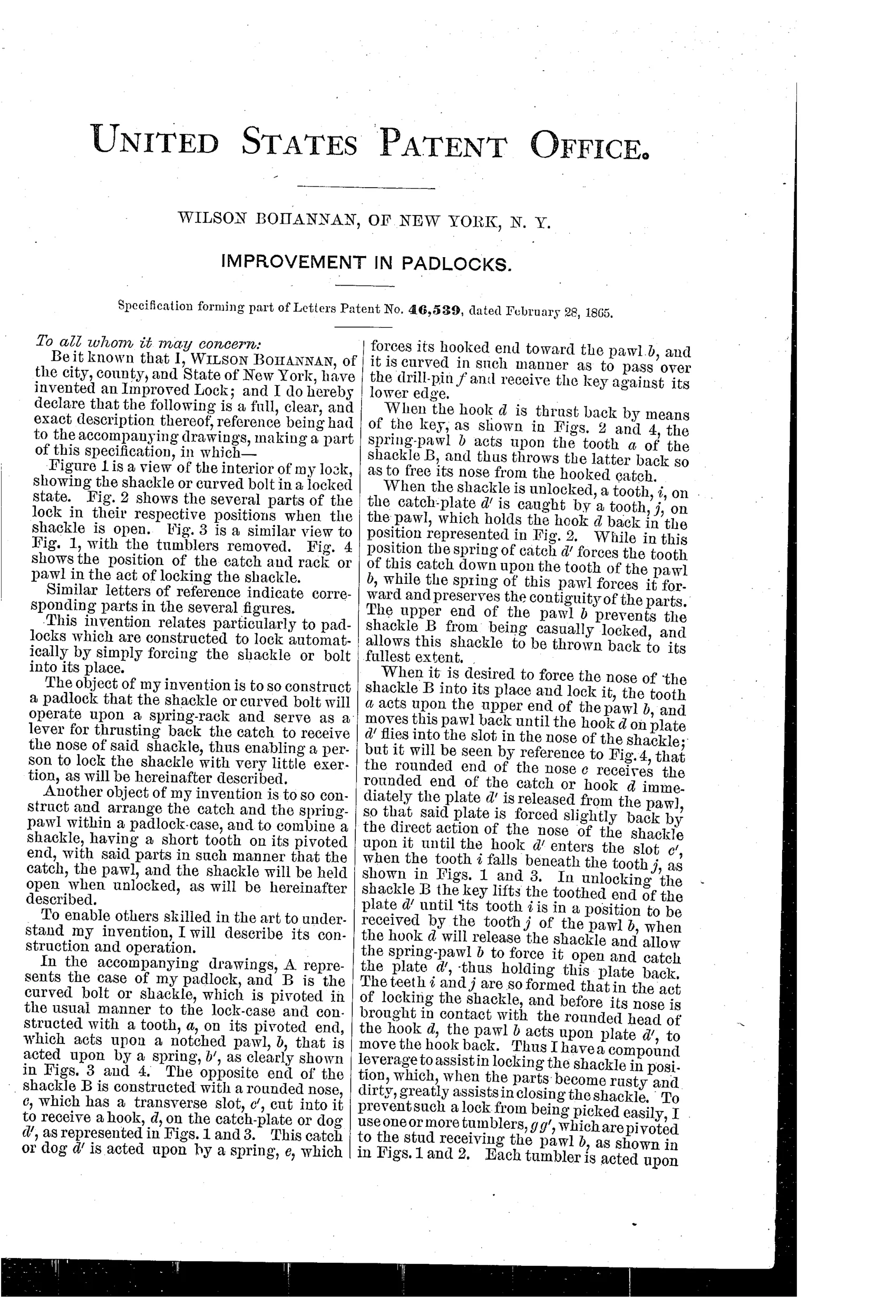
The shackle B is pivoted to the case A and has a tooth a on its pivoted end that acts on a notched spring-pawl b. The opposite end of the shackle has a rounded nose c with a transverse slot c' that receives a hook d on a spring-loaded catch-plate d'. When the shackle is forced closed, its nose pushes back the hook via the pawl's tooth j engaging tooth i on the catch-plate, so that the shackle acts as a lever to thrust back the catch, allowing the lock to close with little exertion. One or more tumblers g, g', pivoted near the pawl, each have an L-slot that must align with a stump on the catch-plate before the shackle can be released by the key, providing pick resistance.
⚿ What was claimed
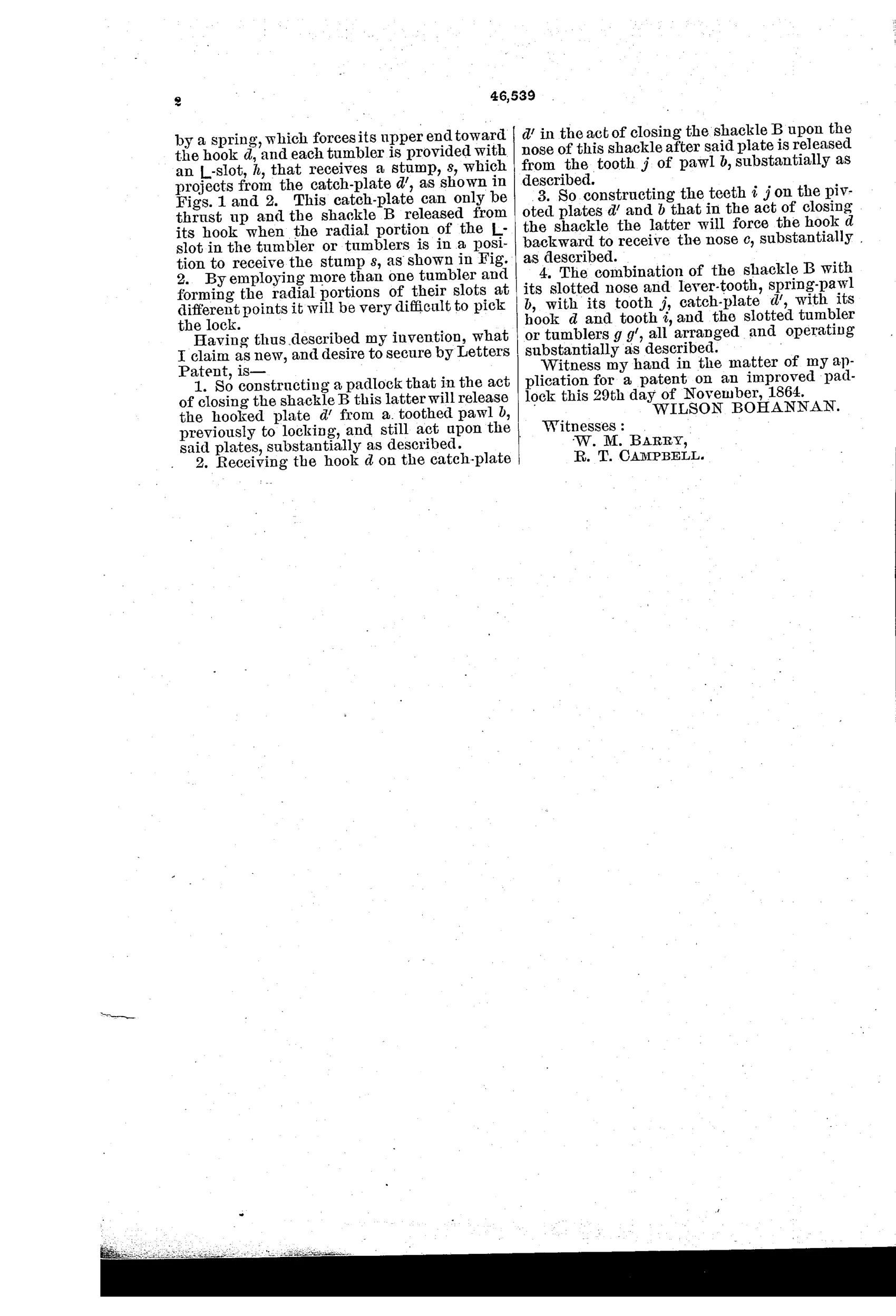
“The combination of the shackle B with its slotted nose and lever-tooth, spring-pawl b, with its tooth j, catch-plate d', with its hook d and tooth i, and the slotted tumbler or tumblers g g', all arranged and operating substantially as described.”
In plain English: The claim covers the combined arrangement of the notched shackle, spring pawl, hooked catch-plate, and slotted tumblers that work together to lock and unlock the padlock.
⚿ In the inventor’s words
“The object of my invention is to so construct a padlock that the shackle or curved bolt will operate upon a spring-rack and serve as a lever for thrusting back the catch to receive the nose of said shackle, thus enabling a person to lock the shackle with very little exertion, as will be hereinafter described.”— Wilson Bohannan, from the specification
Manufactured and sold
Wilson Bohannan built a lock company on his self-locking padlock patents, and locks embodying his 1860s designs were manufactured in quantity.
⚿ More by Wilson Bohannan
- IMPROVEMENT IN PADLOCKS, &c. (1867)
- IMPROVEMENT IN PADLOCKS (1878)
- PADLOCK. (1885)
⚿ Commentary
The trick here is economy of effort. Most padlocks of the 1860s asked something of the user at both ends of the cycle — key to open, key or deliberate pressure to close. Bohannan's arrangement turns the shackle itself into a lever: as you press it home, the tooth on its pivoted heel bears on the spring-pawl, which in turn pries back the hooked catch-plate just far enough to admit the shackle's slotted nose. Then everything springs back and the hook drops into the slot. Fig. 4 is the drawing to study — it freezes the mechanism mid-close, showing how the pawl's tooth j meshes with tooth i on the catch so the closing force is transmitted mechanically rather than by mashing parts past each other.
The slotted tumblers g and g' are the second half of the story, and easy to miss between Figs. 1 and 3 (the latter has them removed for clarity). Each has an L-slot that must line up with a stump on the catch-plate before the key can withdraw the hook — genuine lever-tumbler security layered onto a snap-shut convenience lock.
This sits early in Bohannan's arc, and it points exactly where his company went: sturdy, self-locking brass padlocks that a switchman or teamster could close one-handed in the dark. Not a dead end at all — a foundation.
Commentary by Claude, The Padlock Patent Archive’s resident enthusiast