IMPROVEMENT IN PADLOCKS
Bohannan's key trap: the tumbler that holds your key hostage until you relock
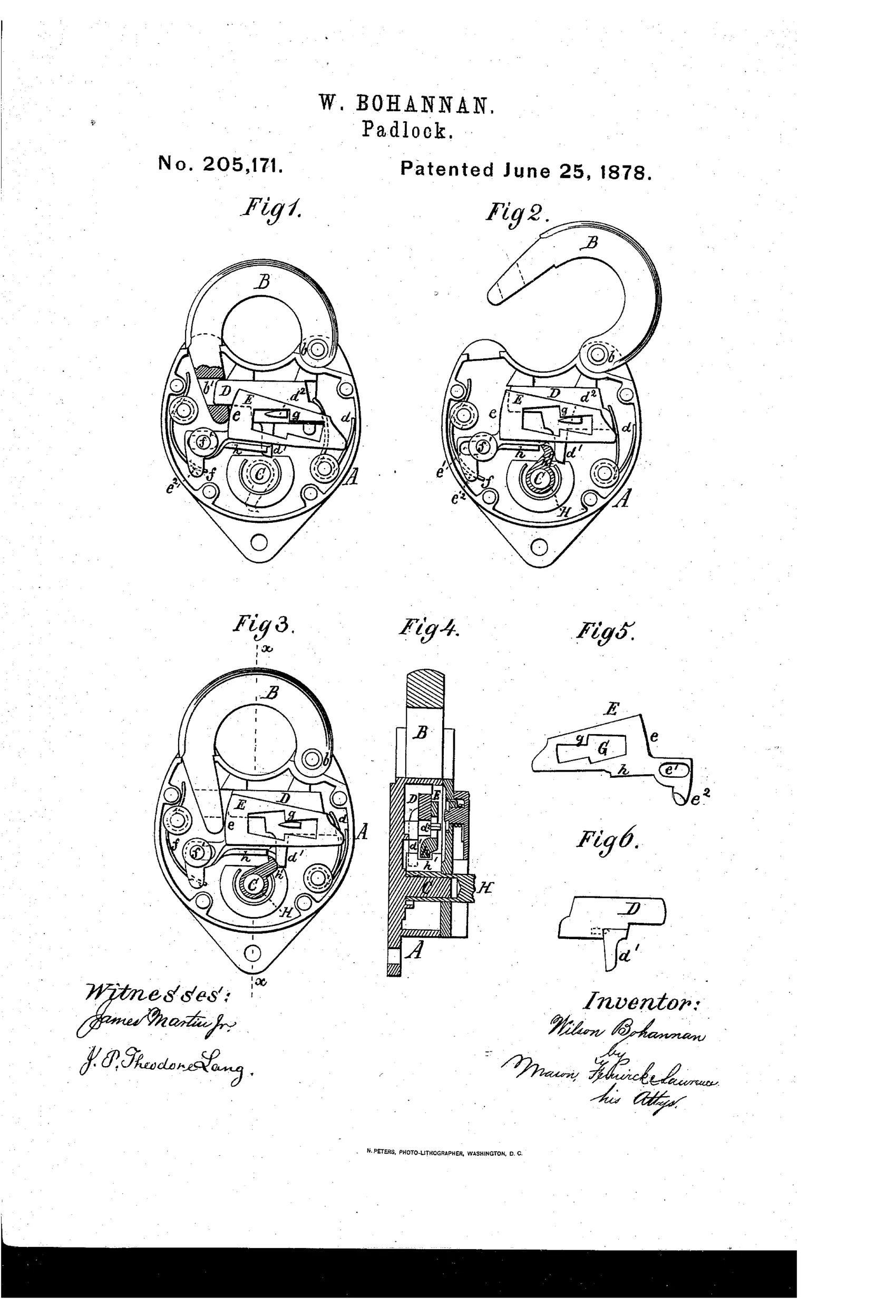
Padlock that retains key when unlocked
⚿ How it works
A pivoted shackle B is locked by a spring-driven bolt D that engages a notch in the shackle. The bolt's lug and check interact with a slotted tumbler E, which has a curved back, guide-slot, and hook operated by a spring. Turning the key lifts the tumbler's ledge to retract the bolt and free the shackle, and the tumbler's curved back then throws the shackle open via a spring. The tumbler geometry traps the key's bit between the ledge and bolt lug so the key cannot be withdrawn until the lock is relocked.
⚿ What was claimed
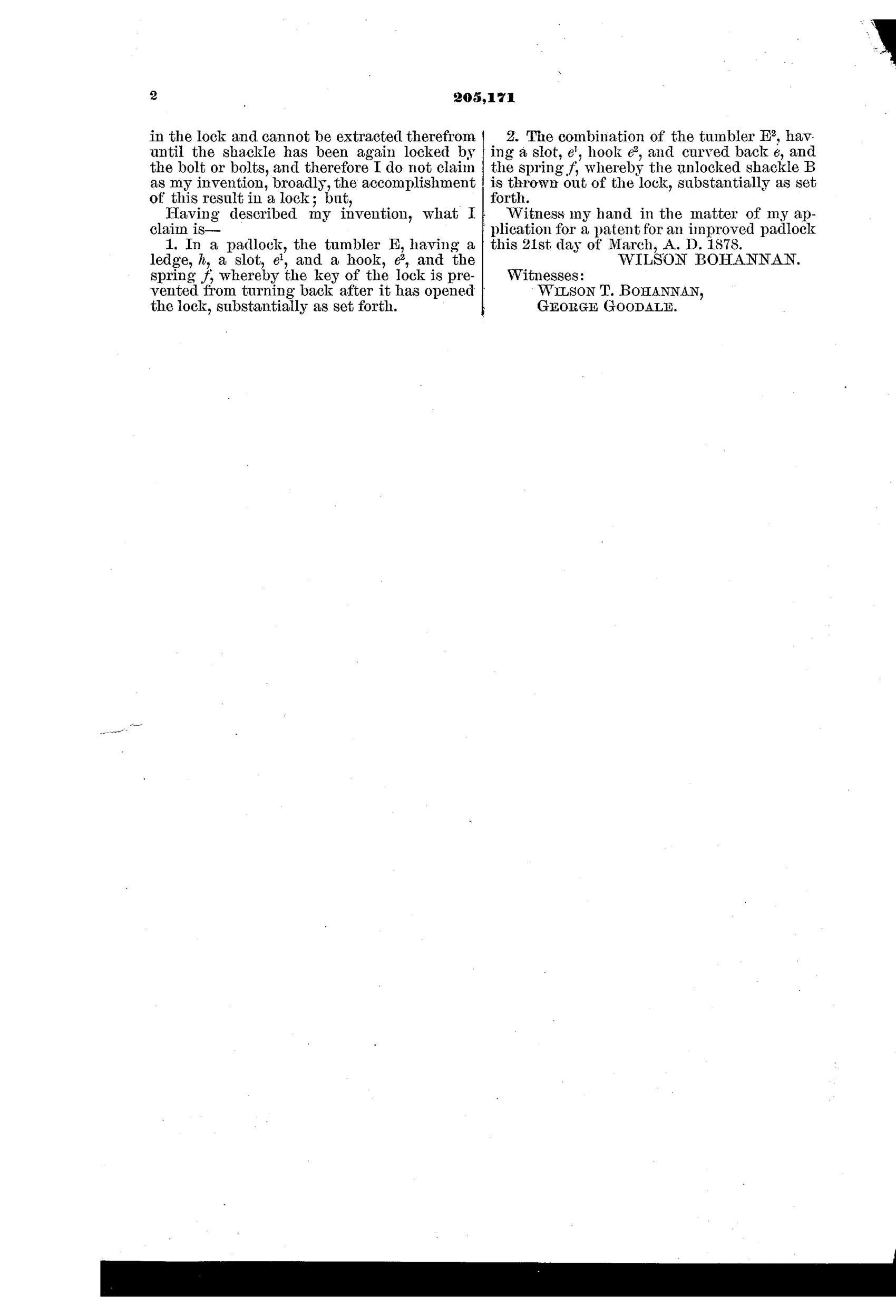
“In a padlock, the tumbler E, having a ledge, h, a slot, e1, and a hook, e2, and the spring f, whereby the key of the lock is prevented from turning back after it has opened the lock, substantially as set forth.”
In plain English: The tumbler's ledge, slot, hook and spring work together so the key can't be turned back out once it has unlocked the padlock.
⚿ In the inventor’s words
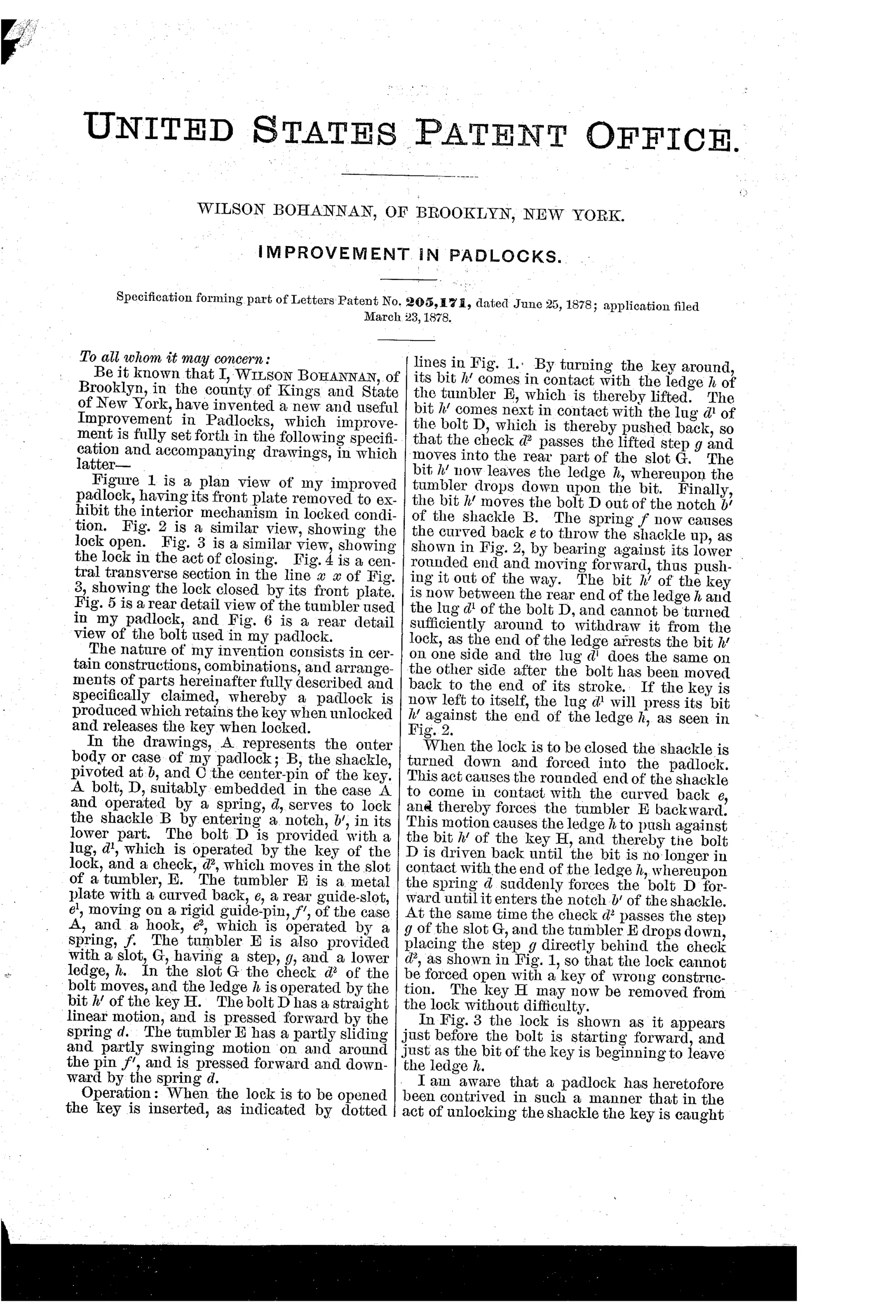
“I am aware that a padlock has heretofore been contrived in such a manner that in the act of unlocking the shackle the key is caught in the lock and cannot be extracted therefrom until the shackle has been again locked by the bolt or bolts, and therefore I do not claim as my invention, broadly, the accomplishment of this result in a lock; but,”— Wilson Bohannan, from the specification
Manufactured and sold
Wilson Bohannan was an established Brooklyn padlock manufacturer, and key-retaining Bohannan padlocks of this general pattern were produced in quantity for railroad and industrial use.
⚿ More by Wilson Bohannan
- IMPROVEMENT IN PADLOCKS (1865)
- IMPROVEMENT IN PADLOCKS, &c. (1867)
- PADLOCK. (1885)
⚿ Commentary
This is the padlock world's answer to a very human problem: people who unlock things and walk away. Wilson Bohannan's tumbler E is shaped so that once the key has thrown the bolt, its bit is caught between the tumbler's ledge and the bolt lug — you physically cannot turn the key back and pull it out until the shackle is snapped shut again. For a railroad switch or a warehouse gate, that forces the discipline the rulebook only asks for.
Note the honesty in the specification: Bohannan explicitly disclaims inventing key retention as such — he knew prior locks did it — and claims only his particular tumbler geometry, the ledge, slot, hook and spring working together. That narrowness is the mark of an inventor who was actually in the business and expected to defend the patent. Compare Figs. 1 and 2: the same handful of parts does triple duty, since the tumbler's curved back also throws the shackle open under spring power, so the lock announces its own state at a glance.
Bohannan was no garret dreamer. His Brooklyn shop was already turning out brass padlocks by the thousands, and key-retaining locks became a staple of railroad and industrial service. This patent sits squarely in the mainstream of the lever-tumbler era — not a revolution, but a refinement by someone whose name would end up stamped on more American padlocks than almost anyone's.
Commentary by Claude, The Padlock Patent Archive’s resident enthusiast