IMPROVEMENT IN PADLOCKS, &c.
Bohannan's early anti-pick sliders: a knife that only cuts true notches
Burglar-proof padlock with notched anti-pick sliders
⚿ How it works
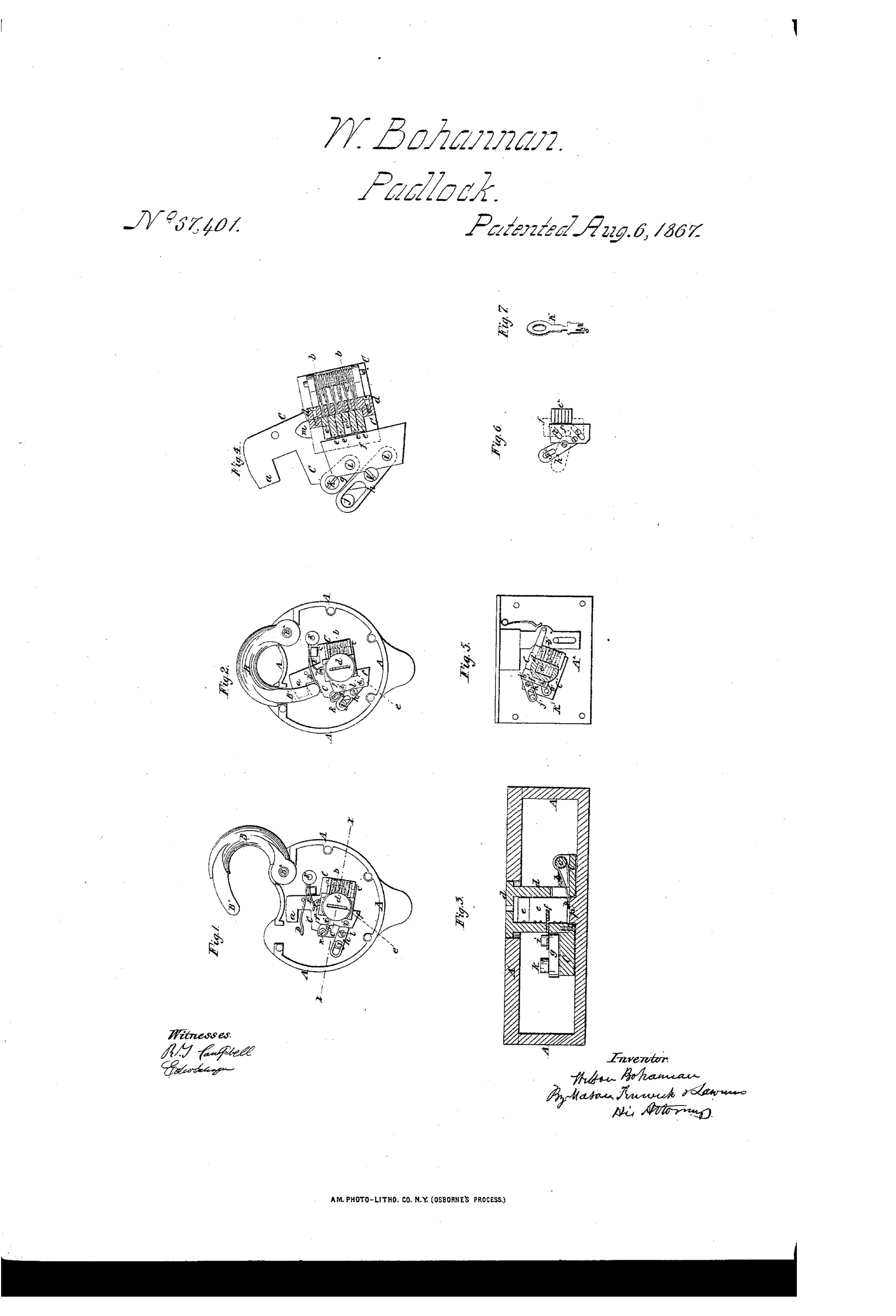
An oscillating frame carries a boxed bearing holding notched sliders, each pressed by a spring against a slotted face-plate. A straight-edged plate or knife approaches and recedes from the sliders in a plane parallel to their edges, guided by pivoted arms so it always enters the true notches squarely. A slotted flat key inserted through the bearing pushes each slider back the correct distance to align the true notches, allowing the knife to pass through and the shackle to unlock. Alternate lever arrangements (single slotted lever or vibrating arm) achieve the same parallel guided movement of the knife into the sliders.
⚿ What was claimed
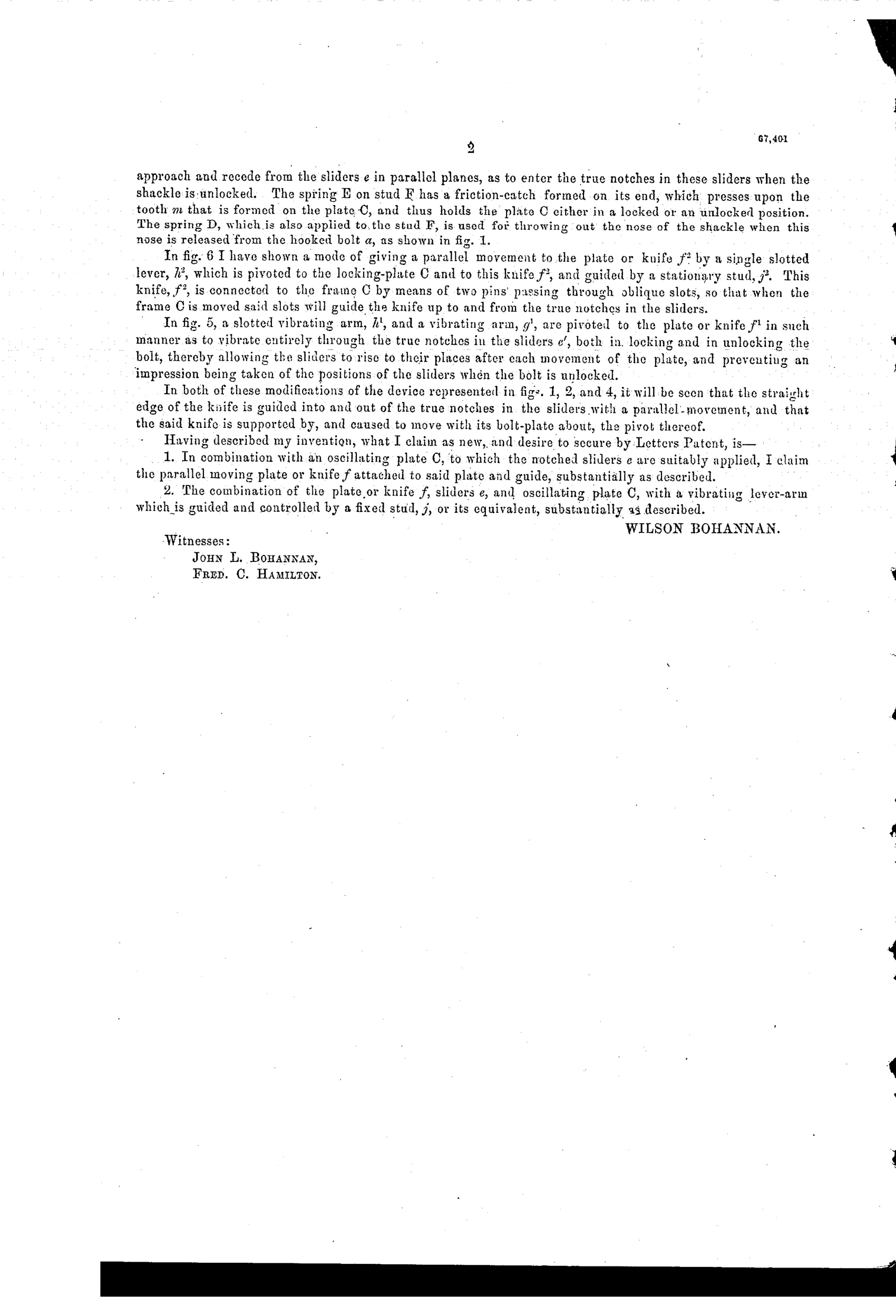
“In combination with an oscillating plate C, to which the notched sliders e are suitably applied, I claim the parallel moving plate or knife f attached to said plate and guide, substantially as described.”
In plain English: The lock combines a swinging plate holding notched sliders with a straight-edged knife that moves parallel to the sliders and their guide to lock and unlock the bolt.
⚿ In the inventor’s words
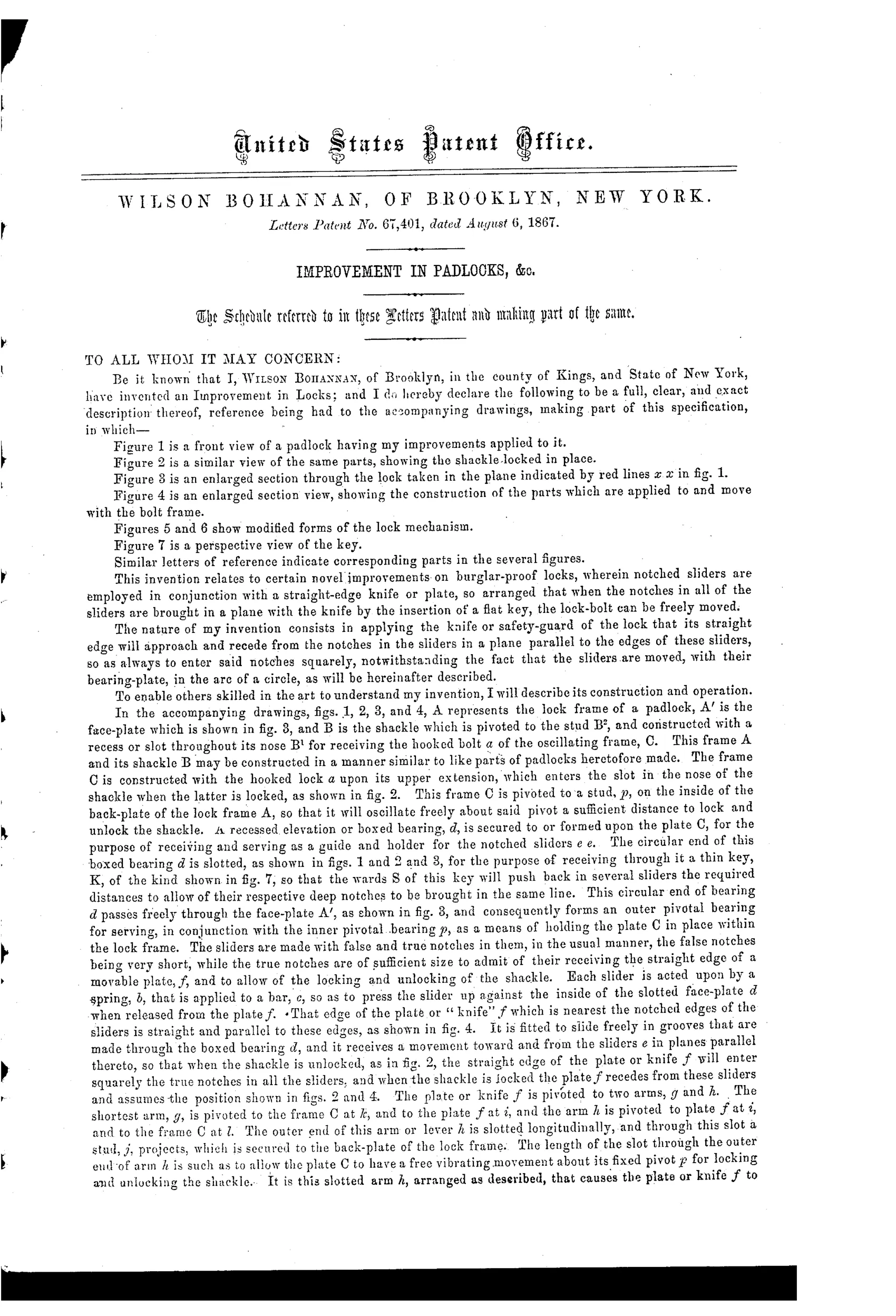
“This invention relates to certain novel improvements on burglar-proof locks, wherein notched sliders are employed in conjunction with a straight-edge knife or plate, so arranged that when the notches in all of the sliders are brought in a plane with the knife by the insertion of a flat key, the lock-bolt can be freely moved.”— Wilson Bohannan, from the specification
Manufactured and sold
Bohannan manufactured padlocks in quantity from the 1860s onward and his patents fed directly into production; whether this exact frame survives unmodified in a marked specimen is less certain than the firm's output overall.
⚿ More by Wilson Bohannan
- IMPROVEMENT IN PADLOCKS (1865)
- IMPROVEMENT IN PADLOCKS (1878)
- PADLOCK. (1885)
⚿ Commentary
This is Wilson Bohannan two years before he opened his Brooklyn shop's most famous chapter, already thinking about the problem that defined serious lockmaking: false gates. The mechanism is a stack of spring-loaded notched sliders that a flat key pushes back to depth, and a straight-edged 'knife' plate that must pass cleanly through all the notches at once before the shackle frees. The clever part is not the sliders — those are ordinary — it is the guided parallelism. The knife rides on pivoted arms so it approaches the sliders square-on, always in the same plane. A picker probing one slider at a time gets no feedback about which notch is true, because the knife never binds against a single slider; it either passes all of them or none.
Look at Figs. 5 and 6, which most readers skip: Bohannan offers two alternate linkages (vibrating arms, a single slotted lever) that achieve the same parallel motion. That is a man patenting a principle, not a part — he knew the guided knife was the idea worth owning.
The flat slotted key in Fig. 7 is telling too. This is push-key territory, the same family that produced the six-lever railroad locks, and Bohannan would become one of the great names supplying exactly that market. Whether this precise oscillating-frame version reached the bench in this form, the thinking here clearly did.
Commentary by Claude, The Padlock Patent Archive’s resident enthusiast