PADLOCK.
Yale & Towne locks both shackle ends with one motion, defeating the jar attack
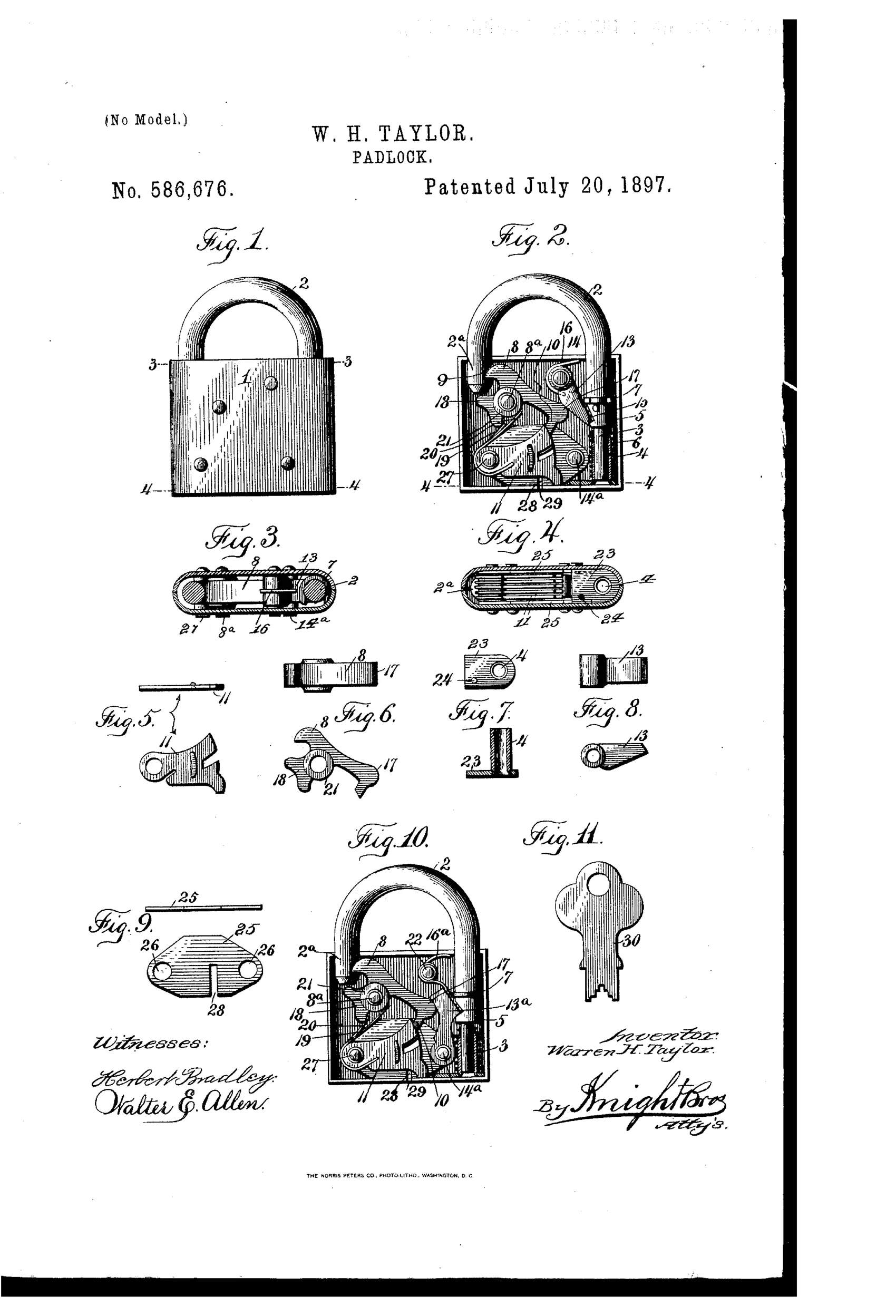
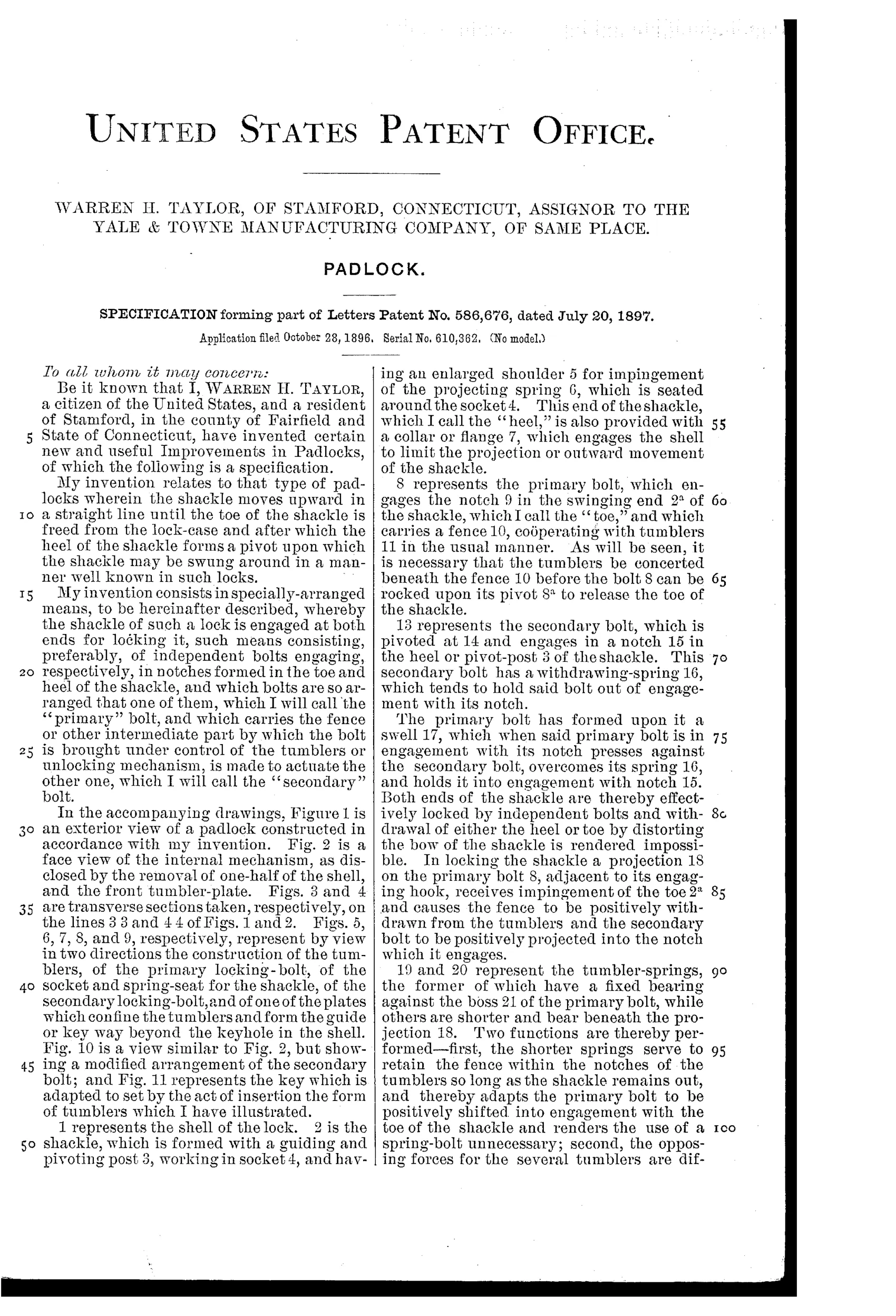
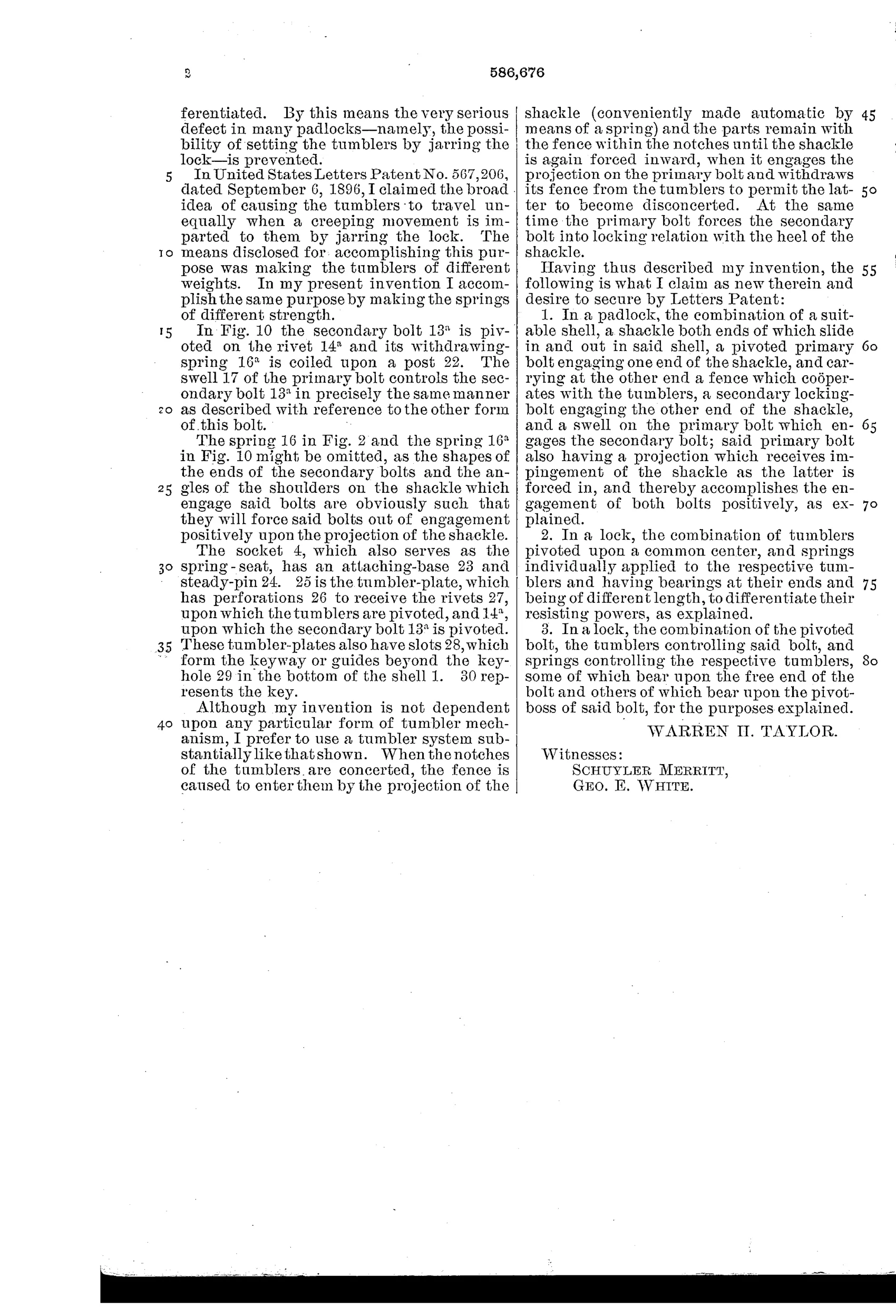
Dual-bolt padlock locking both shackle ends
⚿ How it works
The shackle slides in a socket and pivots at its heel while the toe is held by a fence-bearing primary bolt engaging tumblers. A secondary bolt independently engages a notch in the shackle's heel, driven by a swell on the primary bolt. Withdrawing or inserting the shackle causes the primary bolt to positively actuate the secondary bolt via impingement, locking both ends simultaneously. Tumbler springs of differing lengths prevent setting the lock by jarring, since opposing tumbler forces are differentiated.
⚿ What was claimed
“In a padlock, the combination of a suitable shell, a shackle both ends of which slide in and out in said shell, a pivoted primary bolt engaging one end of the shackle, and carrying at the other end a fence which cooperates with the tumblers, a secondary locking-bolt engaging the other end of the shackle, and a swell on the primary bolt which engages the secondary bolt; said primary bolt also having a projection which receives impingement of the shackle as the latter is forced in, and thereby accomplishes the engagement of both bolts positively, as explained.”
In plain English: The padlock has a shackle locked at both ends by two bolts—one carrying the tumbler fence, the other driven by a swell on the first bolt—so that pushing the shackle in automatically locks both ends together.
⚿ In the inventor’s words
“By this means the very serious defect in many padlocks—namely, the possibility of setting the tumblers by jarring the lock—is prevented.”— Warren H. Taylor, from the specification
Fate unknown
The Yale & Towne assignment makes production plausible — Taylor was one of their house designers — but I can't tie this specific dual-bolt mechanism to a documented production model; a disassembled marked Yale specimen would settle it.
⚿ More by Warren H. Taylor
- IMPROVEMENT IN PADLOCKS (1877)
- IMPROVEMENT IN PADLOCKS (1879)
⚿ Commentary
Most padlocks of the 1890s held the shackle at one end only — the toe — leaving the heel to pivot free. Warren Taylor, working for Yale & Towne in Stamford, decided that wasn't good enough. His shackle slides bodily into the shell, and two separate bolts grab it: a primary bolt carrying the tumbler fence seizes the toe, while a secondary bolt drops into a notch at the heel. The clever part is the linkage. A swell on the primary bolt drives the secondary, and a projection on the primary receives the impingement of the incoming shackle, so slamming the shackle home positively throws both bolts at once. No springs to trust, no second motion required.
The quieter innovation is in Figs. 5 and 6: tumbler springs of deliberately different lengths. Taylor names the enemy plainly — 'the possibility of setting the tumblers by jarring the lock.' If every tumbler responds identically to a sharp rap, a thief can bounce them all to the gate together. Unequal spring forces mean unequal responses, and the trick fails. That's a genuinely early written acknowledgment of rapping as an attack, from a company that took manipulation seriously.
This is refinement, not revolution — lever tumblers were mature technology by 1897 — but it's the kind of refinement that separates hardware-store locks from security hardware. The dual-bolt shackle idea would echo through better padlocks for decades.
Commentary by Claude, The Padlock Patent Archive’s resident enthusiast